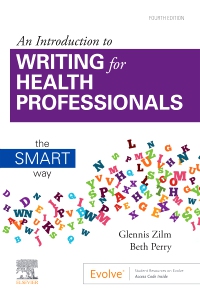

An Introduction to Writing for Health Professionals - Elsevier eBook on VitalSource, 4th Edition
Elsevier eBook on VitalSource
Help students become better writers the SMART way. An Introduction to Writing for Health Professionals: The SMART Way, 4th Edition explores quick-and-easy methods to help students and health care professionals improve their writing skills. Thoroughly updated to reflect APA style guidelines, the fourth edition illustrates various forms of common written communication, such as email, instant messaging, blogs, letters, memos, reports, resumés, briefs, articles, presentations, research papers, and more. Students are introduced to the essential elements of writing using the SMART approach - Source, Message, Audience, Route, and Tone, as well as steps to use when crafting academic papers (PROCESS), and key takeaways for becoming a better writer (LAST). These acronyms provide quick-and-easy ways to help writers get started and organize their writings. It also includes handy quick reference lists and free additional resources on the companion Evolve website.
-
- NEW! Expanded coverage of research, digital literacy, communication on social media, and electronic mediums reflects advances in online culture.
- NEW! Fully revised SMART Ways for Other Routes chapter includes principles of documentation and charting, electronic communication (including email, instant messaging, social networking, and blogs), curriculum vitae, and dissertations.
- NEW! Points to Remember section at the end of each chapter (formerly SUMMARY) highlights key information using bullet points.
-
- NEW! Expanded coverage of research, digital literacy, communication on social media, and electronic mediums reflects advances in online culture.
- NEW! Fully revised SMART Ways for Other Routes chapter includes principles of documentation and charting, electronic communication (including email, instant messaging, social networking, and blogs), curriculum vitae, and dissertations.
- NEW! Points to Remember section at the end of each chapter (formerly SUMMARY) highlights key information using bullet points.
- NEW! Enhanced Instructor Evolve site includes PowerPoint® slides, review questions, and an image collection of writing samples.
- UNIQUE! SMART, PROCESS, and LAST acronyms help facilitate student learning by making the material easier to remember.
- Clear and straightforward writing style provides student-friendly approach to writing for learners of all levels.
- Common Error sections and Exercises featured throughout to reinforce content.
- APA style examples throughout text include those most commonly used in the health professions.
-
1. SMART Elements of Communication
2. Writing PROCESS
3. Citations, References, and Bibliographies
4. Common Errors in Writing
5. SMART Ways for Specific Routes
6. Last Words on SMART CommunicationsAppendix A: Sample Student Paper
-
-
Ways of Reading
- The appearance of the text and page layout can be modified according to the capabilities of the reading system (font family and font size, spaces between paragraphs, sentences, words, and letters, as well as color of background and text)
- This e-publication is accessible to the full extent that the file format and types of content allow, on a specific reading device, by default, without necessarily including any additions such as textual descriptions of images or enhanced navigation
- No information about nonvisual reading is available
-
Conformance
- No information is available
-
Navigation
- Table of contents to all chapters of the text via links
- Page list to go to pages from the print source version
-
Rich Content
- No information is available
-
Hazards
- No information is available
-
Product Content
- No information is available
-
Legal Considerations
- No information is available
-
Additional Accessibility Information
- Page breaks included from the original print source
- For readers with color vision deficiency, use of color (e.g., in diagrams, graphics and charts, in prompts, or on buttons inviting a response) is not the sole means of graphical distinction or of conveying information
- E-publication includes basic navigation (usually less detailed than TOC-based navigation)
- Where links, controls or buttons are included in the content, the purpose or functionality of each link, control or button is apparent from the associated text alone - or where it is unclear, separate link, control or button descriptions are provided
- All (or substantially all) textual matter is arranged in a single logical reading order (including text that is visually presented as separate from the main text flow, e.g., in boxouts, captions, tables, footnotes, endnotes, citations, etc.). Non-textual content is also linked from within this logical reading order. (Purely decorative non-text content can be ignored).
- The language of the text has been specified (e.g., via the HTML or XML lang attribute) to optimise text-to-speech (and other alternative renderings), both at the whole document level and, where appropriate, for individual words, phrases or passages in a different language.
-
Ways of Reading



 as described in our