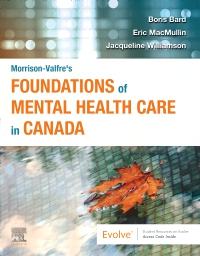

Morrison-Valfre’s Foundations of Mental Health Care in Canada- Elsevier eBook on VitalSource, 1st Edition
Elsevier eBook on VitalSource
Now $46.79
Build a broad fundamental knowledge of Canadian mental health concepts and disorders! Morrison-Valfre’s Foundations of Mental Health Care in Canada uses an easy-to-read, multidisciplinary approach to describe current therapeutic interventions and treatments for mental health conditions. Ideal for nurses and other caregivers, this guide provides concise coverage of skills and principles, therapeutic skills, mental health problems throughout the lifecycle, and common psychological and psychosocial conditions. Included are topics such as new research, the latest mental health legislation, and new psychotropic drugs. Adapted for a Canadian audience by Boris Bard, Eric MacMullin, and Jacqueline Williamson, this resource enables you to provide effective therapy to clients with a wide range of maladaptive behaviours.
New Edition Expected Availability: 09-18-2026

Morrison-Valfre’s Foundations of Mental Health Care in Canada - Elsevier E-Book on VitalSource
-
- NEW! Comprehensive coverage includes Canadian statistics, research, references and resources, guidelines, assessment and screening tools, therapies, drugs, terminology, and more
- NEW! Canadian cultural considerations are included when content relates to race/ethnicity, Indigenous people, and the LGBTQ2 community
- NEW! Coverage of trending topics includes medical assistance in dying (MAID), the opioid crisis, legalization of cannabis (Bill C-45, the Cannabis Act), vaping, harm reduction, violence against women, and more
- NEW! Balanced coverage of mental health care addresses a variety of workplace settings
- NEW! Critical Thinking Questions are included at the end of each chapter, allowing students to apply concepts to practice
-
- Coverage of psychotropic medications emphasizes the latest in safe pharmaceutical treatment in mental health care
- Coverage of internet usage features emerging mental health issues surrounding use of the internet, highlighting related addictions and violence
- Updated DSM-5 diagnoses include the latest information on new mental health diagnoses recognized by the American Psychiatric Association
- Sample client care plans show how members of the health care team work collaboratively to meet client needs
- Case studies use realistic client situations to strengthen critical thinking and ensure that students consider psychosocial aspects of therapeutic care
- Critical Thinking boxes include practice scenarios with client issues as well as questions that stimulate more careful analysis
- Cultural Consideration boxes highlight cultural issues and address the varied mental health needs of culturally diverse clients
- Medication Alert boxes identify the risks and possible adverse reactions of psychotherapeutic medications
- Chapter objectives focus on the most important concepts
- Key terms include phonetic pronunciations and text page references, and are listed in a comprehensive glossary, making it easier for students to understand and use mental health terminology
-
UNIT ONE: MENTAL HEALTH CARE: PAST AND PRESENT
1. The History of Mental Health Care
2. Current Mental Health Care Systems
3. Ethical and Legal Issues
4. Sociocultural Issues
5. Theories and Therapies
6. Complementary and Alternative Therapies
7. Psychotherapeutic Medication Therapy
UNIT TWO: THE CAREGIVER’S THERAPEUTIC SKILLS
8. Principles and Skills of Mental Health Care
9. Mental Health Assessment Skills
10. Therapeutic Communication
11. The Therapeutic Relationship
12. The Therapeutic Environment
UNIT THREE: MENTAL HEALTH CHALLENGES ACROSS THE LIFESPAN
13. Challenges of Childhood
14. Challenges of Adolescence
15. Challenges of Adulthood
16. Challenges of Late Adulthood
17. Cognitive Impairment, Alzheimer’s Disease, and Dementia
UNIT FOUR: PATIENTS WITH PSYCHOLOGICAL PROBLEMS
18. Managing Anxiety
19. Illness and Hospitalization
20. Loss and Grief
21. Depression and Other Mood Disorders
22. Physical Problems, Psychological Sources
23. Eating and Sleeping Disorders
24. Dissociative Disorders
UNIT FIVE: PATIENTS WITH PSYCHOSOCIAL PROBLEMS
25. Anger and Aggression
26. Outward-Focused Emotions: Violence
27. Inward-Focused Emotions: Suicide
28. Substance-Related Disorders and Addictive Disorders
29. Sexual Disorders
30. Personality Disorders
31. Brain Function, Schizophrenia, and Other Psychoses
32. Chronic Mental Health Disorders
33. Challenges for the Future
Appendixes
A: Mental Status Assessment at a Glance
B: A Simple Assessment of Tardive Dyskinesia Symptoms
C: Canadian Standards for Psychiatric-Mental Health Nursing -
-
Ways of Reading
- The appearance of the text and page layout can be modified according to the capabilities of the reading system (font family and font size, spaces between paragraphs, sentences, words, and letters, as well as color of background and text)
- This e-publication is accessible to the full extent that the file format and types of content allow, on a specific reading device, by default, without necessarily including any additions such as textual descriptions of images or enhanced navigation
- All content can be read as read aloud speech or dynamic braille
- Has alternative text descriptions for images
-
Conformance
- The certifier's credential is https://bornaccessible.benetech.org/certified-publishers/
- The publication was certified on 24-03-2026
-
Navigation
- Table of contents to all chapters of the text via links
- Index with links to referenced entries
- Elements such as headings, tables, etc. for structured navigation
- Page list to go to pages from the print source version
-
Rich Content
- Information-rich images are described by extended descriptions
-
Hazards
- The publication contains no hazards
-
Product Content
- Content includes any type of illustrations.
- The primary content is text.
- Content includes maps and/or other cartographic content.
- Content includes a significant number of actionable (clickable) web links to external content, downloadable resources, supplementary material, etc.
- Content includes a significant number of actionable (clickable) cross-references, hyperlinked notes and annotations, or with other actionable links between largely textual elements (e.g., quiz/test questions, 'choose your own ending', etc.).
- Content includes photographs, whether in a plate section / insert or not.
- Content includes figures, diagrams, charts and/or graphs, including other 'mechanical' (i.e. non-photographic) illustrations.
- Content includes images displayed in a specific order for the purpose of graphic storytelling or giving information (e.g. graphic novels, comics and manga). May include text integrated into the image (as speech and thought bubbles, textual 'sound' effects, captions etc.).
- Content includes text within images, including text-as-text embedded in diagrams, charts, or within images containing speech balloons, thought bubbles, captions, etc.
- Content includes visual content that is purely decorative and is not necessary to understanding of the content.
- At least some text - including text within other images - is 'text as an image' (i.e., a picture of text).
-
Legal Considerations
- No information is available
-
Additional Accessibility Information
- Content is enhanced with ARIA roles to optimize organization and facilitate navigation
- Page breaks included from the original print source
- For readers with color vision deficiency, use of color (e.g., in diagrams, graphics and charts, in prompts, or on buttons inviting a response) is not the sole means of graphical distinction or of conveying information
- The body text is presented with a contrast ratio of at least 4.5:1 (or 3:1 for large/heading text)
- Ultra-high contrast between text and background
- E-publication includes basic navigation (usually less detailed than TOC-based navigation)
- Where links, controls or buttons are included in the content, the purpose or functionality of each link, control or button is apparent from the associated text alone - or where it is unclear, separate link, control or button descriptions are provided
- All (or substantially all) textual matter is arranged in a single logical reading order (including text that is visually presented as separate from the main text flow, e.g., in boxouts, captions, tables, footnotes, endnotes, citations, etc.). Non-textual content is also linked from within this logical reading order. (Purely decorative non-text content can be ignored).
- Content provides explanations for unusual words, abbreviations, acronyms, idioms, jargon in an accessible form, such as glossaries, scripted pop-ups.
- Where interactive content is included in the product, controls are provided (e.g., for speed, pause and resume, reset) and labelled to make their use clear.
- The language of the text has been specified (e.g., via the HTML or XML lang attribute) to optimise text-to-speech (and other alternative renderings), both at the whole document level and, where appropriate, for individual words, phrases or passages in a different language.
-
Ways of Reading



 as described in our