ISBN:
9788131266458
Copyright:
2023
Publication Date:
09-09-2023
Page Count:
314
Imprint:
Elsevier India
List Price:
$13.75
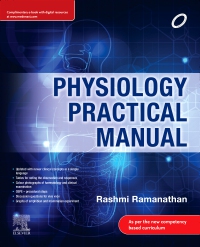
Physiology Practical Manual, 1st Edition, 1st Edition
by Rashmi Ramanathan, MD., MBA (HA)
Paperback
ISBN:
9788131266458
Copyright:
2023
Publication Date:
09-09-2023
Page Count:
314
Imprint:
Elsevier India
List Price:
$13.75
$13.75
Free Shipping!
Not Yet Available
This practical manual delivers clinically relevant and updated concepts as per the Competency-Based Medical Education (CBME) curriculum.
-
• This student-friendly practical manual has an observation table column at the end of most of the chapters.
• Competencies with specific learning objectives (SLOs) are mentioned at the start of each chapter.
• The CBME curriculum mandates the skill certification of competencies in the log book. By using this practical manual, students can directly fill their responses, in the predrawn tables. Thus, the practical hours can be completely used for developing psychomotor skills and skill certification.
• Full-colour photos, labelled diagrams, and illustrations will help to precisely understand and perform the procedural steps in clinical examination.
• Clinical scenarios/charts/graphs/calculations were given in the last few chapters.
• Discussion questions with answers will be useful for the students to score more during the practical viva voice
• Examples of practical OSCE were provided at the end of most of the chapters.
• Amphibian and Mammalian experiments with graphs were provided for postgraduate students.
• This book will be useful to MBBS, MD and MSC physiology students, dental, paramedical, and allied health science students. -
SECTION I Haematology 1. Compound Microscope 2. Introduction to Haematology 3. Collection of Blood Samples and Anticoagulants 4. Haemocytometry 5. Estimation of Total Red Blood Cells (RBC) Count 6. Determination of Haematocrit or Packed Cell Volume (PCV) 7. Determination of Erythrocyte Sedimentation Rate (ESR) 8. Estimation of Haemoglobin: Sahli’s Method 9. Determination of Red Blood Cell (RBC) Indices 10. Estimation of Total Leucocyte Count 11. Differential Leucocyte Count (DLC) 12. Determination of Arneth Count: The Cooke–Arneth Count 13. Determination of Absolute Eosinophil Count (AEC) 14. Blood Grouping and Rhesus (Rh) Typing 15. Determination of Bleeding Time (BT) and Clotting Time (CT) 16. Determination of Platelet Count 17. Determination of Reticulocyte Count 18. Determination of Osmotic Fragility of Red Blood Cells (RBCs) 19. Determination of the Specific Gravity of Blood: Philips and Van Slyke’s CuSo4 Method SECTION II Human Experiments 20. General Examination A. Cardiovascular System 21. Clinical Examination of Radial Pulse and Peripheral Arterial Pulses 22. Determination of Arterial Blood Pressure (BP) 23. Effect of Posture on Blood Pressure and Heart Rate 24. Effect of Exercise on Blood Pressure (BP) 25. Harvard Step Test 26. Clinical Examination of Cardiovascular System 27. Electrocardiography B. Respiratory System 28. Stethography 29. Clinical Examination of the Respiratory System 30. Pulmonary Function Tests (PFT) and Spirometry 31. Vitalograph/Simple Spirometer 32. Cardiopulmonary Resuscitation C. Gastrointestinal System 33. Clinical Examination of Abdomen D. Reproductive System 34. Semen Analysis 35. Pregnancy Diagnostic Tests E. Electroneurodiagnostic Tests 36. Electroencephalography 37. Evoked Potentials 38. Electromyography (EMG) 39. Nerve Conduction Study 40. Polysomnography (PSG) 41. Study of Human Fatigue by Mosso’s Ergograph and Hand Grip Dynamometer F. Nervous System and Special Senses 42. Clinical Examination of Nervous System Examination of Higher Functions 43. Clinical Examination of the Sensory System 44. Clinical Examination of the Motor System 45. Examination of Cranial Nerves 46. Autonomic Function Tests SECTION III Amphibian Experiments A. Experiments on Frog’s Nerve and Muscle 47. Study of Appliances 48. Gastrocnemius Muscle and Sciatic Nerve Preparation 49. Simple Muscle Twitch 50. Effects of Temperature on Muscle Contraction 51. Effect of Increasing Strength of the Stimulus on Muscle Contraction 52. Effect of Two Successive Stimuli on Skeletal Muscle Contraction x CONTENTS 53. Genesis of Tetanus 54. Genesis of Fatigue in Gastrocnemius Sciatic Nerve Preparation 55. Effect of Afterload and Preload on Skeletal Muscle Contraction 56. Determination of Conduction Velocity of the Sciatic Nerve in Frog B. Experiments on Frog’s Heart and Blood Vessel 57. Normal Cardiogram of Frog’s Heart 58. Effect of Temperature on Frog’s Heart 59. Effect of Stannius Ligature on Frog’s Heart 60. Properties of Cardiac Muscle 61. Effect of Stimulation of Vago-Sympathetic Trunk and Crescentic Line on the Cardiogram 62. Effect of Nicotine and Atropine on Frog’s Heart 63. Effect of Adrenaline, Acetylcholine and Ions on the Intact Frogs’ Heart SECTION IV Mammalian Experiments 64. Effects of Drugs and Ions on Isolated Mammalian Intestine SECTION V Practical Exercises 65. Calculations 66. Clinical Case Scenarios 67. Charts and Graphs Index
-
No accessibility information is available for this product.
$13.75
Free Shipping!
Not Yet Available

 as described in our