ISBN:
9780323078092
Copyright:
2011
Publication Date:
02-05-2010
Page Count:
875
Imprint:
Mosby
List Price:
$100.99

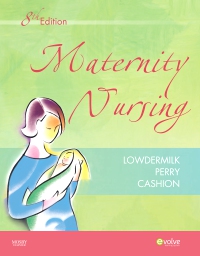
Maternity Nursing - Elsevier eBook on VitalSource, 8th Edition
by Deitra Leonard Lowdermilk, RNC, PhD, FAAN, Shannon E. Perry, RN, PhD, FAAN and Kitty Cashion, RN, BC, MSN
Elsevier eBook on VitalSource
ISBN:
9780323078092
Copyright:
2011
Publication Date:
02-05-2010
Page Count:
875
Imprint:
Mosby
List Price:
$100.99
Most review copies are eBooks – how fast!
A review copy request is most likely to be fulfilled as an eBook on VitalSource rather than a print product, unless no eBook is available. eBooks become available in as little as a few hours. Print products will take between 7 and 10 days to arrive. To request a print copy, please contact us through the Evolve Support Center for further assistance or contact your Elsevier Sales Rep.
Addressing the fundamentals of maternity nursing, this clear, readable textbook features concise, focused coverage of key concepts such as family, culture, and health promotion in the continuum of care.
-
- Evidence-Based Practice boxes have been updated, researched and reformatted to help you focus on current research
- Recognizes the nurse’s need to integrate the family in the care of the mother and newborn
- New and updated information to reflect current nursing research
-
- 21st Century Maternity Nursing: Culturally Competent, Family and Community Focused chapter integrates content on the family and home care
- A focus on the family recognizes the nurse's need to integrate the family in the care of the mother and newborn, and the importance of the role of the mother to the well-being of the family
- Updated content includes information on the late preterm infant and associated concerns such as feeding; guidelines on prioritization and delegation; and centering pregnancy, a new model of health care that brings women together in care groups
- Updated coverage of evidence-based practice includes current research in newly expanded, researched, and reformatted boxes
- Streamlined content focuses your students' attention on the most essential, need-to-know information
- A companion Evolve website includes student resources such as NCLEX® exam-style review questions, audio chapter summaries, a care plan builder, nursing skills, interactive case studies, video clips and animations, anatomy reviews, and an audio glossary with Spanish pronunciations
- Unique! Nursing Alerts highlight critical information in providing care
- Unique! Emergency boxes provide step-by-step procedures for pediatric and maternity emergencies
- Unique! Cultural Considerations boxes discuss customs and beliefs of different cultures that may affect care for patients and families
- Unique! Community Activity boxes provide maternal and newborn exercises to enhance care in local community settings
- Unique! Nursing Process boxes identify information on major diseases and conditions
- Patient Instructions for Self-Management boxes highlight the information nurses need to communicate to patients and families
- Critical Thinking exercises are based on case studies of real-life situations
- Coverage of nursing care management uses a framework of the five steps of the nursing process as well as a focus on collaborative care
- Nursing care plans include specific guidelines and rationales for interventions
-
-
 STUDY GUIDE FOR MATERNITY NURSING Revised Reprint - Elsevier eBook on VitalSourceElsevier eBook on VitalSource
 -
 Clinical Companion for Maternity & Newborn Nursing - Elsevier eBook on VitalSourceElsevier eBook on VitalSource
-
-
1. 21st Century Maternity Nursing: Culturally Competent, Family and Community Focused
Unit One: Reproductive Years
2. Assessment and Health Promotion
3. Common Concerns
4. Contraception, Abortion, and Infertility
Unit Two: Pregnancy
5. Genetics, Conception, and Fetal Development
6. Anatomy and Physiology of Pregnancy
7. Nursing Care of the Family during Pregnancy
8. Maternal and Fetal Nutrition
Unit Three: Childbirth
9. Labor and Birth Processes
10. Management of Discomfort
11. Fetal Assessment during Labor
12. Nursing Care of the Family during Labor and Birth
Unit Four: Postpartum Period
13. Maternal Physiologic Changes
14. Nursing Care of the Family during the Fourth Trimester
15. Transition to Parenthood
Unit Five: The Newborn
16. Physiologic and Behavioral Adaptations
17. Assessment and Care of the Newborn and Family
18. Newborn Nutrition and Feeding
Unit Six: Complications of Childbearing
19. Assessment of High Risk Pregnancy
20. Pregnancy at Risk: Preexisting Conditions
21. Pregnancy at Risk: Gestational Conditions
22. Labor and Birth at Risk
23. Postpartum Complications
24. The Newborn at Risk -
-
Ways of Reading
- The appearance of the text and page layout can be modified according to the capabilities of the reading system (font family and font size, spaces between paragraphs, sentences, words, and letters, as well as color of background and text)
- This e-publication is accessible to the full extent that the file format and types of content allow, on a specific reading device, by default, without necessarily including any additions such as textual descriptions of images or enhanced navigation
- All content can be read as read aloud speech or dynamic braille
-
Conformance
- For detailed accessibility information, see Elsevier's website at https://www.elsevier.com/about/accessibility
- For queries regarding accessibility information, contact [email protected]
- The publication was certified on 07-04-2026
-
Navigation
- Table of contents to all chapters of the text via links
- Page list to go to pages from the print source version
-
Rich Content
- No information is available
-
Hazards
- No information is available
-
Product Content
- No information is available
-
Legal Considerations
- Elsevier is committed to making our eBooks accessible and complying with applicable laws. Given our vast library of titles, there are some cases where making an eBook fully accessible presents unique challenges, and including full features could transform its nature to no longer serve its primary purpose or result in a disproportionate burden for the publisher. As a result this eBook may have limited accessibility. See more at https://www.elsevier.com/en-gb/about/accessibility.
- Please refer to our disproportionate burden or fundamental modification statements.
-
Additional Accessibility Information
- Page breaks included from the original print source
- E-publication includes basic navigation (usually less detailed than TOC-based navigation)
- All (or substantially all) textual matter is arranged in a single logical reading order (including text that is visually presented as separate from the main text flow, e.g., in boxouts, captions, tables, footnotes, endnotes, citations, etc.). Non-textual content is also linked from within this logical reading order. (Purely decorative non-text content can be ignored).
- The language of the text has been specified (e.g., via the HTML or XML lang attribute) to optimise text-to-speech (and other alternative renderings), both at the whole document level and, where appropriate, for individual words, phrases or passages in a different language.
-
Ways of Reading
Most review copies are eBooks – how fast!
A review copy request is most likely to be fulfilled as an eBook on VitalSource rather than a print product, unless no eBook is available. eBooks become available in as little as a few hours. Print products will take between 7 and 10 days to arrive. To request a print copy, please contact us through the Evolve Support Center for further assistance or contact your Elsevier Sales Rep.

 as described in our