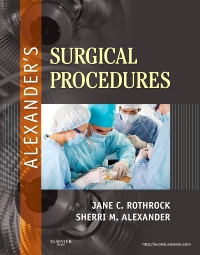

Alexander's Surgical Procedures - Elsevier eBook on VitalSource, 1st Edition
Elsevier eBook on VitalSource
Now $91.69
Developed specifically for surgical technologists, Alexander's Surgical Procedures provides proven, step-by-step coverage of essential surgical procedures from one of the most trusted sources in surgical technology. Building on the renowned content of Alexander's Care of the Surgical Patient, 14th Edition, respected authorities Jane Rothrock and Sherri Alexander (AST president 2007 - 2011) guide you through the pre-op set up, procedure pathology/steps, and post-op considerations for all required procedures. This approachable, easy-to-use resource complements the fundamental coverage in your other surgical technology textbooks, and detailed procedure videos on a companion Evolve website help you ensure success from the classroom to the OR.
-
- Content adapted from Alexander's Care of the Surgical Patient, 14th Edition provides comprehensive procedural coverage optimized for your specific needs as a surgical technologist
- Surgical Technologist Considerations boxes detail practical strategies for applying chapter content to specialty procedures
- Complete pre-op set up, draping, and other instructions for each procedure equip you to confidently perform all of the duties of surgical technologist in the OR setting
- Chapter Outlines, Learning Objectives, and Chapter Summaries help you study chapter content more effectively
- Review questions in the text and case studies on Evolve reinforce key concepts and encourage critical thinking
- More than 700 full-color illustrations clarify surgical anatomy, instrumentation, procedures, and methods
- Surgical Pharmacology tables provide quick, convenient access to generic/trade names, purpose/description, and pharmacokinetics for drugs most commonly associated with each specific surgical procedure
- Cutting-edge content reflects the latest interventions and patient care techniques in surgical practice
- Geriatric Consideration boxes help you manage surgical challenges unique to geriatric patients
- Patient Safety boxes alert you to recent Joint Commission safety initiatives to ensure safe performance of key tasks
- History boxes present chapter content in a broader context to enhance your understanding and retention
- Ambulatory Surgical Considerations boxes highlight important changes to patient care within appropriate procedures
- Risk Reduction Strategies boxes provide specific steps you can take to improve patient safety
-
-

-
 Alexander's Surgical ProceduresHardcover
-
-
1. Importance of the Surgical Technologist on the Surgical Team
2. Gastrointestinal Surgery
3. Surgery of the Liver, Biliary Tract, Pancreas and Spleen
4. Repair of the Hernia
5. Gynecologic and Obstetric Surgery
6. Genitourinary Surgery
7. Thyroid and Parathyroid Surgery
8. Breast Surgery
9. Ophthalmic Surgery
10 Otorhinolaryngologic
11 Orthopedic Surgery
12 Neurosurgery
13. Plastic and Reconstructive Surgery
14. Thoracic Surgery
15. Vascular Surgery
16 Cardiac Surgery
17. Pediatric Surgery
18. Trauma Surgery and Emergency Preparedness -
-
Ways of Reading
- The appearance of the text and page layout can be modified according to the capabilities of the reading system (font family and font size, spaces between paragraphs, sentences, words, and letters, as well as color of background and text)
- This e-publication is accessible to the full extent that the file format and types of content allow, on a specific reading device, by default, without necessarily including any additions such as textual descriptions of images or enhanced navigation
- All content can be read as read aloud speech or dynamic braille
- Has alternative text descriptions for images
-
Conformance
- The publication contains a conformance statement that it meets the EPUB Accessibility 1.1, WCAG 2.1, Level AA standard. Please see https://bornaccessible.benetech.org/certified-publishers/ for further details of our compatibility testing.
- The certifier's credential is https://bornaccessible.benetech.org/certified-publishers/
- For detailed accessibility information, see Elsevier's website at https://www.elsevier.com/about/accessibility
- For queries regarding accessibility information, contact [email protected]
- The publication was certified on 07-04-2026
-
Navigation
- Table of contents to all chapters of the text via links
- Index with links to referenced entries
- Elements such as headings, tables, etc. for structured navigation
- Page list to go to pages from the print source version
-
Rich Content
- Information-rich images are described by extended descriptions
-
Hazards
- The publication contains no hazards
-
Product Content
- Content includes any type of illustrations.
- The primary content is text.
- Content includes a significant number of actionable (clickable) web links to external content, downloadable resources, supplementary material, etc.
- Content includes a significant number of actionable (clickable) cross-references, hyperlinked notes and annotations, or with other actionable links between largely textual elements (e.g., quiz/test questions, 'choose your own ending', etc.).
- Content includes figures, diagrams, charts and/or graphs, including other 'mechanical' (i.e. non-photographic) illustrations.
- Content includes a significant number of web links (printed URLs, QR codes etc.).
- Content includes assessment material, e.g., Questions or student exercises, problems, quizzes or tests (as an integral part of the work).
- Content includes text within images, including text-as-text embedded in diagrams, charts, or within images containing speech balloons, thought bubbles, captions, etc.
-
Legal Considerations
- No information is available
-
Additional Accessibility Information
- Content is enhanced with ARIA roles to optimize organization and facilitate navigation
- Page breaks included from the original print source
- For readers with color vision deficiency, use of color (e.g., in diagrams, graphics and charts, in prompts, or on buttons inviting a response) is not the sole means of graphical distinction or of conveying information
- The body text is presented with a contrast ratio of at least 4.5:1 (or 3:1 for large/heading text)
- Ultra-high contrast between text and background
- E-publication includes basic navigation (usually less detailed than TOC-based navigation)
- Where links, controls or buttons are included in the content, the purpose or functionality of each link, control or button is apparent from the associated text alone - or where it is unclear, separate link, control or button descriptions are provided
- All (or substantially all) textual matter is arranged in a single logical reading order (including text that is visually presented as separate from the main text flow, e.g., in boxouts, captions, tables, footnotes, endnotes, citations, etc.). Non-textual content is also linked from within this logical reading order. (Purely decorative non-text content can be ignored).
- Where interactive content is included in the product, controls are provided (e.g., for speed, pause and resume, reset) and labelled to make their use clear.
- The language of the text has been specified (e.g., via the HTML or XML lang attribute) to optimise text-to-speech (and other alternative renderings), both at the whole document level and, where appropriate, for individual words, phrases or passages in a different language.
-
Ways of Reading

 as described in our