ISBN:
9780323089074
Copyright:
2017
Publication Date:
09-27-2016
Page Count:
480
Imprint:
Mosby
List Price:
$75.99

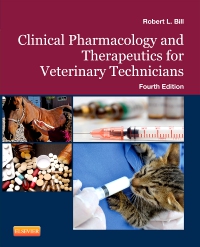
Clinical Pharmacology and Therapeutics for Veterinary Technicians - Elsevier eBook on VitalSource, 4th Edition
by Robert L. Bill, DVM, PhD
Elsevier eBook on VitalSource
ISBN:
9780323089074
Copyright:
2017
Publication Date:
09-27-2016
Page Count:
480
Imprint:
Mosby
List Price:
$75.99
Most review copies are eBooks – how fast!
A review copy request is most likely to be fulfilled as an eBook on VitalSource rather than a print product, unless no eBook is available. eBooks become available in as little as a few hours. Print products will take between 7 and 10 days to arrive. To request a print copy, please contact us through the Evolve Support Center for further assistance or contact your Elsevier Sales Rep.
Help students grasp complex concepts and develop fundamental knowledge, in the rapidly changing field of veterinary pharmacology with Clinical Pharmacology and Therapeutics for Veterinary Technicians, 4th Edition. This accessible, comprehensive text explains how drugs work so students can confidently communicate about current drug therapies. This new edition includes strong introductory coverage of safety, terminology, pharmaceutical procedures, drug handling, dosage calculations, and pharmacokinetics. Featuring the most up-to-date drug information and a new full-color design with added illustrations, tables, and boxes, it covers drug uses, abuses, calculation errors, and common mistakes.
New Edition Expected Availability: 07-18-2023

Bill's Clinical Pharmacology and Therapeutics for Veterinary Technicians - Elsevier eBook on VitalSource
Elsevier eBook on VitalSource
ISBN: 9780323932134
-
- UPDATED and NEW! The most up-to-date information on all drug categories and new content on several drugs
- NEW! Full-color format with photos and line drawings helps visual learners understand concepts and enhances images’ educational value
- NEW! Myths and Misconceptions, Ask Dr. Bill, and You Need to Know boxes break up the narrative and spotlight interesting concepts to make information easier to understand
- NEW! Evolve site with instructor resources, including PowerPoint presentations, test bank questions and answers, an image collection, the answer keys to each chapter’s self-assessment questions, and drug calculation practice exercises
- NEW! Vet Tech Threads design includes key terms, chapter outlines, and learning objectives, as well as other pedagogical features, to help you grasp key content and navigate through the chapters
-
- UPDATED and NEW! The most up-to-date information on all drug categories and new content on several drugs
- NEW! Full-color format with photos and line drawings helps visual learners understand concepts
- NEW! Myths and Misconceptions, Ask Dr. Bill, and You Need to Know boxes break up the narrative and spotlight interesting concepts to make information easier to understand
- NEW! Evolve site with instructor resources, including PowerPoint presentations, test bank questions and answers, an image collection, answer keys to each chapter’s self-assessment questions, and drug calculation practice exercises for students
- NEW! Vet Tech Threads design includes key terms, chapter outlines, and learning objectives, as well as other pedagogical features, to help students grasp key content and navigate through the chapters
- Covers complex principles of pharmacology in a manner appropriate for both veterinary technicians and students
- Provides strong introductory content on safety, terminology, pharmacy procedures, drug handling (including the latest OSHA requirements), dosage calculations, and pharmacokinetics
- Emphasizes the reasons behind drug properties, actions, and effects — not just lists of facts
- Valuable clinical applications are interspersed throughout every chapter, and concepts are linked to real-life situations to help reinforce learning
- Critical thinking and review questions at the end of every chapter help students test comprehension and encourage class discussion
-
1. Veterinary Pharmacology and the Veterinary Technician – An Introduction to Understanding Therapeutic Applications
2. Pharmacy Procedures and Dosage Calculations
3. Pharmacokinetics and Pharmacodynamics: The Principles of How Drugs Work
4. Drugs Affecting the Gastrointestinal Tract
5. Drugs Affecting the Cardiovascular System
6. Drugs Affecting the Respiratory System
7. Drugs Affecting the Endocrine System
8. Drugs Affecting the Nervous System: Analgesics, Tranquilizers, Sedatives, and Anesthetics
9. Drugs Affecting the Nervous System: Anticonvulsants and Behavior-Modifying Drugs
10. Antimicrobials
11. Disinfectants and Antiseptics
12. Antiparasitics
13. Antiinflammatory Drugs -
-
Ways of Reading
- The appearance of the text and page layout can be modified according to the capabilities of the reading system (font family and font size, spaces between paragraphs, sentences, words, and letters, as well as color of background and text)
- This e-publication is accessible to the full extent that the file format and types of content allow, on a specific reading device, by default, without necessarily including any additions such as textual descriptions of images or enhanced navigation
- No information about nonvisual reading is available
-
Conformance
- No information is available
-
Navigation
- Table of contents to all chapters of the text via links
- Page list to go to pages from the print source version
-
Rich Content
- No information is available
-
Hazards
- No information is available
-
Product Content
- No information is available
-
Legal Considerations
- No information is available
-
Additional Accessibility Information
- Page breaks included from the original print source
- For readers with color vision deficiency, use of color (e.g., in diagrams, graphics and charts, in prompts, or on buttons inviting a response) is not the sole means of graphical distinction or of conveying information
- E-publication includes basic navigation (usually less detailed than TOC-based navigation)
- Where links, controls or buttons are included in the content, the purpose or functionality of each link, control or button is apparent from the associated text alone - or where it is unclear, separate link, control or button descriptions are provided
- All (or substantially all) textual matter is arranged in a single logical reading order (including text that is visually presented as separate from the main text flow, e.g., in boxouts, captions, tables, footnotes, endnotes, citations, etc.). Non-textual content is also linked from within this logical reading order. (Purely decorative non-text content can be ignored).
- The language of the text has been specified (e.g., via the HTML or XML lang attribute) to optimise text-to-speech (and other alternative renderings), both at the whole document level and, where appropriate, for individual words, phrases or passages in a different language.
-
Ways of Reading
Most review copies are eBooks – how fast!
A review copy request is most likely to be fulfilled as an eBook on VitalSource rather than a print product, unless no eBook is available. eBooks become available in as little as a few hours. Print products will take between 7 and 10 days to arrive. To request a print copy, please contact us through the Evolve Support Center for further assistance or contact your Elsevier Sales Rep.

 as described in our