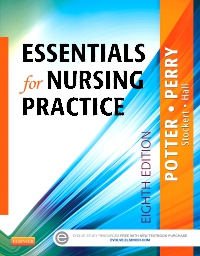

Essentials for Nursing Practice - Elsevier eBook on VitalSource, 8th Edition
Elsevier eBook on VitalSource
Worrying about how you’re going to cover all the fundamental nursing principles and concepts in a limited amount of time? Facing students that are overwhelmed by too much information? Get peace of mind with Potter and Perry’s Essentials for Nursing Practice, 8th Edition. This revitalized text combines all the expert nursing content and student-friendly features of Potter and Perry’s Fundamentals text and streamlines it into a shorter format that’s perfect for busy nursing students — and busy nursing instructors! Formerly Basic Nursing, this essential text contains all the nursing principles, concepts, skills, and focus on critical thinking that educators have come to love about Potter and Perry. The new eighth edition also includes new visuals and interactive learning features, and a new TEACH for Nurses suite of educator resources designed to help you carry out your course without a hitch!
New Edition Expected Availability: 05-02-2018

Essentials for Nursing Practice - Elsevier eBook on VitalSource
-
- NEW! QSEN scenarios present a clinical situation followed by an open-ended question designed to help you understand and apply these core competencies.
- NEW! Chapter on professional nursing includes information on QSEN, prioritization, delegation, and professional levels.
- NEW! Completely revised review questions contain a strong mix of clinical thinking and application-level questions.
- NEW! Content on the impact of exercise covers its influence on disease reduction, compassion fatigue, lateral violence, cyber bullying, social media implications, caregiver strain, and safe patient handling.
- NEW! Expanded use of Evidence-Based Practice boxes include a PICO question, summary of the results of a research study, and a description of how the study has affected nursing practice — in every chapter.
- NEW! Patient-Centered Care boxes address racial and ethnic diversity along with the cultural differences that impact socioeconomic status, values, geography, and religion. These will related to the chapter case studies when possible.
-
- NEW! Chapter on professional nursing includes information on QSEN, prioritization, delegation, and professional levels.
- NEW! QSEN activity scenarios present a clinical situation followed by an open-ended question designed to help students understand and apply these core competencies.
- NEW! TEACH for Nurses suite of educator resources gives you all the tools you need to make your course as effective and easy as possible.
- Progressive case studies are introduced at the beginning of the chapter and are then used to tie together the care plan, concept map, and clinical decision-making exercises.
- NEW! Revised review questions contain a strong mix of clinical thinking and application-level questions.
- NEW! Procedural guidelines on blood glucose monitoring and a new skill on patient-controlled analgesia give students insight and direction in performing these key skills.
- NEW! Patient-Centered Care boxes address racial and ethnic diversity along with the cultural differences that impact socioeconomic status, values, geography, and religion. These will related to the chapter case studies when possible.
- NEW! Expanded use of Evidence-Based Practice boxes include a PICO question, summary of the results of a research study, and a description of how the study has affected nursing practice — in every chapter.
- NEW! Content on the impact of exercise covers its influence on disease reduction, compassion fatigue, lateral violence, cyber bullying, social media implications, caregiver strain, and safe patient handling.
- 65 Skills and procedural guidelines provide clear, step-by-step instructions for providing safe nursing care.
- 5-step nursing process provides a consistent framework for clinical chapters.
- NEW! Over 100 updated images capture the latest updates in skills and equipment.
-
-
 Study Guide for Essentials for Nursing Practice - Elsevier eBook on VitalSourceElsevier eBook on VitalSource
-
-
UNIT 1: CONCEPTS IN NURSING1. Professional Nursing NEW!
2. Health and Wellness
3. The Health Care Delivery System
4. Community-Based Nursing Practice
5. Legal Principles in Nursing
6. Ethics
7. Evidence-Based PracticeUNIT 2: PROCESSES IN NURSING CARE
8. Critical Thinking
9. Nursing Process
10. Informatics and Documentation
11. Communication
12. Patient Education
13. Managing Patient CareUNIT 3: NURSING PRACTICE FOUNDATIONS
14. Infection Control
15. Vital Signs
16. Health Assessment and Physical Examination
17. Administering Medications
18. Fluid, Electrolyte, and Acid-Base BalancesUNIT 4: PROMOTING PSYCHOSOCIAL HEALTH
19. Caring in Nursing Practice
20. Cultural Awareness
21. Spiritual Health
22. Growth and Development
23. Self-Concept and Sexuality
24. Family in Nursing
25. Stress and Coping
26. Loss and GriefUNIT 5: PROMOTING PHYSICAL HEALTH
27. Exercise and Activity
28. Safety
29. Hygiene
30. Oxygenation
31. Sleep
32. Pain Management
33. Nutrition
34. Urinary Elimination
35. Bowel Elimination
36. Immobility
37. Skin and Wound Care
38. Sensory Alterations
39. Surgical Patient -
-
Ways of Reading
- The appearance of the text and page layout can be modified according to the capabilities of the reading system (font family and font size, spaces between paragraphs, sentences, words, and letters, as well as color of background and text)
- This e-publication is accessible to the full extent that the file format and types of content allow, on a specific reading device, by default, without necessarily including any additions such as textual descriptions of images or enhanced navigation
- No information about nonvisual reading is available
-
Conformance
- The publication was certified on 27-05-2026
-
Navigation
- Table of contents to all chapters of the text via links
- Page list to go to pages from the print source version
-
Rich Content
- No information is available
-
Hazards
- No information is available
-
Product Content
- No information is available
-
Legal Considerations
- No information is available
-
Additional Accessibility Information
- Page breaks included from the original print source
- For readers with color vision deficiency, use of color (e.g., in diagrams, graphics and charts, in prompts, or on buttons inviting a response) is not the sole means of graphical distinction or of conveying information
- E-publication includes basic navigation (usually less detailed than TOC-based navigation)
- Where links, controls or buttons are included in the content, the purpose or functionality of each link, control or button is apparent from the associated text alone - or where it is unclear, separate link, control or button descriptions are provided
- All (or substantially all) textual matter is arranged in a single logical reading order (including text that is visually presented as separate from the main text flow, e.g., in boxouts, captions, tables, footnotes, endnotes, citations, etc.). Non-textual content is also linked from within this logical reading order. (Purely decorative non-text content can be ignored).
- The language of the text has been specified (e.g., via the HTML or XML lang attribute) to optimise text-to-speech (and other alternative renderings), both at the whole document level and, where appropriate, for individual words, phrases or passages in a different language.
-
Ways of Reading

 as described in our