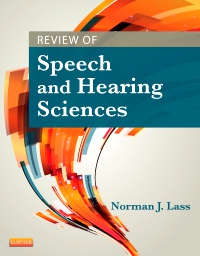

Review of Speech and Hearing Sciences - Elsevier eBook on VitalSource, 1st Edition
Elsevier eBook on VitalSource
Give your students the extra practice they need to master speech and hearing science classes and pass their credentialing exams. Perfect for use in conjunction with any textbook for undergraduate or graduate speech and hearing science course, this helpful workbook features variety of interactive anatomic identification exercises, mathematical problem sets, and study questions covering the areas of basic acoustics, acoustics of speech production, respiration, phonation, articulation, and auditory mechanism. Workbook questions mirror the topics specified by ASHA in the Knowledge and Skills Acquisition (KASA) Summary Form for Certification in Speech-Language Pathology and information covered on the Speech-Language Pathology and Audiology Praxis exams to help students stay on course in their study.
-
- Content follows KASA standards for speech-language pathology and audiology certification.
- Broad-spectrum of coverage in the speech and hearing sciences makes this workbook a great review tool for a variety of speech and hearing courses.
- Review sections at the end of each chapter include multiple choice, fill-in-the-blank, and true and false questions.
- Questions on anatomy will have two levels of difficulty.
- LEVEL 1: the names of parts of structures to identify are provided, with arrows pointing to each part
- LEVEL 2: the names of parts of structures to identify are provided, but no arrows are available
-
- BASIC ACOUSTICS
- ACOUSTICS OF SPEECH PRODUCTION
- RESPIRATION
- PHONATION
- ARTICULATION
- THE CONDUCTIVE AUDITORY MECHANISM
- THE SENSORY AUDITORY MECHANISM
- THE CENTRAL AUDITORY MECHANISM
-
-
Ways of Reading
- The appearance of the text and page layout can be modified according to the capabilities of the reading system (font family and font size, spaces between paragraphs, sentences, words, and letters, as well as color of background and text)
- This e-publication is accessible to the full extent that the file format and types of content allow, on a specific reading device, by default, without necessarily including any additions such as textual descriptions of images or enhanced navigation
- No information about nonvisual reading is available
-
Conformance
- No information is available
-
Navigation
- Table of contents to all chapters of the text via links
- Page list to go to pages from the print source version
-
Rich Content
- No information is available
-
Hazards
- No information is available
-
Product Content
- No information is available
-
Legal Considerations
- No information is available
-
Additional Accessibility Information
- Page breaks included from the original print source
- For readers with color vision deficiency, use of color (e.g., in diagrams, graphics and charts, in prompts, or on buttons inviting a response) is not the sole means of graphical distinction or of conveying information
- E-publication includes basic navigation (usually less detailed than TOC-based navigation)
- Where links, controls or buttons are included in the content, the purpose or functionality of each link, control or button is apparent from the associated text alone - or where it is unclear, separate link, control or button descriptions are provided
- All (or substantially all) textual matter is arranged in a single logical reading order (including text that is visually presented as separate from the main text flow, e.g., in boxouts, captions, tables, footnotes, endnotes, citations, etc.). Non-textual content is also linked from within this logical reading order. (Purely decorative non-text content can be ignored).
- The language of the text has been specified (e.g., via the HTML or XML lang attribute) to optimise text-to-speech (and other alternative renderings), both at the whole document level and, where appropriate, for individual words, phrases or passages in a different language.
-
Ways of Reading

 as described in our