ISBN:
9780323168021
Copyright:
2009
Publication Date:
01-09-2009
Page Count:
928
Imprint:
Mosby
List Price:
$64.99

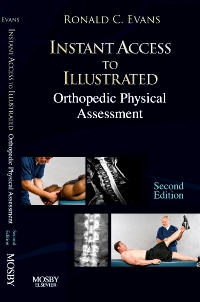
Instant Access to Orthopedic Physical Assessment - Elsevier eBook on VitalSource, 2nd Edition
by Ronald C. Evans, DC, FACO, FICC
Elsevier eBook on VitalSource
ISBN:
9780323168021
Copyright:
2009
Publication Date:
01-09-2009
Page Count:
928
Imprint:
Mosby
List Price:
$64.99
Was
$64.99
Now $45.49
Or $0.00 with a valid access code
Here’s a powerful quick reference and clinical tool – small enough to fit into your pocket, yet complete enough to cover any assessment test you need to perform! Detailing every test included in Illustrated Orthopedic Physical Assessment, 3rd Edition, this handy, thoroughly illustrated pocket guide includes only the essential information you need to know. Information for each test is presented in a consistent manner for quick reference, and includes: name of the test, alternate names for the test, suspected syndrome, concise description of the testing procedure, clinical pearl, and photo(s) of the procedure. Plus, just as in the parent text, each test also contains a corresponding orthopedic gamut which provides a summary of key points in a concise list, serving as a diagnostic rubric for use in patient exams.
-
- All-new photos clearly illustrate every assessment test.
- Updated content ensures you have the latest assessment information at your fingertips.
-
- Fits in your lab coat pocket, giving you easy access to frequently used assessment and testing information.
- Every test from the parent textbook, Illustrated Orthopedic Physical Assessment, 3rd Edition, is included in this pocket guide.
- A consistent format for each test (the same format as the parent text) ensures that you’ll find the information you need quickly and easily.
- Clinical pearls appear with almost every test, detailing author’s own clinical experience and providing valuable insight to both students and practitioners.
- Nearly 400 orthopedic gamuts concisely cover anatomy, motion assessment, muscle function, and imaging elements – essential concepts for effective assessment and diagnostic decision-making.
- A complete index of tests appears on the inside cover in alphabetical order, as well as by body system, so you can see at a glance which tests are covered and where to find them.
- Nearly 500 illustrations (line drawings and photographs) show key moves of each test, and other necessary maneuvers, anatomy, and pathologies.
- A glossary of key abbreviations is included at the end of the book, familiarizing you with common clinical terms and notation.
- A comprehensive bibliography provides helpful references for further research and study.
-
Chapter 1: Principles in Assessing Musculoskeletal Disorders
Chapter 2: Cardinal Symptoms and Signs
Chapter 3: The Cervical Spine
Chapter 4: The Shoulder
Chapter 5: The Elbow
Chapter 6: The Forearm, Wrist, and Hand
Chapter 7: The Thoracic Spine
Chapter 8: The Lumbar Spine
Chapter 9: The Pelvis and Sacroiliac Joint
Chapter 10: The Hip Joint
Chapter 11: The Knee
Chapter 12: Lower Leg, Ankle, and Foot
Chapter 13: Malingering
Bibliography
Glossary of Abbreviations
Index -
-
Ways of Reading
- The appearance of the text and page layout can be modified according to the capabilities of the reading system (font family and font size, spaces between paragraphs, sentences, words, and letters, as well as color of background and text)
- This e-publication is accessible to the full extent that the file format and types of content allow, on a specific reading device, by default, without necessarily including any additions such as textual descriptions of images or enhanced navigation
- All content can be read as read aloud speech or dynamic braille
-
Conformance
- For detailed accessibility information, see Elsevier's website at https://www.elsevier.com/about/accessibility
- For queries regarding accessibility information, contact [email protected]
- The publication was certified on 07-04-2026
-
Navigation
- Table of contents to all chapters of the text via links
- Page list to go to pages from the print source version
-
Rich Content
- No information is available
-
Hazards
- No information is available
-
Product Content
- No information is available
-
Legal Considerations
- Elsevier is committed to making our eBooks accessible and complying with applicable laws. Given our vast library of titles, there are some cases where making an eBook fully accessible presents unique challenges, and including full features could transform its nature to no longer serve its primary purpose or result in a disproportionate burden for the publisher. As a result this eBook may have limited accessibility. See more at https://www.elsevier.com/en-gb/about/accessibility.
- Please refer to our disproportionate burden or fundamental modification statements.
-
Additional Accessibility Information
- Page breaks included from the original print source
- E-publication includes basic navigation (usually less detailed than TOC-based navigation)
- All (or substantially all) textual matter is arranged in a single logical reading order (including text that is visually presented as separate from the main text flow, e.g., in boxouts, captions, tables, footnotes, endnotes, citations, etc.). Non-textual content is also linked from within this logical reading order. (Purely decorative non-text content can be ignored).
- The language of the text has been specified (e.g., via the HTML or XML lang attribute) to optimise text-to-speech (and other alternative renderings), both at the whole document level and, where appropriate, for individual words, phrases or passages in a different language.
-
Ways of Reading

Was
$64.99
Now $45.49
Or $0.00 with a valid access code

 as described in our