ISBN:
9780323168069
Copyright:
2009
Publication Date:
03-20-2008
Page Count:
320
Imprint:
Mosby
List Price:
$54.99

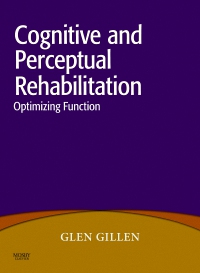
Cognitive and Perceptual Rehabilitation - Elsevier eBook on VitalSource, 1st Edition
by Glen Gillen, EdD, OTR, FAOTA
Elsevier eBook on VitalSource
ISBN:
9780323168069
Copyright:
2009
Publication Date:
03-20-2008
Page Count:
320
Imprint:
Mosby
List Price:
$54.99
Was
$54.99
Now $49.49
Or $0.00 with a valid access code
Reflecting current practice with a renewed focus on function-based assessments and evidence-based interventions, Cognitive and Perceptual Rehabilitation: Optimizing Function includes all of the tools you need to make a positive impact on your patients’ lives. This clinical resource summarizes, highlights, and constructively critiques the state of cognitive and perceptual rehabilitation. This text helps you enhance your patients’ quality of life by promoting improved performance of necessary and meaningful activities, and decreasing participation restrictions.
-
- Evidence-based intervention tables focus on improving daily function through proven methods.
- Summary tables highlight each assessment’s clinical utility and pyschometric properties to provide you with the tools you need to choose the best assessment for each patient.
- An entire chapter on Application of Concepts features five case studies, each discussing background data and medical record review, evaluation findings, assessments, long-term goals, short-term goals, and interventions/functional activities to help you apply the theories and principles from the book to real-world situations.
- Handy learning aids including Key Terms, Learning Objectives, and Review Questions help you remember important information.
-
-
 Cognitive and Perceptual RehabilitationPaperback
-
-
1. Overview of Cognitive and Perceptual Rehabilitation
2. General Considerations: Evaluations and Interventions for Those Living with Functional Limitations Secondary to Cognitive and Perceptual Impairments
3. Managing Visual and Spatial Impairments to Optimize Function
4. Self-Awareness and Insight: Foundations for Intervention
-Appendix 4-1. Evidence-Based Practice for Awareness Interventions
5. Managing Apraxia to Optimize Function
-Appendix 5-1. Evidence-Based Interventions for Apraxia Focused on Improving Daily Function
6. Managing Unilateral Neglect to Optimize Function
-Appendix 6-1. Evidence-Based Interventions for Neglect Focused on Improving Daily Function
7. Managing Agnosias to Optimize Function
-Appendix 7-1. Evidence-Based Practice for Agnosia Interventions
8. Managing Attention Deficits to Optimize Function
-Appendix 8-1. Evidence-Based Interventions Focused on Improving Activity Performance and Participation for those with Attention Impairments
9. Managing Memory Deficits to Optimize Function
-Appendix 9-1. Evidence-Based Interventions for Memory Loss Focused on Improving Daily Function
10. Managing Executive Function Impairments to Optimize Function
-Appendix 10-1. Evidence-Based Interventions for Impairments of Executive Functions Focused on Improving Daily Function
11. Application of Concepts: Case Studies
Appendix A. The Glasgow Coma Scale
Appendix B. Rancho Levels of Cognitive Functioning Revised and The Family Guide to the Rancho Levels of Cognitive Functioning Revised -
-
Ways of Reading
- The appearance of the text and page layout can be modified according to the capabilities of the reading system (font family and font size, spaces between paragraphs, sentences, words, and letters, as well as color of background and text)
- This e-publication is accessible to the full extent that the file format and types of content allow, on a specific reading device, by default, without necessarily including any additions such as textual descriptions of images or enhanced navigation
- All content can be read as read aloud speech or dynamic braille
- Has alternative text descriptions for images
-
Conformance
- The publication contains a conformance statement that it meets the EPUB Accessibility 1.1, WCAG 2.1, Level AA standard. Please see https://bornaccessible.benetech.org/certified-publishers/ for further details of our compatibility testing.
- The certifier's credential is https://bornaccessible.benetech.org/certified-publishers/
- For detailed accessibility information, see Elsevier's website at https://www.elsevier.com/about/accessibility
- For queries regarding accessibility information, contact [email protected]
- The publication was certified on 07-04-2026
-
Navigation
- Table of contents to all chapters of the text via links
- Index with links to referenced entries
- Elements such as headings, tables, etc. for structured navigation
- Page list to go to pages from the print source version
-
Rich Content
- Information-rich images are described by extended descriptions
-
Hazards
- The publication contains no hazards
-
Product Content
- Content includes any type of illustrations.
- The primary content is text.
- Content includes a significant number of actionable (clickable) web links to external content, downloadable resources, supplementary material, etc.
- Content includes a significant number of actionable (clickable) cross-references, hyperlinked notes and annotations, or with other actionable links between largely textual elements (e.g., quiz/test questions, 'choose your own ending', etc.).
- Content includes figures, diagrams, charts and/or graphs, including other 'mechanical' (i.e. non-photographic) illustrations.
- Content includes a significant number of web links (printed URLs, QR codes etc.).
- Content includes text within images, including text-as-text embedded in diagrams, charts, or within images containing speech balloons, thought bubbles, captions, etc.
- Content includes mathematical notations, formulae.
-
Legal Considerations
- No information is available
-
Additional Accessibility Information
- Content is enhanced with ARIA roles to optimize organization and facilitate navigation
- Page breaks included from the original print source
- For readers with color vision deficiency, use of color (e.g., in diagrams, graphics and charts, in prompts, or on buttons inviting a response) is not the sole means of graphical distinction or of conveying information
- The body text is presented with a contrast ratio of at least 4.5:1 (or 3:1 for large/heading text)
- Ultra-high contrast between text and background
- E-publication includes basic navigation (usually less detailed than TOC-based navigation)
- Where links, controls or buttons are included in the content, the purpose or functionality of each link, control or button is apparent from the associated text alone - or where it is unclear, separate link, control or button descriptions are provided
- All (or substantially all) textual matter is arranged in a single logical reading order (including text that is visually presented as separate from the main text flow, e.g., in boxouts, captions, tables, footnotes, endnotes, citations, etc.). Non-textual content is also linked from within this logical reading order. (Purely decorative non-text content can be ignored).
- Content provides explanations for unusual words, abbreviations, acronyms, idioms, jargon in an accessible form, such as glossaries, scripted pop-ups.
- Where interactive content is included in the product, controls are provided (e.g., for speed, pause and resume, reset) and labelled to make their use clear.
- The language of the text has been specified (e.g., via the HTML or XML lang attribute) to optimise text-to-speech (and other alternative renderings), both at the whole document level and, where appropriate, for individual words, phrases or passages in a different language.
-
Ways of Reading
Was
$54.99
Now $49.49
Or $0.00 with a valid access code

 as described in our