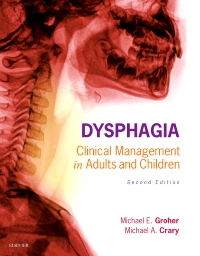

Dysphagia - Elsevier eBook on VitalSource, 2nd Edition
Elsevier eBook on VitalSource
Give students all the information and tools they need to confidently manage dysphagia in professional practice with Dysphagia: Clinical Management in Adults and Children, 2nd Edition! This logically organized, evidence-based resource reflects the latest advancements in dysphagia in an approachable and student-friendly manner to help your class easily master the clinical evaluation and diagnostic decision-making processes. New coverage of the latest insights and research along with expanded information on infant and child swallowing will help prepare students for all types of conditions they might face in the clinical setting. Plus, the realistic case scenarios and detailed review questions threaded throughout the book will help them develop the clinical reasoning skills needed for professional success. The Evolve website features a full-length video depicting adult swallowing disorders. More than 50 other videos highlight selected content within the book, some showing fluoroscopic and endoscopic views.
New Edition Expected Availability: 07-27-2020

-
- NEW! Expanded content on infant and child swallowing will help readers learn the insights needed for this growing area of practice.
- NEW! Updated content and references throughout reflect the most up to date research in existence.
-
- NEW! Expanded content on infant and child swallowing will help students learn the insights needed for this growing area of practice.
- NEW! Updated content and references throughout reflect the most up-to-date research in existence.
- Emphasis on evidence-based practice prepares students to properly support their diagnostic and treatment decisions.
- Case histories throughout the book promote critical thinking in realistic clinical situations.
- Critical thinking questions help students determine their understanding on the content and reinforce learning.
- Student-friendly learning features throughout the book include chapter outlines, learning objectives, and bullet-pointed summaries at chapter ends to help students focus their attention on mastering important content.
-
Part I: Foundations
1. Dysphagia UnpluggedPart II: Dysphagia in Adults
2. Normal Swallowing in Adults
Section 1: Causes and Characteristics of Dysphagia
3. Adult Neurologic Disorders
4. Dysphagia and Head and Neck Cancer
5. Esophageal Disorders
6. Respiratory and Iatrogenic Disorders
Section 2: Evaluation of Swallowing
7. Clinical Evaluation of Adults
8. Imaging Swallowing Examinations: Videofluoroscopy and Endoscopy
Section 3: Approaches to Treatment
9. Treatment Considerations, Options, and Decisions
10. Treatment for Adults
11. Ethical ConsiderationsPart III: Dysphagia in Infants and Children
12. Typical Feeding and Swallowing Development in Infants and Children
13. Disorders Affecting Feeding and Swallowing in Infants and Children
14. Evaluating Feeding and Swallowing in Infants and Children
15. Treatment of Feeding and Swallowing Difficulties in Infants and Children -
-
Ways of Reading
- The appearance of the text and page layout can be modified according to the capabilities of the reading system (font family and font size, spaces between paragraphs, sentences, words, and letters, as well as color of background and text)
- This e-publication is accessible to the full extent that the file format and types of content allow, on a specific reading device, by default, without necessarily including any additions such as textual descriptions of images or enhanced navigation
- No information about nonvisual reading is available
-
Conformance
- The publication was certified on 27-05-2026
-
Navigation
- Table of contents to all chapters of the text via links
- Page list to go to pages from the print source version
-
Rich Content
- No information is available
-
Hazards
- No information is available
-
Product Content
- No information is available
-
Legal Considerations
- No information is available
-
Additional Accessibility Information
- Page breaks included from the original print source
- For readers with color vision deficiency, use of color (e.g., in diagrams, graphics and charts, in prompts, or on buttons inviting a response) is not the sole means of graphical distinction or of conveying information
- E-publication includes basic navigation (usually less detailed than TOC-based navigation)
- Where links, controls or buttons are included in the content, the purpose or functionality of each link, control or button is apparent from the associated text alone - or where it is unclear, separate link, control or button descriptions are provided
- All (or substantially all) textual matter is arranged in a single logical reading order (including text that is visually presented as separate from the main text flow, e.g., in boxouts, captions, tables, footnotes, endnotes, citations, etc.). Non-textual content is also linked from within this logical reading order. (Purely decorative non-text content can be ignored).
- The language of the text has been specified (e.g., via the HTML or XML lang attribute) to optimise text-to-speech (and other alternative renderings), both at the whole document level and, where appropriate, for individual words, phrases or passages in a different language.
-
Ways of Reading

 as described in our