
Therapeutic Exercise Prescription - Elsevier eBook on VitalSource, 1st Edition
Elsevier eBook on VitalSource
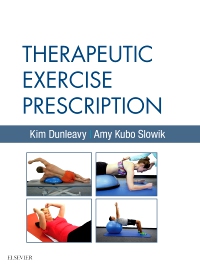
Dunleavy and Slowik’s Therapeutic Exercise Prescription delivers on exactly what today’s students (and their instructors) need from a core therapeutic exercise text. This all-new, full-color text combines evidence-based content, theoretical concepts, AND practical application to give students a robust understanding of therapeutic exercise. Using an approachable, easy-to-follow writing style, it introduces foundational concepts, discusses how to choose the right exercises, and guides students in developing goals for treatment. Coverage also includes the examination process and specific ways to choose, monitor, and evaluate the most effective exercise. Each exercise in the text is presented with progressions — a unique feature exclusive to this title — to give students an understanding of how the exercise(s) may change from the initial phase of exercise prescription to the functional recovery stage. In addition to its highly-digestible format, this text also boasts case studies, practical discussions, and engaging online videos to provide students with a more dynamic and more effective learning experience.
-
- UNIQUE! Clinical reasoning approach to exercise selection, modification, instruction, and progression provides a framework for students, from the initial exercise prescription to the functional recovery stage
- Emphasis on patient safety and precautions includes the use of the ICF model, as well as coverage of tissue healing and biometrics
- UNIQUE! Clinical case examples provide practical examples in a succinct compare and contrast format to help students build clinical reasoning skills and learn to apply theory to practice
- Full case studies cover all the regions of the body as well as each of the mobility-, trauma-, and psychologically-informed concepts
- Discussion questions and answers at the end of each case study and at the end each chapter encourage students to assimilate and use all previously acquired knowledge and help prepare them for the types of critical thinking they will be required to do in practice
- UNIQUE! Integrated content builds from foundational concepts, with reinforcement throughout the book using illustrations and explanations of important concepts
- UNIQUE! Discussion of broad categories, such as extremes of mobility impairments, types of trauma, and presence of psychological impairments, strengthen student assimilation and understanding
- UNIQUE! Detailed exercise depictions include teaching tips with instruction examples, common errors to correct, and methods to prevent or address compensations
- UNIQUE! Workbook format offers students comprehensive coverage of exercise examples with alternatives and progressions
-
1. Introduction
2. Review of foundational concepts
3. Relationship between impairments and function
4. Examination techniques and evaluation
5. Exercise prescription — exercise parameters
6. Exercise prescription — factors influencing selection of exercises
7. Teaching and learning concepts for motor tasks
8. Evaluation and adjustment of exercise performance
9. Lower extremity
10. Upper extremity
11. Spine -
-
Ways of Reading
- The appearance of the text and page layout can be modified according to the capabilities of the reading system (font family and font size, spaces between paragraphs, sentences, words, and letters, as well as color of background and text)
- This e-publication is accessible to the full extent that the file format and types of content allow, on a specific reading device, by default, without necessarily including any additions such as textual descriptions of images or enhanced navigation
- No information about nonvisual reading is available
-
Conformance
- No information is available
-
Navigation
- Table of contents to all chapters of the text via links
- Page list to go to pages from the print source version
-
Rich Content
- No information is available
-
Hazards
- No information is available
-
Product Content
- No information is available
-
Legal Considerations
- No information is available
-
Additional Accessibility Information
- Page breaks included from the original print source
- For readers with color vision deficiency, use of color (e.g., in diagrams, graphics and charts, in prompts, or on buttons inviting a response) is not the sole means of graphical distinction or of conveying information
- E-publication includes basic navigation (usually less detailed than TOC-based navigation)
- Where links, controls or buttons are included in the content, the purpose or functionality of each link, control or button is apparent from the associated text alone - or where it is unclear, separate link, control or button descriptions are provided
- All (or substantially all) textual matter is arranged in a single logical reading order (including text that is visually presented as separate from the main text flow, e.g., in boxouts, captions, tables, footnotes, endnotes, citations, etc.). Non-textual content is also linked from within this logical reading order. (Purely decorative non-text content can be ignored).
- The language of the text has been specified (e.g., via the HTML or XML lang attribute) to optimise text-to-speech (and other alternative renderings), both at the whole document level and, where appropriate, for individual words, phrases or passages in a different language.
-
Ways of Reading



 as described in our