ISBN:
9780323327336
Copyright:
2016
Publication Date:
05-26-2015
Page Count:
336
Imprint:
Saunders
List Price:
$75.99

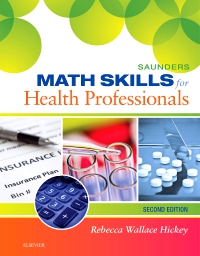
Saunders Math Skills for Health Professions - Elsevier eBook on VitalSource, 2nd Edition
by Rebecca Hickey, RN, RMC, AHI, CHI
Elsevier eBook on VitalSource
ISBN:
9780323327336
Copyright:
2016
Publication Date:
05-26-2015
Page Count:
336
Imprint:
Saunders
List Price:
$75.99
Most review copies are eBooks – how fast!
A review copy request is most likely to be fulfilled as an eBook on VitalSource rather than a print product, unless no eBook is available. eBooks become available in as little as a few hours. Print products will take between 7 and 10 days to arrive. To request a print copy, please contact us through the Evolve Support Center for further assistance or contact your Elsevier Sales Rep.
Set up your students for success in math! Saunders Math Skills for Health Professionals, 2nd Edition reviews and simplifies the everyday math skills they need to succeed as healthcare professionals. Practical examples show how to solve problems step by step, and clarify fundamental math principles including fractions and percentages, ratios and proportions, basic algebra, and statistics. New to this edition is a chapter on solutions and IV calculations, as well as even more practice problems with step-by-step solutions. No other textbook makes math so friendly and so accessible!
-
- NEW! Solutions and IV Calculations chapter includes topics seen in chemistry, such as calculations for IV solutions and drip rate conversions, duration and total volume of solutions, and discussions on solutes, solvents, logarithms, and pH conversions.
- NEW! Additional content includes the translation of orders written with abbreviations, use of mercury thermometers, problems involving I&O, and reading and writing prescriptions.
- NEW word problems include more Practice the Skill and more Building Confidence with the Skill exercises, helping you apply abstract mathematical concepts to real-world situations.
- NEW! More focus on graph charting is provided throughout the book.
- NEW! More Math in the Real World boxes take information that you use in your everyday life and demonstrate how the same concept can be applied in health care.
-
- A work-text format lets students solve problems as they review the material.
- UNIQUE! Full-color format highlights key information and fully illustrates examples such as how to set up problems, the different parts of equations, and how to move decimal points.
- Learning objectives follow Bloom’s taxonomy, highlight the key topics in each chapter, and explain their importance in patient care.
- Chapter Outlines and Chapter Overviews serve as a framework for each chapter and explain why it is important to understand the material presented.
- NEW! Solutions and IV Calculations chapter includes topics seen in chemistry, such as calculations for IV solutions and drip rate conversions, duration and total volume of solutions, and discussions on solutes, solvents, logarithms, and pH conversions.
- NEW! Additional content includes the translation of orders written with abbreviations, use of mercury thermometers, problems involving I&O, and reading and writing prescriptions.
- NEW word problems include more Practice the Skill and more Building Confidence with the Skill exercises, helping students apply abstract mathematical concepts to real-world situations.
- EXPANDED! Example problems in each chapter use a step-by-step method for solving problems.
- NEW! More focus on graph charting is provided throughout the book.
- Master the Skill boxes provide end-of-chapter quizzes for learning assessment.
- NEW! More Math in the Real World boxes take information used in everyday life and demonstrate how the same concepts can be applied in health care.
- Key terms that explain mathematical computations are bolded at first mention in the text and defined in the glossary.
- NEW! Key term vocabulary test in each chapter assesses student knowledge with multiple choice, matching, and fill-in-the-blank questions.
- NEW! 20-question Pre-Tests in Lesson Plans for each chapter is available to instructors on Evolve.
- NEW! Appendix of answers to odd-numbered problems is provided for Practice the Skill and Building Confidence problems.
- Spiral binding with plenty of white space allows students to write out answers and work through problems in the book.
-
1. Basic Math Review
2. Roman Numerals and Military Time
3. Fractions
4. Word Problems, Percentages, and Decimals
5. Ratios and Proportions
6. General Accounting
7. The Metric System
8. U.S. Customary Units and the Apothecary System
9. Application of Measurement and Dose Conversion
10. Power of 10
11. Solutions and IV Calculations NEW!
12. Introduction to Statistics
13. Graphs: Tools of Organization
Appendix: Answers to Odd-Numbered Problems for Practice the Skill and Building the Skill
Glossary -
-
Ways of Reading
- The appearance of the text and page layout can be modified according to the capabilities of the reading system (font family and font size, spaces between paragraphs, sentences, words, and letters, as well as color of background and text)
- This e-publication is accessible to the full extent that the file format and types of content allow, on a specific reading device, by default, without necessarily including any additions such as textual descriptions of images or enhanced navigation
- No information about nonvisual reading is available
-
Conformance
- No information is available
-
Navigation
- Table of contents to all chapters of the text via links
- Page list to go to pages from the print source version
-
Rich Content
- No information is available
-
Hazards
- No information is available
-
Product Content
- No information is available
-
Legal Considerations
- No information is available
-
Additional Accessibility Information
- Page breaks included from the original print source
- For readers with color vision deficiency, use of color (e.g., in diagrams, graphics and charts, in prompts, or on buttons inviting a response) is not the sole means of graphical distinction or of conveying information
- E-publication includes basic navigation (usually less detailed than TOC-based navigation)
- Where links, controls or buttons are included in the content, the purpose or functionality of each link, control or button is apparent from the associated text alone - or where it is unclear, separate link, control or button descriptions are provided
- All (or substantially all) textual matter is arranged in a single logical reading order (including text that is visually presented as separate from the main text flow, e.g., in boxouts, captions, tables, footnotes, endnotes, citations, etc.). Non-textual content is also linked from within this logical reading order. (Purely decorative non-text content can be ignored).
- The language of the text has been specified (e.g., via the HTML or XML lang attribute) to optimise text-to-speech (and other alternative renderings), both at the whole document level and, where appropriate, for individual words, phrases or passages in a different language.
-
Ways of Reading


Most review copies are eBooks – how fast!
A review copy request is most likely to be fulfilled as an eBook on VitalSource rather than a print product, unless no eBook is available. eBooks become available in as little as a few hours. Print products will take between 7 and 10 days to arrive. To request a print copy, please contact us through the Evolve Support Center for further assistance or contact your Elsevier Sales Rep.

 as described in our