ISBN:
9780323340922
Copyright:
2014
Publication Date:
10-28-2013
Page Count:
440
Imprint:
Saunders
List Price:
$62.99

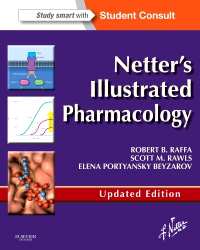
Netter's Illustrated Pharmacology Updated Edition Elsevier eBook on VitalSource, 1st Edition
by Robert B. Raffa, PhD, Scott M. Rawls, PhD and Elena Portyansky Beyzarov, PharmD
Elsevier eBook on VitalSource
ISBN:
9780323340922
Copyright:
2014
Publication Date:
10-28-2013
Page Count:
440
Imprint:
Saunders
List Price:
$62.99
Was
$62.99
Now $44.09
Or $0.00 with a valid access code
This updated edition of Netter's Illustrated Pharmacology allows you to take a distinct visual approach to understanding both the basic science and clinical applications of pharmacology. Designed to be compatible and used in conjunction with other pharmacology resources, this medical reference book offers a vivid, uniquely effective visual presentation of the pharmacodynamic relationship between drugs and the human body. And with the new addition of Student Consult online access, Netter's Illustrated Pharmacology is even more convenient than ever before!
-
- NEW! Nora AI - an AI-powered learning assistant exclusive to Elsevier ebooks on VitalSource's Bookshelf® platform - offers built-in AI learning support that provides personalized answers based on content from the Elsevier ebook
- Available online for the first time! Search the full contents of Netter's Illustrated Pharmacology no matter what your location with convenient access to Student Consult
- Visually grasp the most important principles in pharmacology with succinct, easy-to-understand presentations of introductory pharmacologic principles based on classic images by Frank Netter, as well as dynamic new illustrations from other talented medical artists
- Learn how drugs are used to treat specific disorders in the body, as well as their effects on a particular site, with a format divided by organ system and full-color illustrations of the systems themselves
- Access in-depth guidance on the must-know elements of each pharmacologic principle with clear, concise notes located beneath the corresponding image
-
1. BASIC PRINCIPLES OF PHARMACOLOGY
2. DRUGS USED TO AFFECT THE AUTONOMIC AND SOMATIC NERVOUS SYSTEMS
3. DRUGS USED IN DISORDERS OF THE CENTRAL NERVOUS SYSTEM AND TREATMENT OF PAIN
4. DRUGS USED IN DISORDERS OF THE CARDIOVASCULAR SYSTEM
5. DRUGS USED IN DISORDERS OF THE ENDOCRINE SYSTEM
6. DRUGS USED IN DISORDERS OF THE GASTROINTESTINAL SYSTEM
7. DRUGS USED IN DISORDERS OF THE RESPIRATORY SYSTEM
8. DRUGS USED IN DISORDERS OF THE REPRODUCTIVE SYSTEM
9. DRUGS USED TO AFFECT RENAL FUNCTION
10. DRUGS USED IN INFECTIOUS DISEASE
11. DRUGS USED IN NEOPLASTIC DISORDERS
12. DRUGS USED FOR SKIN DISORDERS
13. VITAMINS: DEFICIENCIES AND DRUG INTERACTIONS
14. DRUG ALLERGY, ABUSE, AND POISONING OR OVERDOSE -
-
Ways of Reading
- The appearance of the text and page layout can be modified according to the capabilities of the reading system (font family and font size, spaces between paragraphs, sentences, words, and letters, as well as color of background and text)
- This e-publication is accessible to the full extent that the file format and types of content allow, on a specific reading device, by default, without necessarily including any additions such as textual descriptions of images or enhanced navigation
- No information about nonvisual reading is available
-
Conformance
- No information is available
-
Navigation
- Table of contents to all chapters of the text via links
- Page list to go to pages from the print source version
-
Rich Content
- No information is available
-
Hazards
- No information is available
-
Product Content
- No information is available
-
Legal Considerations
- No information is available
-
Additional Accessibility Information
- Page breaks included from the original print source
- For readers with color vision deficiency, use of color (e.g., in diagrams, graphics and charts, in prompts, or on buttons inviting a response) is not the sole means of graphical distinction or of conveying information
- E-publication includes basic navigation (usually less detailed than TOC-based navigation)
- Where links, controls or buttons are included in the content, the purpose or functionality of each link, control or button is apparent from the associated text alone - or where it is unclear, separate link, control or button descriptions are provided
- All (or substantially all) textual matter is arranged in a single logical reading order (including text that is visually presented as separate from the main text flow, e.g., in boxouts, captions, tables, footnotes, endnotes, citations, etc.). Non-textual content is also linked from within this logical reading order. (Purely decorative non-text content can be ignored).
- The language of the text has been specified (e.g., via the HTML or XML lang attribute) to optimise text-to-speech (and other alternative renderings), both at the whole document level and, where appropriate, for individual words, phrases or passages in a different language.
-
Ways of Reading


Was
$62.99
Now $44.09
Or $0.00 with a valid access code

 as described in our