
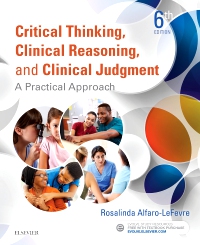

Critical Thinking, Clinical Reasoning and Clinical Judgment - Elsevier eBook on VitalSource, 6th Edition
Elsevier eBook on VitalSource
Now $52.79
What's behind every healed patient? Critical thinking! And what book best equips you to master the critical thinking skills needed for success on the NCLEX examination and in professional nursing practice? Alfaro's Critical Thinking, Clinical Reasoning, and Clinical Judgment, 6th Edition! With a motivational style and insightful "how-to" approach, this unique textbook draws upon real-life scenarios and evidence-based strategies as it guides you in learning to think critically in clinically meaningful ways. The new edition features a more streamlined, full-color design, and expanded coverage on some of key trends, including: interdisciplinary care teams, competency-based education, the IOM’s Leading Health Indicators, legal considerations, the effects of the Affordable Care Act, and much more. If you want to truly succeed in nursing practice today and be thinking-oriented rather than task-oriented, then look no further than this one-of-a-kind textbook.
Newer Edition Available

Critical Thinking, Clinical Reasoning and Clinical Judgment Elsevier eBook on VitalSource
-
- Simple approach and motivational writing style include vivid examples, memorable anecdotes, and real case scenarios to make content come alive.
- Practical strategies to promote critical thinking, clinical reasoning, and clinical judgment are incorporated along with supporting evidence as to why the strategies work.
- Focus on application (or "how to") and inclusion of supporting rationales (theory) make difficult concepts easy to learn.
- Critical thinking indicators feature evidence-based descriptions from the author of behaviors that promote critical thinking in nursing practice.
- Highlighted features and sections — such as Chapter at a Glance, Pre-Chapter Self-Tests, Guiding Principles, Critical Moments, Other Perspectives, Think-Pair-Share, Help Me Out cartoons, real-life clinical scenarios, key points, critical thinking exercises, and more — promote independent learning.
- UNIQUE! Brain-based learning principles utilize strategies that challenge the mind and are incorporated throughout the text.
- Timely coverage includes topical issues, such as: problem-focused versus outcome-focused thinking, prioritizing, developing a culture of safety, healthy work environments, expanding roles related to diagnosis and management, applying delegation principles, evidence-based practice, improving grades and passing tests the first time, NCLEX preparation, ensuring documentation reflects critical thinking, communication and interpersonal skills, strategies for common workplace challenges, and more.
- Inclusion of ethics- and standards-based professional practice reflects today’s professional climate which demands increasing accountability.
- Incorporation of cultural, spiritual, and lifespan content along with the nurse’s role in hospitals, communities, and long-term care settings presents a broad approach to critical thinking.
- Discussion of Tanner and Benner’s most recent work on what the research says about critical thinking and clinical judgment in nursing keeps readers up to date on the evidence-based side of practice.
- Coverage of IOM, QSEN, and other patient safety standards also keeps readers up to date on safe and effective nursing care.
-
- NEW! Full-color, eye-catching design facilitates learning.
- NEW! Additional coverage of key trends in nursing education and practice, discuss important topics such as interdisciplinary care teams, competency-based education, clinical residencies, leadership at the bedside, and implications of the Affordable Care Act.
- NEW! Updated coverage of the Institute of Medicine’s (IOM) Leading Health Indicators addresses the latest Healthy People 2020 goals.
- NEW! Carefully improved pedagogy throughout the text features streamlined headings, learning features, and content to help readers focus on what’s most important to know.
- NEW! Inclusion of key concepts from Jean Giddens' work are now listed in the chapter openers.
- NEW! Expanded coverage of legal considerations brings this increasingly important subject area to the forefront of consideration.
- NEW! Interactive NCLEX practice questions are now available on the Evolve companion website to better simulate the NCLEX test-taking experience.
- NEW! Shorter chapter organization gives readers more manageable reading assignments.
-
1. What are Critical Thinking, Clinical Reasoning, and Clinical Judgment?
2. Developing Critical Thinking
3. Critical Thinking and Learning Cultures: Teaching, Learning, and Taking Tests
4. Clinical Reasoning and Clinical Judgment
5. Ethical Reasoning, Evidence-Based Practice and Quality Improvement
6. Practicing Clinical Reasoning Skills: Applying the Nursing Process
7. Interpersonal, Teamwork, and Self-Management Skills
Appendices
A. Example Responses
B. Concept Mapping: Getting in the "Right" State of Mind
C. Results of Two Studies Describing Critical Thinking Skills
D. Key Brain Parts Involved in Thinking
E. Patients' Rights and Responsibilities
Glossary
Index -
-
Ways of Reading
- The appearance of the text and page layout can be modified according to the capabilities of the reading system (font family and font size, spaces between paragraphs, sentences, words, and letters, as well as color of background and text)
- This e-publication is accessible to the full extent that the file format and types of content allow, on a specific reading device, by default, without necessarily including any additions such as textual descriptions of images or enhanced navigation
- All content can be read as read aloud speech or dynamic braille
-
Conformance
- The publication contains a conformance statement that it meets the EPUB Accessibility 1.1, WCAG 2.1, Level AA standard. Please see https://bornaccessible.benetech.org/certified-publishers/ for further details of our compatibility testing.
- The certifier's credential is https://bornaccessible.benetech.org/certified-publishers/
- For detailed accessibility information, see Elsevier's website at https://www.elsevier.com/about/accessibility
- For queries regarding accessibility information, contact [email protected]
- The publication was certified on 20-12-2025
-
Navigation
- Table of contents to all chapters of the text via links
- Page list to go to pages from the print source version
-
Rich Content
- No information is available
-
Hazards
- No information is available
-
Product Content
- No information is available
-
Legal Considerations
- No information is available
-
Additional Accessibility Information
- Content is enhanced with ARIA roles to optimize organization and facilitate navigation
- Page breaks included from the original print source
- For readers with color vision deficiency, use of color (e.g., in diagrams, graphics and charts, in prompts, or on buttons inviting a response) is not the sole means of graphical distinction or of conveying information
- The body text is presented with a contrast ratio of at least 4.5:1 (or 3:1 for large/heading text)
- Ultra-high contrast between text and background
- E-publication includes basic navigation (usually less detailed than TOC-based navigation)
- Where links, controls or buttons are included in the content, the purpose or functionality of each link, control or button is apparent from the associated text alone - or where it is unclear, separate link, control or button descriptions are provided
- All (or substantially all) textual matter is arranged in a single logical reading order (including text that is visually presented as separate from the main text flow, e.g., in boxouts, captions, tables, footnotes, endnotes, citations, etc.). Non-textual content is also linked from within this logical reading order. (Purely decorative non-text content can be ignored).
- Where interactive content is included in the product, controls are provided (e.g., for speed, pause and resume, reset) and labelled to make their use clear.
- The language of the text has been specified (e.g., via the HTML or XML lang attribute) to optimise text-to-speech (and other alternative renderings), both at the whole document level and, where appropriate, for individual words, phrases or passages in a different language.
-
Ways of Reading


 as described in our