ISBN:
9780323399968
Copyright:
2017
Publication Date:
02-15-2017
Page Count:
908
Imprint:
Elsevier
List Price:
$109.99

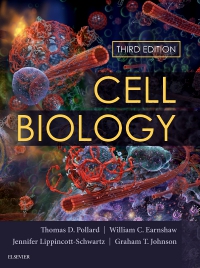
Cell Biology Elsevier eBook on VitalSource, 3rd Edition
by Thomas D. Pollard, MD, William C. Earnshaw, PhD, FRS, Jennifer Lippincott-Schwartz, PhD and Graham Johnson, MA, PhD, CMI
Elsevier eBook on VitalSource
ISBN:
9780323399968
Copyright:
2017
Publication Date:
02-15-2017
Page Count:
908
Imprint:
Elsevier
List Price:
$109.99
Was
$109.99
Now $76.99
Or $0.00 with a valid access code
The much-anticipated 3rd edition of Cell Biology delivers comprehensive, clearly written, and richly illustrated content to today’s students, all in a user-friendly format. Relevant to both research and clinical practice, this rich resource covers key principles of cellular function and uses them to explain how molecular defects lead to cellular dysfunction and cause human disease. Concise text and visually amazing graphics simplify complex information and help readers make the most of their study time.
New Edition Expected Availability: 02-21-2023

-
- Clearly written format incorporates rich illustrations, diagrams, and charts
- Uses real examples to illustrate key cell biology concepts
- Includes beneficial cell physiology coverage
- Clinically oriented text relates cell biology to pathophysiology and medicine
- Takes a mechanistic approach to molecular processes
-
Section 1: Introduction to Cell Biology
1. Introduction to Cells
2. Evolution of Life on Earth
Section 2: Chemical and Physical Background
3. Molecules: Structures and Dynamics
4. Biophysical Principles
5. Macromolecular Assembly
6. Research Strategies
Section 3: Chromatin, Chromosomes, and the Cell Nucleus
7. Chromosome Organization
8. DNA Packaging in Chromatin and Chromosomes
9. Nuclear Structure and Dynamics
Section 4: Central Dogma: From Gene to Protein
10. Gene Expression
11. Eukaryotic RNA Processing
12. Protein Synthesis and Folding
Section 5: Membrane Structure and Function
13. Membrane Structure and Dynamics
14. Membrane Pumps
15. Membrane Carriers
16. Membrane Channels
17. Membrane Physiology
Section 6: Cellular Organelles and Membrane Trafficking
18. Posttranslational Targeting of Proteins
19. Mitochondria, Chloroplasts, Peroxisomes
20. Endoplasmic Reticulum
21. Secretory Membrane System and Golgi Apparatus
22. Endocytosis and the Endosomal Membrane
23. Processing and Degradation of Cellular Components
Section 7: Signaling Mechanisms
24. Plasma Membrane Receptors
25. Protein Hardware for Signaling
26. Second Messengers
27. Integration of Signals
Section 8: Cellular Adhesion and the Extracellular Matrix
28. Cells of the Extracellular Matrix and Immune System
29. Extracellular Matrix Molecules
30. Cellular Adhesion
31. Intercellular Junctions
32. Connective Tissues
Section 9: Cytoskeleton and Cellular Motility
33. Actin and Actin-Binding Proteins
34. Microtubules and Centrosomes
35. Intermediate Filaments
36. Motor Proteins
37. Intracellular Motility
38. Cellular Motility
39. Muscles
Section 10: Cell Cycle
40. Introduction to the Cell Cycle
41. G1 Phase and Regulation of Cell Proliferation
42. S Phase and DNA Replication
43. G2 Phase and Control of Entry into Mitosis
44. Mitosis and Cytokinesis
45. Meiosis
46. Programmed Cell Death -
-
Ways of Reading
- No information about appearance modifiability is available
- All content can be read as read aloud speech or dynamic braille
- Has alternative text descriptions for images
-
Conformance
- The certifier's credential is https://bornaccessible.benetech.org/certified-publishers/
- The publication was certified on 07-04-2026
-
Navigation
- Index with links to referenced entries
- Page list to go to pages from the print source version
-
Rich Content
- Math formulas in accessible format (MathML)
- Chemical formulas in accessible format (MathML)
- Information-rich images are described by extended descriptions
-
Hazards
- The publication contains no hazards
-
Product Content
- Content includes any type of illustrations.
- The primary content is text.
- Content includes a significant number of actionable (clickable) web links to external content, downloadable resources, supplementary material, etc.
- Content includes a significant number of actionable (clickable) cross-references, hyperlinked notes and annotations, or with other actionable links between largely textual elements (e.g., quiz/test questions, 'choose your own ending', etc.).
- Content includes additional textual content such as an interview, feature article, essay, bibliography, quiz/test, other background material, or text that is not included in a primary or 'unenhanced' version.
- Content includes photographs, whether in a plate section / insert or not.
- Content includes figures, diagrams, charts and/or graphs, including other 'mechanical' (i.e. non-photographic) illustrations.
- Content includes animated / interactive illustrations, e.g., animated diagrams, charts, graphs or other illustrations (usually without sound).
- Content includes narrative animation, e.g., cartoon, animatic or CGI animation (usually includes sound).
- Content includes a significant number of web links (printed URLs, QR codes etc.).
- Content includes images displayed in a specific order for the purpose of graphic storytelling or giving information (e.g. graphic novels, comics and manga). May include text integrated into the image (as speech and thought bubbles, textual 'sound' effects, captions etc.).
- Content includes chemical notations, formulae.
- Content includes mathematical notations, formulae.
- At least some text - including text within other images - is 'text as an image' (i.e., a picture of text).
- Product includes actionable (clickable) links to external interactive content.
-
Legal Considerations
- No information is available
-
Additional Accessibility Information
- Content is enhanced with ARIA roles to optimize organization and facilitate navigation
- Page breaks included from the original print source
- The body text is presented with a contrast ratio of at least 4.5:1 (or 3:1 for large/heading text)
- Ultra-high contrast between text and background
- Content provides explanations for unusual words, abbreviations, acronyms, idioms, jargon in an accessible form, such as glossaries, scripted pop-ups.
- Where interactive content is included in the product, controls are provided (e.g., for speed, pause and resume, reset) and labelled to make their use clear.
-
Ways of Reading
Was
$109.99
Now $76.99
Or $0.00 with a valid access code

 as described in our