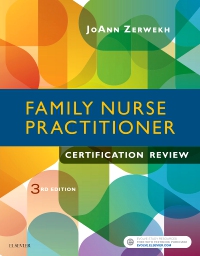

Family Nurse Practitioner Certification Review - Elsevier eBook on VST, 3rd Edition
Elsevier eBook on VitalSource
Ensure that your students are thoroughly prepared for the Family Nursing Practitioner (FNP) certification exam. Family Nurse Practitioner Certification Review, 3rd Edition reflects the latest evidence-based clinical practice and national treatment guidelines and protocols. This comprehensive resource features more than 1,500 high-quality multiple-choice questions with detailed rationales for correct answers. Questions related to patient safety are highlighted with a QSEN safety icon to highlight the graduate-level safety competency of the Quality & Safety Education for Nurses initiative. Also included is a companion Evolve website that provides virtually unlimited, randomly generated practice exams that match the length and question distribution of the actual AANP and ANCC FNP certification exams.
New Edition Expected Availability: 11-10-2020

Family Nurse Practitioner Certification Review Elsevier eBook on VitalSource
-
- NEW! Updated questions throughout review the latest evidence-based clinical practice and national treatment guidelines and protocols to prepare students for the AANP and ANCC FNP certification exams and clinical practice.
- NEW! Questions emphasizing patient safety are highlighted to reinforce the graduate-level safety competency of the Quality & Safety Education for Nurses initiative.
-
- More than 1,500 multiple-choice questions with by detailed rationales help students understand the reasoning behind each answer.
- NEW! Updated questions throughout review the latest evidence-based clinical practice and national treatment guidelines and protocols to prepare students for the AANP and ANCC FNP certification exams and clinical practice.
- NEW! Questions emphasizing patient safety are highlighted to reinforce the graduate-level safety competency of the Quality & Safety Education for Nurses initiative.
- Division of clinical chapters into Physical Examination and Diagnostic Tests, Disorders, and Pharmacology makes it easy for students to locate specific information within each system.
- Chapters on Research and Theory and Professional Issues provide information on professional competencies important to the FNP role.
-
A new Evolve website featuring practice exams with multiple-choice, drag-and-drop, multiple-response, and image-based questions that mirror the format of the FNP certification exams.
-
1. Test-Taking Strategies
2. Growth and Development
3. Health Promotion and Maintenance
4. Cardiovascular
5. Respiratory
6. Immune and Allergy
7. Head, Eyes, Ears, Nose, and Throat (HEENT)
8. Integumentary
9. Endocrine
10. Musculoskeletal
11. Neurology
12. Gastrointestinal and Liver
13. Hematology
14. Renal/Urinary
15. Male Reproductive
16. Female Reproductive
17. Maternity
18. Pediatrics
19. Mental Health
20. Research and Theory
21. Professional Issues
Bibliography
-
-
Ways of Reading
- The appearance of the text and page layout can be modified according to the capabilities of the reading system (font family and font size, spaces between paragraphs, sentences, words, and letters, as well as color of background and text)
- This e-publication is accessible to the full extent that the file format and types of content allow, on a specific reading device, by default, without necessarily including any additions such as textual descriptions of images or enhanced navigation
- No information about nonvisual reading is available
-
Conformance
- No information is available
-
Navigation
- Table of contents to all chapters of the text via links
- Page list to go to pages from the print source version
-
Rich Content
- No information is available
-
Hazards
- No information is available
-
Product Content
- No information is available
-
Legal Considerations
- No information is available
-
Additional Accessibility Information
- Page breaks included from the original print source
- For readers with color vision deficiency, use of color (e.g., in diagrams, graphics and charts, in prompts, or on buttons inviting a response) is not the sole means of graphical distinction or of conveying information
- E-publication includes basic navigation (usually less detailed than TOC-based navigation)
- Where links, controls or buttons are included in the content, the purpose or functionality of each link, control or button is apparent from the associated text alone - or where it is unclear, separate link, control or button descriptions are provided
- All (or substantially all) textual matter is arranged in a single logical reading order (including text that is visually presented as separate from the main text flow, e.g., in boxouts, captions, tables, footnotes, endnotes, citations, etc.). Non-textual content is also linked from within this logical reading order. (Purely decorative non-text content can be ignored).
- The language of the text has been specified (e.g., via the HTML or XML lang attribute) to optimise text-to-speech (and other alternative renderings), both at the whole document level and, where appropriate, for individual words, phrases or passages in a different language.
-
Ways of Reading

 as described in our