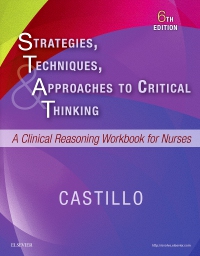

Strategies, Techniques, and Approaches to Critical Thinking - Elsevier eBook on VitalSource, 6th Edition
Elsevier eBook on VitalSource
Help students develop the clinical nursing judgment they need to become safe, competent clinicians! Strategies, Techniques, & Approaches to Critical Thinking: A Clinical Reasoning Workbook for Nurses helps build clinical reasoning skills by walking students step-by-step through the author’s unique, research-based critical thinking model. This straightforward, programmatic approach helps student nurses learn and apply essential knowledge, guiding them through increasingly sophisticated levels of critical thinking, priority-setting, and clinical decision-making. More than 100 true-to-life case studies reflect scenarios commonly encountered in clinical practice. New to this edition is coverage of emerging topics such as QSEN, interprofessional collaboration, and nursing leadership and delegation.
New Edition Expected Availability: 03-15-2021

Strategies, Techniques, and Approaches to Critical Thinking Elsevier eBook on VitalSource
-
- NEW! Expanded coverage of the Safety and Patient-Centered Care competencies of the Quality and Safety Education for Nurses (QSEN) initiative, with distinctive icons highlighting this content.
- NEW and UNIQUE! Coverage of interprofessional collaborative practice includes integration of interactions with other professions into relevant cases (especially in the cases involving leadership), incorporation of the Core Competencies for Interprofessional Collaborative Practice set forth by the Interprofessional Education Collaborative (IPEC), and inclusion of SBAR communication as a tool for interprofessional collaboration.
- NEW! Increased emphasis on delegation, leadership, and collaborative learning promotes professional practice and team-based learning.
- NEW! UPDATED content reflects changes in clinical practice and the latest NCLEX® Examination test plan, featuring new examples of EHR charting, the use of only generic drug names, and the exclusion of medical diagnoses from questions unless absolutely necessary.
-
- NEW! Expanded coverage of the Safety and Patient-Centered Care competencies of the Quality and Safety Education for Nurses (QSEN) initiative, with distinctive icons highlighting this content.
- NEW and UNIQUE! Coverage of interprofessional collaborative practice includes integration of interactions with other professions into relevant cases (especially in the cases involving leadership), incorporation of the Core Competencies for Interprofessional Collaborative Practice set forth by the Interprofessional Education Collaborative (IPEC), and inclusion of SBAR communication as a tool for interprofessional collaboration.
- NEW! Increased emphasis on delegation, leadership, and collaborative learning promotes professional practice and team-based learning.
- UNIQUE! Step-by-step approach builds skills in critical thinking, clinical decision-making, and clinical reasoning, walking students through the author's research-based critical thinking model.
- More than 100 true-to-life cases demonstrate how cases progress and complications arise, helping students develop increasingly sophisticated levels of critical thinking.
- NEW! UPDATED content reflects changes in clinical practice and the latest NCLEX® Examination test plan, featuring new examples of EHR charting, the use of only generic drug names, and the exclusion of medical diagnoses from questions unless absolutely necessary.
- Emphasis on prioritization helps students prepare for nursing practice and for the NCLEX Examination.
- Integrated NCLEX Examination review helps students apply critical thinking skills to test questions and prepares them for the state boards.
- Full instructor version of the text is included on the Evolve companion website, with all answers provided.
-
Section 1: Knowledge Application
Section 2: Priority-Setting and Decision-Making
Section 3: Critical Thinking Model Application
Section 4: Management and Leadership
Section 5: NCLEX Examination Preparation
Section 6: Professional Nursing Practice
Section 7: Evaluation -
-
Ways of Reading
- The appearance of the text and page layout can be modified according to the capabilities of the reading system (font family and font size, spaces between paragraphs, sentences, words, and letters, as well as color of background and text)
- This e-publication is accessible to the full extent that the file format and types of content allow, on a specific reading device, by default, without necessarily including any additions such as textual descriptions of images or enhanced navigation
- No information about nonvisual reading is available
-
Conformance
- The publication was certified on 27-05-2026
-
Navigation
- Table of contents to all chapters of the text via links
- Page list to go to pages from the print source version
-
Rich Content
- No information is available
-
Hazards
- No information is available
-
Product Content
- No information is available
-
Legal Considerations
- No information is available
-
Additional Accessibility Information
- Page breaks included from the original print source
- For readers with color vision deficiency, use of color (e.g., in diagrams, graphics and charts, in prompts, or on buttons inviting a response) is not the sole means of graphical distinction or of conveying information
- E-publication includes basic navigation (usually less detailed than TOC-based navigation)
- Where links, controls or buttons are included in the content, the purpose or functionality of each link, control or button is apparent from the associated text alone - or where it is unclear, separate link, control or button descriptions are provided
- All (or substantially all) textual matter is arranged in a single logical reading order (including text that is visually presented as separate from the main text flow, e.g., in boxouts, captions, tables, footnotes, endnotes, citations, etc.). Non-textual content is also linked from within this logical reading order. (Purely decorative non-text content can be ignored).
- The language of the text has been specified (e.g., via the HTML or XML lang attribute) to optimise text-to-speech (and other alternative renderings), both at the whole document level and, where appropriate, for individual words, phrases or passages in a different language.
-
Ways of Reading

 as described in our