ISBN:
9780323478434
Copyright:
2018
Publication Date:
05-25-2017
Page Count:
784
Imprint:
Saunders
List Price:
$93.99

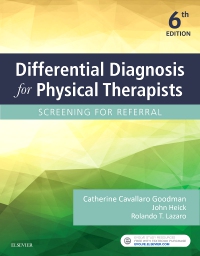
Differential Diagnosis for Physical Therapists - Elsevier eBook on VitalSource, 6th Edition
by Catherine Cavallaro Kellogg, MBA, PT, CBP, John Heick and Rolando T. Lazaro
Elsevier eBook on VitalSource
ISBN:
9780323478434
Copyright:
2018
Publication Date:
05-25-2017
Page Count:
784
Imprint:
Saunders
List Price:
$93.99
Most review copies are eBooks – how fast!
A review copy request is most likely to be fulfilled as an eBook on VitalSource rather than a print product, unless no eBook is available. eBooks become available in as little as a few hours. Print products will take between 7 and 10 days to arrive. To request a print copy, please contact us through the Evolve Support Center for further assistance or contact your Elsevier Sales Rep.
Show your PT students how to screen for red flags and when to refer clients to a medical specialist. Differential Diagnosis for Physical Therapists, 6th Edition provides a step-by-step approach to screening for possible systemic disease and medical conditions that can mimic neuromuscular and musculoskeletal problems. It describes both red flags and yellow flags, so students can recognize the signs and symptoms for conditions that may be outside the scope of physical therapy practice. This edition includes new information on women’s health issues. Reviewing this text will facilitate success on the differential diagnosis section of the licensure exam!
New Edition Expected Availability: 07-12-2022

Goodman and Snyder’s Differential Diagnosis for Physical Therapists - Elsevier eBook on VitalSource
Elsevier eBook on VitalSource
ISBN: 9780323833714
-
- New content on women’s health expands coverage of this important topic
- UPDATES reflect the most current information on screening for referral
- New associate editors — John Heick and Rolando Lazaro — bring fresh insight, as respected physical therapy educators
- New! Color tabs make it easier to locate chapters and topics
-
- New content on women’s health contributed by Beth Shelly expands coverage of this important topic.
- New associate editors — John Heick and Rolando Lazaro — bring fresh insight, as respected physical therapy educators.
- UPDATES reflect the most current information on screening for referral.
- UNIQUE! Five-step screening model is systems- and symptoms-based, and follows the standards for competency established by the American Physical Therapy Association, covering past medical history, risk factor assessment, clinical presentation, associated signs and symptoms, and review of symptoms.
- UNIQUE! Case examples and case studies are based on clinical experience and give real-world examples of how to integrate screening information into the diagnostic process and when to treat or refer.
- Evidence for the screening process is based on peer-reviewed literature, reporting on the sensitivity, specificity, and likelihood ratios of yellow (cautionary) and red (warning) flags.
- Key Points to Remember boxes at the end of each chapter provide quick, bulleted summaries of critical information.
- Screening tools and checklists are found in the book and on the Evolve website, and are downloadable and printable for use in the clinic.
- New! Color tabs make it easier to locate chapters and topics.
- Student-friendly features include tables, boxes, follow-up questions, clinical signs and symptoms, and case examples, each highlighted for quick reference.
- Quick response (QR) codes that can be scanned on a smartphone, tablet, or other mobile device link readers to valuable screening tools such as lists of questions for screening specific problems, checklists, intake forms, and assessment tests.
-
Section One: Introduction to the Screening Process
1. Introduction to Screening for Referral in Physical Therapy
2. Interviewing as a Screening Tool
3. Pain Types and Viscerogenic Pain Patterns
4. Physical Assessment as a Screening Tool
Section Two: Viscerogenic Causes of Neuromusculoskeletal Pain and Dysfunction
5. Screening for Hematologic Disease
6. Screening for Cardiovascular Disease
7. Screening for Pulmonary Disease
8. Screening for Gastrointestinal Disease
9. Screening for Hepatic and Biliary Disease
10. Screening for Urogenital Disease
11. Screening for Endocrine and Metabolic Disease
12. Screening for Immunologic Disease
13. Screening for Cancer
Section Three: Systemic Origins of Neuromusculoskeletal Pain and Dysfunction
14. Screening the Head, Neck, and Back
15. Screening the Sacrum, Sacroiliac, and Pelvis
16. Screening the Lower Quadrant: Buttock, Hip, Thigh, Groin, and Leg
17. Screening the Chest, Breasts, and Ribs
18. Screening the Shoulder and Upper Extremity -
-
Ways of Reading
- The appearance of the text and page layout can be modified according to the capabilities of the reading system (font family and font size, spaces between paragraphs, sentences, words, and letters, as well as color of background and text)
- This e-publication is accessible to the full extent that the file format and types of content allow, on a specific reading device, by default, without necessarily including any additions such as textual descriptions of images or enhanced navigation
- No information about nonvisual reading is available
-
Conformance
- The publication was certified on 27-05-2026
-
Navigation
- Table of contents to all chapters of the text via links
- Page list to go to pages from the print source version
-
Rich Content
- No information is available
-
Hazards
- No information is available
-
Product Content
- No information is available
-
Legal Considerations
- No information is available
-
Additional Accessibility Information
- Page breaks included from the original print source
- For readers with color vision deficiency, use of color (e.g., in diagrams, graphics and charts, in prompts, or on buttons inviting a response) is not the sole means of graphical distinction or of conveying information
- E-publication includes basic navigation (usually less detailed than TOC-based navigation)
- Where links, controls or buttons are included in the content, the purpose or functionality of each link, control or button is apparent from the associated text alone - or where it is unclear, separate link, control or button descriptions are provided
- All (or substantially all) textual matter is arranged in a single logical reading order (including text that is visually presented as separate from the main text flow, e.g., in boxouts, captions, tables, footnotes, endnotes, citations, etc.). Non-textual content is also linked from within this logical reading order. (Purely decorative non-text content can be ignored).
- The language of the text has been specified (e.g., via the HTML or XML lang attribute) to optimise text-to-speech (and other alternative renderings), both at the whole document level and, where appropriate, for individual words, phrases or passages in a different language.
-
Ways of Reading
Most review copies are eBooks – how fast!
A review copy request is most likely to be fulfilled as an eBook on VitalSource rather than a print product, unless no eBook is available. eBooks become available in as little as a few hours. Print products will take between 7 and 10 days to arrive. To request a print copy, please contact us through the Evolve Support Center for further assistance or contact your Elsevier Sales Rep.

 as described in our