ISBN:
9780323484275
Copyright:
2018
Publication Date:
06-01-2017
Page Count:
336
Imprint:
Mosby
List Price:
$66.99

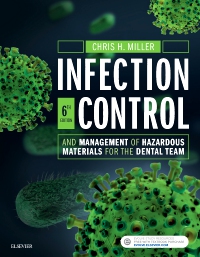
Infection Control and Management of Hazardous Materials for the Dental Team - Elsevier eBook on VitalSource, 6th Edition
by Chris H. Miller, BA, MS, PhD
Elsevier eBook on VitalSource
ISBN:
9780323484275
Copyright:
2018
Publication Date:
06-01-2017
Page Count:
336
Imprint:
Mosby
List Price:
$66.99
Most review copies are eBooks – how fast!
A review copy request is most likely to be fulfilled as an eBook on VitalSource rather than a print product, unless no eBook is available. eBooks become available in as little as a few hours. Print products will take between 7 and 10 days to arrive. To request a print copy, please contact us through the Evolve Support Center for further assistance or contact your Elsevier Sales Rep.
Emphasizing patient safety and disease prevention in the dental office, Infection Control and Management of Hazardous Materials for the Dental Team, 6th Edition, is a go-to text for all members of the dental team. With discussions ranging from microbiology concepts to protocols for clinical asepsis, this comprehensive, highly practical text features the most up-to-date regulatory recommendations as well as new chapters on patient safety preparation and infection control breaches. Step-by-step instructions make it easy for students to perform safety procedures and use the supplies and equipment needed to prevent the spread of infectious disease, and new case scenarios present opportunities for critical thinking and application.
New Edition Expected Availability: 11-25-2021

Infection Control and Management of Hazardous Materials for the Dental Team - Elsevier eBook on VitalSource
Elsevier eBook on VitalSource
ISBN: 9780323764940
-
- NEW! Updated content based on the CDC’s Summary of Infection Prevention Practices in Dental Settings, which includes additional topics and information to augment the 2003 Guidelines for Infection Control in Dental Health-Care Settings
- NEW! Two new chapters cover preparing for patient safety (focusing on training for dental personnel) and infection control breaches within dental offices
- NEW! Case scenarios added to specific chapters examine an infection control incident, along with its potential consequences, possible preventive measures, and related recommendations and regulations
- NEW and EXPANDED! Additional full-color images focus on disease states, disease transfer, and safety culture, helping improve teaching and learning
-
- NEW! Updated content based on the CDC’s Summary of Infection Prevention Practices in Dental Settings, which includes additional topics and information to augment the 2003 Guidelines for Infection Control in Dental Health-Care Settings.
- NEW! Two new chapters cover preparing for patient safety (focusing on training for dental personnel) and infection control breaches within dental offices
- NEW! Case scenarios added to specific chapters examine an infection control incident, along with its potential consequences, possible preventive measures, and related recommendations and regulations
- NEW and EXPANDED! Additional full-color images focus on disease states, disease transfer, and safety culture, enhancing both teaching and learning
- Comprehensive coverage looks at infection control and prevention from the perspective of all dental team members
- Easy-to-follow, step-by-step procedures are provided for skills that dental team members must master, each presented with a goal, materials, chronological steps, and rationales for the performance of each step
- Review questions ensure students’ comprehension of the material and provide practice for classroom and board examinations, with 10 to 20 multiple-choice questions at the end of each chapter
- Key terms begin each chapter and are highlighted within text discussions and defined in a back-of-book glossary
- Resources on the Evolve companion website include lesson plans, PowerPoint presentations, and answer keys for instructors and review questions for students to supplement the core text presentations, ease the work of teaching, and enhance learning
- Trusted author and oral biology and infection control expert, Chris Miller, delivers the most up-to-date content needed to ensure patient safety and clinical competence within the dental office
- A highly approachable writing style makes this text a trusted educational tool, as well as a refresher on infection control
- Logically organized into three parts with brief chapters that move from foundational biology through specific areas of infection control and application to a dental office
- Eight practical appendices offer easy access to the most significant regulatory agency rules and recommendations for infection control
- Chapter objectives help students set goals for what they will accomplish, and serve as checkpoints for comprehension and study tools in preparation for examinations
- Summary tables and boxes make study easier by highlighting key concepts and procedures and serve as useful review tools
-
PART 1: The Microbial World
1. Scope of Microbiology and Infection Control
2. Characteristics of Microorganisms
3. Development of Infectious Diseases
4. Emerging Diseases
5. Oral Microbiology and Plaque-Associated Diseases
PART 2: Infection Control
6. Blood-Borne Pathogens
7. Oral and Respiratory Diseases
8. Infection Control Rationale and Regulations
9. NEW! Preparing for Patient Safety and Occupational Health
10. Immunizations
11. Hand Hygiene
12. Personal Protective Barriers
13. Instrument Processing
14. Surface and Equipment Asepsis
15. Dental Unit Water Asepsis and Air Quality
16. Aseptic Techniques
17. Laboratory and Radiographic Asepsis
18. Waste Management
19. Prevention of Sharps Injuries
20. A Clinical Asepsis Protocol
21. General Office Asepsis
22. Greener Infection Control
23. Home Hygiene
PART 3: Office Safety
24. Occupational Safety and Health Administration
25. OSHA Inspections
26. Management of the Office Safety Program
27. Managing Chemicals Safely
28. Employee Fire Prevention and Emergency Action Plans
29. Infection Control Concerns during Remodeling and Construction
30. NEW! Infection Control Breaches and Disease Transmissions in Dental Facilities
Appendix A: Resource List
Appendix B: CDC Guidelines for Infection Control in Dental Health-Care Settings
Appendix C: CDC Guidelines for Prevention of Tuberculosis in Dental Settings
Appendix D: Organization for Safety, Asepsis and Prevention (OSAP)
Appendix E: Exposure Incident Report
Appendix F: Infection Control and the American Dental Association
Appendix G: The Occupational Safety and Health Administration Bloodborne Pathogen Standard
Appendix H: The Occupational Safety and Health Administration Hazard Communication Standard
Glossary
Index -
-
Ways of Reading
- The appearance of the text and page layout can be modified according to the capabilities of the reading system (font family and font size, spaces between paragraphs, sentences, words, and letters, as well as color of background and text)
- This e-publication is accessible to the full extent that the file format and types of content allow, on a specific reading device, by default, without necessarily including any additions such as textual descriptions of images or enhanced navigation
- No information about nonvisual reading is available
-
Conformance
- The publication was certified on 27-05-2026
-
Navigation
- Table of contents to all chapters of the text via links
- Page list to go to pages from the print source version
-
Rich Content
- No information is available
-
Hazards
- No information is available
-
Product Content
- No information is available
-
Legal Considerations
- No information is available
-
Additional Accessibility Information
- Page breaks included from the original print source
- For readers with color vision deficiency, use of color (e.g., in diagrams, graphics and charts, in prompts, or on buttons inviting a response) is not the sole means of graphical distinction or of conveying information
- E-publication includes basic navigation (usually less detailed than TOC-based navigation)
- Where links, controls or buttons are included in the content, the purpose or functionality of each link, control or button is apparent from the associated text alone - or where it is unclear, separate link, control or button descriptions are provided
- All (or substantially all) textual matter is arranged in a single logical reading order (including text that is visually presented as separate from the main text flow, e.g., in boxouts, captions, tables, footnotes, endnotes, citations, etc.). Non-textual content is also linked from within this logical reading order. (Purely decorative non-text content can be ignored).
- The language of the text has been specified (e.g., via the HTML or XML lang attribute) to optimise text-to-speech (and other alternative renderings), both at the whole document level and, where appropriate, for individual words, phrases or passages in a different language.
-
Ways of Reading
Most review copies are eBooks – how fast!
A review copy request is most likely to be fulfilled as an eBook on VitalSource rather than a print product, unless no eBook is available. eBooks become available in as little as a few hours. Print products will take between 7 and 10 days to arrive. To request a print copy, please contact us through the Evolve Support Center for further assistance or contact your Elsevier Sales Rep.

 as described in our