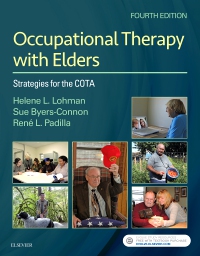

Occupational Therapy with Elders - Elsevier eBook on VitalSource, 4th Edition
Elsevier eBook on VitalSource
Give your COTA students the smart foundation they need to successfully work with older adults. Occupational Therapy with Elders: Strategies for the COTA, 4th Edition is the only comprehensive book on geriatric occupational therapy designed specifically for the certified occupational therapy assistant. It provides in-depth coverage of each aspect of geriatric practice — from wellness and prevention to death and dying. Expert authors Helene Lohman, Sue Byers-Connon, and René Padilla, offer an unmatched discussion of diverse populations and the latest on geriatric policies and procedures in this fast-growing area of practice. Students will come away with a strong foundation in aging trends and strategies for elder care in addition to having a deep understanding of emerging areas such as low-vision rehabilitation, driving and mobility issues, Alzheimer’s disease and other forms of dementia, new technological advancements, health literacy, public policy, dignity therapy, and more. Plus, they will benefit from 20 additional evidence briefs and numerous case studies to help apply all the information they learn to real-life practice. It’s the focused, evidence-based, and client-centered approach that your OTA students need to effectively care for today’s elder patients.
New Edition Expected Availability: 02-08-2023

Occupational Therapy with Older Adults - Elsevier eBook on VitalSource
-
- NEW! 20 Additional evidence briefs have been added to reinforce this book’s evidence-based client-centered approach
- NEW! Incorporation of EMR prevalence and telehealth as a diagnostic and monitoring tool have been added throughout this new edition
- NEW! Expanded content on mild cognitive impairment, health literacy, and chronic conditions have been incorporated throughout the book to reflect topical issues commonly faced by OTs and OTAs today
- NEW! Coverage of technological advancements has been incorporated in the chapter on sensory impairments
- NEW! Other updated content spans public policy, HIPAA, power of attorney, advanced directives, alternative treatment settings, dignity therapy, and validation of the end of life
- NEW! Merged chapters on vision and hearing impairments create one sensory chapter that offers a thorough background in both areas
-
- NEW! 20 Additional evidence briefs have been added to reinforce this book’s evidence-based client-centered approach
- NEW! Coverage of technological advancements has been incorporated in the chapter on sensory impairments
- NEW! Incorporation of EMR prevalence and telehealth as a diagnostic and monitoring tool have been added throughout this new edition
- NEW! Merged chapters on vision and hearing impairments create one sensory chapter that offers a thorough background in both areas
- NEW! Expanded content on mild cognitive impairment, health literacy, and chronic conditions have been incorporated throughout the book to reflect topical issues commonly faced by OTs and OTAs today
- NEW! Updated teaching assets include end-of-chapter review questions, case studies, glossary and its related exercises
- NEW! Updated content spans public policy, HIPAA, power of attorney, advanced directives, alternative treatment settings, dignity therapy, and validation of the end of life
- UNIQUE! Focus on the occupational therapy assistant highlights the importance of COTAs to the care of elder clients
- Unique! Attention to diverse populations and cultures addresses how to respect and care for clients of different backgrounds
- UNIQUE! Discussion of elder abuse, battered women, and literacy includes information on how the OTA can address these issues that are often overlooked
- Instructor resources on Evolve include a test bank, image collection and lecture slides.
- Learning activities on Evolve give students a chance to review what they have learned and assess their comprehension
- Case studies at the end of certain chapters illustrate help students understand the content as it relates to real-life situations
- Multidisciplinary approach demonstrates the importance of collaboration between the OT and OTA by highlights the OTA’s role in caring for the elderly and how they work in conjunction with occupational therapists
- Key terms, chapter objectives, and review questions are found in each chapter to help identify what information is most important
-
Section One: Concepts of Aging
1. Aging trends and concepts
2. Biological and social theories of aging
3. The Aging process
4. Psychological aspects of aging
5. Aging well: health promotion and disease prevention
6. The regulation of public policy for elders
Section Two: Occupational Therapy Intervention with Elders
7. Occupational therapy practice models
8. Opportunities for best practice in various settings
9. Cultural diversity of the aging population
10. Ethical aspects in the work with elders
11. Working with families and caregivers of elders
12. Addressing sexual activity of elders
13. Use of medications by elders
14. Considerations of Mobility
Part 1: Restraint reduction
Part 2: Wheelchair seating and positioning
Part 3: Fall prevention
Part 4: Community mobility
15. Working with elders who have vision impairments
16. Working with elders who have hearing impairments
17. Strategies to maintain continence in elders
18. Dysphagia and other eating and nutritional concerns with elders
19. Working with elders who have had cerebrovascular accidents
20. Working with elders who have dementia and Alzheimer's disease
21. Working with elders who have psychiatric conditions
22. Working with elders who have orthopedic conditions
23. Working with elders who have cardiovascular conditions
24. Working with elders who have pulmonary conditions
25. Working with elders who have oncological conditions -
-
Ways of Reading
- The appearance of the text and page layout can be modified according to the capabilities of the reading system (font family and font size, spaces between paragraphs, sentences, words, and letters, as well as color of background and text)
- This e-publication is accessible to the full extent that the file format and types of content allow, on a specific reading device, by default, without necessarily including any additions such as textual descriptions of images or enhanced navigation
- No information about nonvisual reading is available
-
Conformance
- The publication was certified on 27-05-2026
-
Navigation
- Table of contents to all chapters of the text via links
- Page list to go to pages from the print source version
-
Rich Content
- No information is available
-
Hazards
- No information is available
-
Product Content
- No information is available
-
Legal Considerations
- No information is available
-
Additional Accessibility Information
- Page breaks included from the original print source
- For readers with color vision deficiency, use of color (e.g., in diagrams, graphics and charts, in prompts, or on buttons inviting a response) is not the sole means of graphical distinction or of conveying information
- E-publication includes basic navigation (usually less detailed than TOC-based navigation)
- Where links, controls or buttons are included in the content, the purpose or functionality of each link, control or button is apparent from the associated text alone - or where it is unclear, separate link, control or button descriptions are provided
- All (or substantially all) textual matter is arranged in a single logical reading order (including text that is visually presented as separate from the main text flow, e.g., in boxouts, captions, tables, footnotes, endnotes, citations, etc.). Non-textual content is also linked from within this logical reading order. (Purely decorative non-text content can be ignored).
- The language of the text has been specified (e.g., via the HTML or XML lang attribute) to optimise text-to-speech (and other alternative renderings), both at the whole document level and, where appropriate, for individual words, phrases or passages in a different language.
-
Ways of Reading

 as described in our