ISBN:
9780323529334
Copyright:
2019
Publication Date:
10-11-2018
Page Count:
560
Imprint:
Mosby
List Price:
$77.99

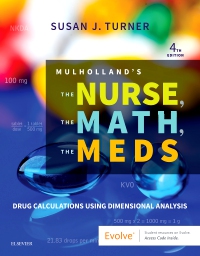
Mulholland's The Nurse, The Math, The Meds - Elsevier eBook on VitalSource, 4th Edition
by Susan Turner, RN, MSN, FNP
Elsevier eBook on VitalSource
ISBN:
9780323529334
Copyright:
2019
Publication Date:
10-11-2018
Page Count:
560
Imprint:
Mosby
List Price:
$77.99
Most review copies are eBooks – how fast!
A review copy request is most likely to be fulfilled as an eBook on VitalSource rather than a print product, unless no eBook is available. eBooks become available in as little as a few hours. Print products will take between 7 and 10 days to arrive. To request a print copy, please contact us through the Evolve Support Center for further assistance or contact your Elsevier Sales Rep.
Teach the simplicity of the dimensional analysis method for accurate drug calculations! Mulholland’s The Nurse, The Math, The Meds, 4th Edition helps students overcome any math anxiety they may have by clearly explaining how to use dimensional analysis to minimize drug calculation errors. It shows how to analyze and set up problems, estimate a reasonable answer, and then evaluate the answer for accuracy. But first, a review of basic math provides a refresher of essential math skills. The only Elsevier text to exclusively teach the dimensional analysis method, Mulholland’s includes plenty of practice exercises to give students a full understanding of this popular drug calculation technique.
New Edition Expected Availability: 08-30-2022

Mulholland’s The Nurse, The Math, The Meds Elsevier eBook on VitalSource
Elsevier eBook on VitalSource
ISBN: 9780323792035
-
- NEW and Updated! Safety-related procedures and protocols include the newest ISMP, JCAHO, and QSEN safety standards and new content on drug calculations
- NEW and Updated! Photos and medication labels ensure that you are up to date on today’s medications
- NEW! SBAR information describes Situation, Background, Assessment, Recommendation in Metric Units and Conversions chapter
- NEW information on health care provider orders is added to Oral Medications chapter
- NEW table of insulins and their uses is included in Antidiabetic Medications chapter
- NEW content on thrombolytics, clotting inhibitors, anti-platelet aggregants, and herbal supplements is included in Anticoagulant Medications chapter
-
- NEW and Updated! Safety-related procedures and protocols include the newest ISMP, JCAHO, and QSEN safety standards and clarified instructions on drug calculations
- NEW and Updated! Photos and medication labels ensure students are up to date on today’s medications
- NEW! SBAR information describes Situation, Background, Assessment, Recommendation in Metric Units and Conversions chapter
- NEW information on health care provider orders is added to Oral Medications chapter
- NEW table of insulins and their uses is included in Antidiabetic Medications chapter
- NEW content on thrombolytics, clotting inhibitors, anti-platelet aggregants, and herbal supplements is included in Anticoagulant Medications chapter
- UNIQUE! Useful FAQs and answers in each chapter are based on years of classroom questions compiled by the author
- UNIQUE! Communication boxes show sample nurse-patient and nurse-prescriber dialogues, relating the math to the medications and to clinical application
- UNIQUE! Ask Yourself questions help students synthesize information and reinforce their comprehension
- Rapid Practice quizzes provide practice problems following each new topic, making it easy for students to master both math concepts and drug calculation at the same time
- Mnemonics offer shortcuts to make memorization easier, and save time in learning
- Red arrow alerts call attention to potential math errors and patient safety issues
- High-risk drug icons are used to highlight potentially dangerous drugs
- Multiple choice-format questions at the end of each chapter help students review concepts and prepare for the NCLEX® exam
- Chapter finals boost student understanding by providing additional practice with the major concepts covered in each chapter; the answer key shows how to work out the problems
- Comprehensive final practice boosts student understanding by providing additional practice with the major concepts covered through the entire text; the answer key shows how to work out the problems
-
Part I: Math Review
Math Self-Assessment
1. Math Review
2. Dimensional Analysis Method
Part II: Metric System and Medication Calculations
3. Metric Units and Conversions
4. Patient Records, Medication Orders, and Medication Labels
Part III: Reconstituted Medications
5. Oral Medications
6. Syringes for Injection
7. Reconstitution of Medication
Part IV: Parenteral Medications
8. Injectable Medications
9. Basic Intravenous Calculations
10. Advanced Intravenous Calculations
Part V: Common High Alert Medications
11. Antidiabetic Medications
12. Anticoagulant Medications
Part VI: Medications for Infants and Children
13. Pediatric Medication
Comprehensive Final Practice
Appendix A: TJC Do Not Use List
Appendix B: ISMP’s List of High-Alert Medications
Appendix C: 5-Minute Sample Verbal Communication Hand-Off Report
Appendix D: Sample Medication Administration Errors and Potential Clinical Outcomes
Appendix E: Apothecary System and Household Measurements -
-
Ways of Reading
- The appearance of the text and page layout can be modified according to the capabilities of the reading system (font family and font size, spaces between paragraphs, sentences, words, and letters, as well as color of background and text)
- This e-publication is accessible to the full extent that the file format and types of content allow, on a specific reading device, by default, without necessarily including any additions such as textual descriptions of images or enhanced navigation
- No information about nonvisual reading is available
-
Conformance
- The publication was certified on 27-05-2026
-
Navigation
- Table of contents to all chapters of the text via links
- Page list to go to pages from the print source version
-
Rich Content
- No information is available
-
Hazards
- No information is available
-
Product Content
- No information is available
-
Legal Considerations
- No information is available
-
Additional Accessibility Information
- Page breaks included from the original print source
- For readers with color vision deficiency, use of color (e.g., in diagrams, graphics and charts, in prompts, or on buttons inviting a response) is not the sole means of graphical distinction or of conveying information
- E-publication includes basic navigation (usually less detailed than TOC-based navigation)
- Where links, controls or buttons are included in the content, the purpose or functionality of each link, control or button is apparent from the associated text alone - or where it is unclear, separate link, control or button descriptions are provided
- All (or substantially all) textual matter is arranged in a single logical reading order (including text that is visually presented as separate from the main text flow, e.g., in boxouts, captions, tables, footnotes, endnotes, citations, etc.). Non-textual content is also linked from within this logical reading order. (Purely decorative non-text content can be ignored).
- The language of the text has been specified (e.g., via the HTML or XML lang attribute) to optimise text-to-speech (and other alternative renderings), both at the whole document level and, where appropriate, for individual words, phrases or passages in a different language.
-
Ways of Reading

Most review copies are eBooks – how fast!
A review copy request is most likely to be fulfilled as an eBook on VitalSource rather than a print product, unless no eBook is available. eBooks become available in as little as a few hours. Print products will take between 7 and 10 days to arrive. To request a print copy, please contact us through the Evolve Support Center for further assistance or contact your Elsevier Sales Rep.

 as described in our