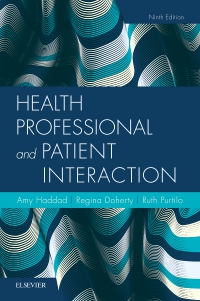

Health Professional and Patient Interaction Elsevier eBook on VitalSource, 9th Edition
Elsevier eBook on VitalSource
Now $65.69
Easily navigate through the complicated and challenging world of daily on-the-job human interactions, with Health Professional and Patient Interaction, 9th Edition. Covering strategies for effective communication, this time-tested guide offers the tools you need to establish positive patient and interprofessional relationships built on respect. It not only covers respectful actions and good decision-making, but also demonstrates how those decisions directly shape your on-the-job success. Practical examples and authentic scenarios highlight how to apply respect and professionalism to coworkers and patients of various ages and various backgrounds across a wide spectrum of healthcare environments. It’s the foundation you need to effectively and successfully communicate on the job.
New Edition Expected Availability: 05-23-2023

Health Professional and Patient Interaction - Elsevier eBook on VitalSource
-
- UNIQUE! New chapter on respectful interprofessional collaboration and communication discusses best practices for respectfully interacting with one’s coworkers across the professional health team
- NEW & UNIQUE! Clearer integration of respect throughout the text underscores its necessity across the many different types of interactions between the health professional and patient
- NEW! Introduction on how respect impacts a professional’s practice has been added to Part One of the text and covers critical topics such as establishing a professional identity and creating healthy, respectful relationships while being mindful of boundaries within such relationships
- NEW! Updated photos feature health professionals engaged in authentic clinical activities
-
- Overall emphasis on respect sets up a basis for building positive relationships with patients and fellow health professionals through good decision-making
- UNIQUE! Authentic scenarios and examples demonstrate strategies and tools for effective communication with patients of all ages in a wide range of health care settings
- UNIQUE! Interdisciplinary approach addresses issues that apply to many different healthcare disciplines to help you identify with your specific field as well as recognize themes that apply across the healthcare spectrum
- Authentic patient cases give you a more personal connection as to how the various communications and actions discussed in the text affect the patient
- Reflections Questions throughout the text challenge you to apply critical thinking skills and your personal experience to different scenarios
- Questions for Thought and Discussion at the end of each section help you apply your knowledge to a variety of situations
-
SECTION ONE: Creating a Context of Respect
1. Respect in the Professional Role
2. Professional Relatedness Built on Respect
3. Professional Boundaries Guided by Respect
SECTION TWO: Respectful Interaction in the Delivery of Care
4. Respect for Self: One’s Professional Role
5. Respect in a Diverse Society
6. Respect in Care Delivery Systems
SECTION THREE: Respect for the Patient’s Situation
7. Respecting the Patient’s Story
8. Respect for the Patient’s Family and Significant Relationships
SECTION FOUR: Respect through Communication
9. Respectful Interprofessional Communication
10. Respectful Communication in an Information Age
SECTION FIVE: Respectful Interactions Across the Life Span
11. Respectful Interaction: Working with Newborns, Infants, and Children in the Early Years
12. Respectful Interaction: Working with School Age Children and Adolescents
13. Respectful Interaction: Working with Adults
14. Respectful Interaction: Working with Older Adults
SECTION SIX: Some Special Challenges: Creating a Context of Respect
15. Respectful Interaction When the Patient Is Dying
16. Respectful Interaction in Complex Situations -
-
Ways of Reading
- The appearance of the text and page layout can be modified according to the capabilities of the reading system (font family and font size, spaces between paragraphs, sentences, words, and letters, as well as color of background and text)
- This e-publication is accessible to the full extent that the file format and types of content allow, on a specific reading device, by default, without necessarily including any additions such as textual descriptions of images or enhanced navigation
- No information about nonvisual reading is available
-
Conformance
- The publication was certified on 27-05-2026
-
Navigation
- Table of contents to all chapters of the text via links
- Page list to go to pages from the print source version
-
Rich Content
- No information is available
-
Hazards
- No information is available
-
Product Content
- No information is available
-
Legal Considerations
- No information is available
-
Additional Accessibility Information
- Page breaks included from the original print source
- For readers with color vision deficiency, use of color (e.g., in diagrams, graphics and charts, in prompts, or on buttons inviting a response) is not the sole means of graphical distinction or of conveying information
- E-publication includes basic navigation (usually less detailed than TOC-based navigation)
- Where links, controls or buttons are included in the content, the purpose or functionality of each link, control or button is apparent from the associated text alone - or where it is unclear, separate link, control or button descriptions are provided
- All (or substantially all) textual matter is arranged in a single logical reading order (including text that is visually presented as separate from the main text flow, e.g., in boxouts, captions, tables, footnotes, endnotes, citations, etc.). Non-textual content is also linked from within this logical reading order. (Purely decorative non-text content can be ignored).
- The language of the text has been specified (e.g., via the HTML or XML lang attribute) to optimise text-to-speech (and other alternative renderings), both at the whole document level and, where appropriate, for individual words, phrases or passages in a different language.
-
Ways of Reading

 as described in our