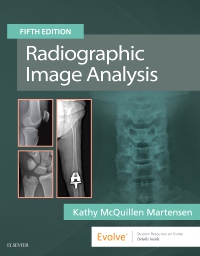

Radiographic Image Analysis Elsevier E-Book on VitalSource, 5th Edition
Elsevier eBook on VitalSource
Now $93.59
Learn to produce quality radiographs on the first try with Radiographic Image Analysis, 5th Edition. This updated, user-friendly text reflects the latest ARRT guidelines and revamped chapters to reflect the latest digital technology. Chapters walk you through the steps of how to carefully evaluate an image, how to identify the improper positioning or technique that caused a poor image, and how to correct the problem. For each procedure, there is a diagnostic-quality radiograph along with several examples of unacceptable radiographs, a complete list of radiographic evaluation guidelines, and detailed discussions on how each of the evaluation points is related to positioning and technique. It’s everything you need to critically think, evaluate, and ultimately produce the best possible diagnostic quality radiographs.
New Edition Expected Availability: 01-18-2024

Radiographic Image Analysis - Elsevier E-Book on VitalSource
-
- NEW! Updated content reflects the latest ARRT guidelines
- NEW! Revamped sections on digital imagery within pediatric, obesity, and trauma situations incorporate the latest technology
- NEW! Additional images offer further visual guidance to help you better critique and correct positioning errors
- NEW! More robust digital halftones throughout images paint a clearer picture of proper technique
-
- Chapter objectives, key terms, and outlines reinforce what is most important in every chapter
- Bold and defined key terms at first mention in the text ensure that you understand the terms from the start of when they are used in discussions
- Expanded glossary serves as a quick reference and study tool
- Two-color text design makes it easier to read and retain pertinent information
-
-
 Workbook for Radiographic Image Analysis Elsevier eBook on VitalSourceElsevier eBook on VitalSource
 -

-
-
1. Guidelines for Image Analysis
2. Visibility of Details
3. Image Analysis of the Chest and Abdomen
4. Image Analysis of the Upper Extremity
5. Image Analysis of the Shoulder
6. Image Analysis of the Lower Extremity
7. Image Analysis of the Hip and Pelvis
8. Image Analysis of the Cervical and Thoracic Vertebrae
9. Image Analysis of the Lumbar Vertebrae, Sacrum, and Coccyx
10. Image Analysis of the Sternum and Ribs
11. Image Analysis of the Cranium
12. Image Analysis of the Digestive System -
-
Ways of Reading
- The appearance of the text and page layout can be modified according to the capabilities of the reading system (font family and font size, spaces between paragraphs, sentences, words, and letters, as well as color of background and text)
- This e-publication is accessible to the full extent that the file format and types of content allow, on a specific reading device, by default, without necessarily including any additions such as textual descriptions of images or enhanced navigation
- No information about nonvisual reading is available
-
Conformance
- No information is available
-
Navigation
- Table of contents to all chapters of the text via links
- Page list to go to pages from the print source version
-
Rich Content
- No information is available
-
Hazards
- No information is available
-
Product Content
- No information is available
-
Legal Considerations
- No information is available
-
Additional Accessibility Information
- Page breaks included from the original print source
- For readers with color vision deficiency, use of color (e.g., in diagrams, graphics and charts, in prompts, or on buttons inviting a response) is not the sole means of graphical distinction or of conveying information
- E-publication includes basic navigation (usually less detailed than TOC-based navigation)
- Where links, controls or buttons are included in the content, the purpose or functionality of each link, control or button is apparent from the associated text alone - or where it is unclear, separate link, control or button descriptions are provided
- All (or substantially all) textual matter is arranged in a single logical reading order (including text that is visually presented as separate from the main text flow, e.g., in boxouts, captions, tables, footnotes, endnotes, citations, etc.). Non-textual content is also linked from within this logical reading order. (Purely decorative non-text content can be ignored).
- The language of the text has been specified (e.g., via the HTML or XML lang attribute) to optimise text-to-speech (and other alternative renderings), both at the whole document level and, where appropriate, for individual words, phrases or passages in a different language.
-
Ways of Reading

 as described in our