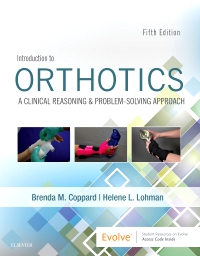

Introduction to Orthotics - Elsevier E-book on VitalSource, 5th Edition
Elsevier eBook on VitalSource
Now $85.49
Develop the critical thinking skills you need to choose and fit effective orthoses for patients with hand injuries and functional deficits. As a combination workbook/textbook, Introduction to Orthotics, 5th Edition uses reader friendly language to cover the theory, design, and fabrication of orthopedic devices. Ideal for use in the classroom or in the clinical setting, it emphasizes upper extremity versus hand orthoses, with additional coverage of lower extremity orthotics and upper extremity prosthetics, and offers case studies promoting clinical reasoning and problem solving as well as an occupation-based approach. This new edition also demonstrates the fine detail of orthotics and equips you with a repertoire of skills and knowledge related to orthoses.
-
- NEW! chapter covering Casting techniques provides guidance regarding current advances
- NEW! Chapter for Professional Issues Related to Orthotic Provision
- NEW! Elbow, Forearm, and Shoulder Immobilization Orthoses expands the content that previously only addressed elbow and forearm orthoses to include shoulder immobilization orthoses
- NEW! Photos and illustrations for pre-fabrication, fitting, and fabrication techniques appear throughout the text
- NEW! Evidence-based practice charts
-
- Updated content, references, grading forms and self-evaluation, and case studies provide students and practitioners with the most current and up-to-date information they need to prepare to serve their clients’ needs
- Combined textbook/workbook format makes it easier to develop fundamental skills in the theory, design, and fabrication of orthoses
- Numerous case studies in each chapter show how concepts relate to real-life clinical practice
- How-To videos on the Evolve companion website let students watch the construction of orthotics again and again to increase their proficiency
- Integration of patient safety addresses this important aspect of patient care
- Spiral binding lets the book lay flat when opened for convenient use while on the job
- Self-evaluation forms allow you to analyze personal strengths and weaknesses related to new orthotic intervention techniques
- Review questions and self-quizzes reinforce your comprehension of the material
- Laboratory exercises test your clinical reasoning and technical skills
-
UNIT ONE: Orthotic Foundations
1. Foundations of Orthotics
2. Occupation-based Orthotic Intervention
3. Orthotic Processes, Tools, & Techniques
4. Anatomic and Biomechanical Principles related to Orthotic Provision
5. Clinical Examination for Orthotic Intervention
6. Clinical Reasoning for Orthotic Fabrication
UNIT TWO: Orthosis for Conditions and Populations
7. Orthoses for the Wrist
8. Thumb Immobilization Orthoses
9. Hand Immobilization Orthoses
10. Elbow and Forearm Immobilization Orthoses
11. Orthoses for the Shoulder
12. Orthotics for the Fingers
13. Mobilization Orthoses: Serial-static, Dynamic, and Static Progressive Orthoses
14. Orthotic Intervention for Nerve Injuries
15. Orthotic Provision to Manage Spasticity
16. Orthotic Intervention for Older Adults
17. Orthoses for the Pediatric Population
UNIT THREE: Topics Related to Orthosis
18. Lower Extremity Orthotics
19. Casting
20. Upper Extremity Prosthetics
21. Professional Issues related to Orthotic Provision -
-
Ways of Reading
- The appearance of the text and page layout can be modified according to the capabilities of the reading system (font family and font size, spaces between paragraphs, sentences, words, and letters, as well as color of background and text)
- This e-publication is accessible to the full extent that the file format and types of content allow, on a specific reading device, by default, without necessarily including any additions such as textual descriptions of images or enhanced navigation
- No information about nonvisual reading is available
-
Conformance
- No information is available
-
Navigation
- Table of contents to all chapters of the text via links
- Page list to go to pages from the print source version
-
Rich Content
- No information is available
-
Hazards
- No information is available
-
Product Content
- No information is available
-
Legal Considerations
- No information is available
-
Additional Accessibility Information
- Page breaks included from the original print source
- For readers with color vision deficiency, use of color (e.g., in diagrams, graphics and charts, in prompts, or on buttons inviting a response) is not the sole means of graphical distinction or of conveying information
- E-publication includes basic navigation (usually less detailed than TOC-based navigation)
- Where links, controls or buttons are included in the content, the purpose or functionality of each link, control or button is apparent from the associated text alone - or where it is unclear, separate link, control or button descriptions are provided
- All (or substantially all) textual matter is arranged in a single logical reading order (including text that is visually presented as separate from the main text flow, e.g., in boxouts, captions, tables, footnotes, endnotes, citations, etc.). Non-textual content is also linked from within this logical reading order. (Purely decorative non-text content can be ignored).
- The language of the text has been specified (e.g., via the HTML or XML lang attribute) to optimise text-to-speech (and other alternative renderings), both at the whole document level and, where appropriate, for individual words, phrases or passages in a different language.
-
Ways of Reading


 as described in our