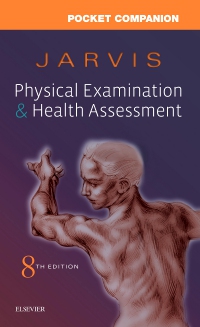

Pocket Companion for Physical Examination and Health Assessment - Elsevier eBook on VitalSource, 8th Edition
Elsevier eBook on VitalSource
A practical handbook for the assessment lab and the clinical setting, Jarvis’ Pocket Companion for Physical Examination & Health Assessment, 8th Edition makes it fast and easy to review essential assessment skills and techniques. Your students will conduct more effective exams and develop greater confidence in their assessment skills by referring to summaries of examination steps, comparisons of normal versus abnormal findings, lifespan and cultural considerations, and more than 250 full-color photos and drawings. New to this edition are enhanced integration of QSEN competencies and updated coverage of EHR documentation. Written by renowned educator and clinician Dr. Carolyn Jarvis, this companion handbook is also an ideal clinical tool for experienced practitioners who need a portable reference!
New Edition Expected Availability: 01-17-2023

Pocket Companion for Physical Examination & Health Assessment - Elsevier eBook on VitalSource
-
- NEW! Updated content throughout corresponds to the 8th edition of the Jarvis textbook, and incorporates the latest evidence-based assessment guidelines
- NEW! Enhanced Quality and Safety Education for Nurses (QSEN) content throughout text emphasizes the patient safety competency
- NEW! Health Promotion and Patient Teaching sections underscores the unique role of nurses (especially advanced practice nurses) in health promotion
- NEW! Improved look-and-feel of selected illustrations developed for the Jarvis textbook
- NEW! Updated Documentation sections with EHR integration reflect the types of documentation that nurses will enter into electronic health records (EHRs or EMRs)
-
- Convenient two-column format makes it easier to access, learn, and understand key physical examination skills and findings
- More than 250 full-color illustrations demonstrate examination skills, underlying anatomy and physiology, and normal and abnormal findings
- Color-coded design helps you to easily locate the information you need, dividing each body system chapter into major sections (anatomy, subjective data, objective data, and abnormal findings)
- Abnormal findings tables help in recognizing, sorting, and describing key abnormal findings
- Summary checklists offer reviews of key examination steps for quick reference
- Developmental Competence sections highlight content specific to infants, children, adolescents, pregnant women, and older adults
- Spanish-language translation chart helps to improve communication with Hispanic patients during the physical examination
- Cultural Competence sections provide a context for care of multicultural patient groups
-
-
 Physical Examination and Health Assessment - Elsevier eBook on VitalSourceElsevier eBook on VitalSource
-
-
1. The Interview and the Health History
2. Mental Status
3. Assessment Techniques and the Clinical Setting
4. The General Survey, Measurement, Vital Signs, and Pain Assessment
5. Skin, Hair, and Nails
6. Head, Face, and Neck, Including Regional Lymphatics
7. Eyes
8. Ears
9. Nose, Mouth, and Throat
10. Breasts and Axillae, Including Regional Lymphatics
11. Thorax and Lungs
12. Heart and Neck Vessels
13. Peripheral Vascular System and Lymphatics
14. Abdomen
15. Musculoskeletal System
16. Neurologic System
17. Male Genitourinary System
18. Female Genitourinary System
19. Anus, Rectum, and Prostate
20. Integration of the Complete Physical Examination
21. Bedside Assessment and Electronic Documentation -
-
Ways of Reading
- The appearance of the text and page layout can be modified according to the capabilities of the reading system (font family and font size, spaces between paragraphs, sentences, words, and letters, as well as color of background and text)
- This e-publication is accessible to the full extent that the file format and types of content allow, on a specific reading device, by default, without necessarily including any additions such as textual descriptions of images or enhanced navigation
- All content can be read as read aloud speech or dynamic braille
-
Conformance
- The publication contains a conformance statement that it meets the EPUB Accessibility 1.1, WCAG 2.1, Level AA standard. Please see https://bornaccessible.benetech.org/certified-publishers/ for further details of our compatibility testing.
- The certifier's credential is https://bornaccessible.benetech.org/certified-publishers/
- For detailed accessibility information, see Elsevier's website at https://www.elsevier.com/about/accessibility
- For queries regarding accessibility information, contact [email protected]
- The publication was certified on 07-04-2026
-
Navigation
- Table of contents to all chapters of the text via links
- Page list to go to pages from the print source version
-
Rich Content
- No information is available
-
Hazards
- No information is available
-
Product Content
- No information is available
-
Legal Considerations
- No information is available
-
Additional Accessibility Information
- Content is enhanced with ARIA roles to optimize organization and facilitate navigation
- Page breaks included from the original print source
- For readers with color vision deficiency, use of color (e.g., in diagrams, graphics and charts, in prompts, or on buttons inviting a response) is not the sole means of graphical distinction or of conveying information
- The body text is presented with a contrast ratio of at least 4.5:1 (or 3:1 for large/heading text)
- Ultra-high contrast between text and background
- E-publication includes basic navigation (usually less detailed than TOC-based navigation)
- Where links, controls or buttons are included in the content, the purpose or functionality of each link, control or button is apparent from the associated text alone - or where it is unclear, separate link, control or button descriptions are provided
- All (or substantially all) textual matter is arranged in a single logical reading order (including text that is visually presented as separate from the main text flow, e.g., in boxouts, captions, tables, footnotes, endnotes, citations, etc.). Non-textual content is also linked from within this logical reading order. (Purely decorative non-text content can be ignored).
- Where interactive content is included in the product, controls are provided (e.g., for speed, pause and resume, reset) and labelled to make their use clear.
- The language of the text has been specified (e.g., via the HTML or XML lang attribute) to optimise text-to-speech (and other alternative renderings), both at the whole document level and, where appropriate, for individual words, phrases or passages in a different language.
-
Ways of Reading

 as described in our