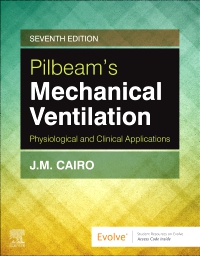

Pilbeam's Mechanical Ventilation Elsevier eBook on VitalSource, 7th Edition
Elsevier eBook on VitalSource
Now $98.99
Ensure you understand one of the most sophisticated areas of respiratory care with Pilbeam's Mechanical Ventilation: Physiological and Clinical Applications, 7th Edition! Known for its simple explanations and in-depth coverage of patient-ventilator management, this evidence-based text walks you through the most fundamental and advanced concepts surrounding mechanical ventilation and helps you understand how to properly apply these principles to patient care. This new edition is an excellent reference for all critical care practitioners and features coverage of the physiological effects of mechanical ventilation on different cross sections of the population. Additionally, student-friendly features promote critical thinking and clinical application — such as key points, AARC clinical practice guidelines, critical care concepts, updated learning objectives which address ACCS exam topics and are currently mandated by the NBRC for the RRT-ACCS credential.
New Edition Expected Availability: 07-27-2023

Pilbeam's Mechanical Ventilation - Elsevier eBook on VitalSource
-
- NEW! Interprofessional education and practice concepts integrated throughout text and within respective chapters
- NEW! Enhanced content on the physiological effects of mechanical ventilation application provides in-depth coverage of patient concerns
- UPDATED! Content on ventilator modes in, Selecting the Ventilator Mode and Initial Ventilator Settings chapters
- NEW! Revised Basic Concepts of Noninvasive Positive Pressure Ventilation chapter includes the latest practics in this area of respiratory care
- NEW! Learning Objectives and end-of-chapter Review Questions reflect the updated content and the latest NBRC RRT-ACCS exam topics
-
- Brief patient case studies list important assessment data and pose a critical thinking question to you
- Critical Care Concepts are presented in short questions to help you apply knowledge to difficult concepts
- UNIQUE! Chapter on ventilator-associated pneumonia provides in-depth, comprehensive coverage of this challenging issue
- Clinical scenarios cover patient presentation, assessment data, and treatment options to acquaint you with different clinical situations
- Key Point boxes highlight need-to-know information
- Logical chapter sequence builds on previously learned concepts and information
- Bulleted end-of-chapter summaries help you to review and assess your comprehension
- Excerpts of Clinical Practice Guidelines developed by the AARC (American Association for Respiratory Care) make it easy to access important information regarding indications/contraindications, hazards and complications, assessment of need, assessment of outcome, and monitoring
- Chapter outlines show the big picture of each chapter's content
- Glossary of mechanical ventilation terminology includes definitions to highlighted key terms in each chapter
- NBRC exam-style assessment questions at the end of each chapter offer practice for the certification exam
-
-
 Workbook for Pilbeam's Mechanical Ventilation Elsevier eBook on VitalSourceElsevier eBook on VitalSource
 -

-
-
1. Basic Terms and Concepts of Mechanical Ventilation
2. How Ventilators Work
3. How a Breath Is Delivered
4. Establishing the Need for Mechanical Ventilation
5. Selecting the Ventilator and the Mode
6. Initial Ventilator Settings
7. Final Considerations in Ventilator Setup
8. Initial Patient Assessment
9. Ventilator Graphics
10. Assessment of Respiratory Function
11. Hemodynamic Monitoring
12. Methods to Improve Ventilation in Patient-Ventilator Management
13. Improving Oxygenation and Management of Acute Respiratory Distress Syndrome
14. Ventilator-Associated Pneumonia
15. Sedatives, Analgesics and Paralytics
16. Extrapulmonary Effects of Mechanical Ventilation
17. Effects of Positive-Pressure Ventilation on the Pulmonary System
18. Troubleshooting and Problem Solving
19. Basic Concepts of Noninvasive Positive- Pressure Ventilation
20. Weaning and Discontinuation from Mechanical Ventilation
21. Long-Term Ventilation
22. Neonatal and Pediatric Mechanical Ventilation
23. Special Techniques in Ventilatory Support -
-
Ways of Reading
- The appearance of the text and page layout can be modified according to the capabilities of the reading system (font family and font size, spaces between paragraphs, sentences, words, and letters, as well as color of background and text)
- This e-publication is accessible to the full extent that the file format and types of content allow, on a specific reading device, by default, without necessarily including any additions such as textual descriptions of images or enhanced navigation
- No information about nonvisual reading is available
-
Conformance
- No information is available
-
Navigation
- Table of contents to all chapters of the text via links
- Page list to go to pages from the print source version
-
Rich Content
- No information is available
-
Hazards
- No information is available
-
Product Content
- No information is available
-
Legal Considerations
- No information is available
-
Additional Accessibility Information
- Page breaks included from the original print source
- For readers with color vision deficiency, use of color (e.g., in diagrams, graphics and charts, in prompts, or on buttons inviting a response) is not the sole means of graphical distinction or of conveying information
- E-publication includes basic navigation (usually less detailed than TOC-based navigation)
- Where links, controls or buttons are included in the content, the purpose or functionality of each link, control or button is apparent from the associated text alone - or where it is unclear, separate link, control or button descriptions are provided
- All (or substantially all) textual matter is arranged in a single logical reading order (including text that is visually presented as separate from the main text flow, e.g., in boxouts, captions, tables, footnotes, endnotes, citations, etc.). Non-textual content is also linked from within this logical reading order. (Purely decorative non-text content can be ignored).
- The language of the text has been specified (e.g., via the HTML or XML lang attribute) to optimise text-to-speech (and other alternative renderings), both at the whole document level and, where appropriate, for individual words, phrases or passages in a different language.
-
Ways of Reading

 as described in our