
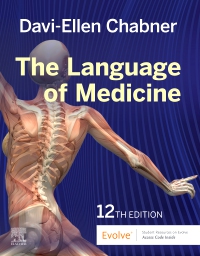

The Language of Medicine Elsevier eBook on VitalSource, 12th Edition
Elsevier eBook on VitalSource
Now $87.99
Easily and effectively master medical terminology with Davi-Ellen Chabner's The Language of Medicine, 12th Edition! Using Chabner’s proven method of learning medical terms by studying them in the context of the human body, this highly-praised and best-selling text helps individuals of all educational backgrounds easily understand and remember important medical terminology by incorporating easy-to-follow explanations, logical and interesting examples, and countless reinforcement exercises. This new twelfth edition also features additional spotlight boxes on high-interest medical topics; updated medical scenario reports, laboratory tests, and clinical procedures; a new mini dictionary; additional in person stories, ADA-compliant resources, and more. No matter where your career path takes you, Chabner’s proven method for med term mastery will help keep you grounded.

Newer Edition Available

The Language of Medicine - Elsevier eBook on VitalSource
-
-
 Elsevier Adaptive Quizzing for The Language of Medicine(eCommerce Version)Elsevier Adaptive Quizzing - Next Generation
 -

-

-
-
- Simple and easy-to-understand explanations of terms enables learners with little or no previous medical or science background to easily grasp medical terms and concepts
- Wide variety of interactive exercises provides multiple opportunities to reinforce and remember content
- Practical applications in each chapter (including case reports, operative and diagnostic tests, laboratory and x-ray reports) help leaners apply knowledge to situations you will encounter in the clinical environment
- Anatomy, physiology, and pathology coverage is presented in detail with clear illustrations and brilliant images to orient learners to the structure and function of the body system. This format offers the best context for learning the medical terms by showing readers how it is used in practice
- Actual clinical procedures and lab tests are provided within the body system or medical specialty chapters to further demonstrate medical terminology in action.
- Abbreviations are covered in every chapter to help learners master the medical shorthand used in clinical practice
- Pronunciations of terms appear at the ends of chapters along with phonetic spellings
- Comprehensive glossaries (word parts to English and English to word parts) and appendices (plurals, abbreviations, drug resource, and hematologic lab reference) appear at the end of the text and serve as quick references for use in class and on the job
- Error-prone abbreviations list derived from the Joint Commission alerts reader to abbreviations that should not be used in the clinical setting
- Interactive learner resources on companion website provide users with endless practice building, spelling, listening to, and understanding medical terms, while providing instant feedback
- NEW! Elsevier Adaptive Quizzing (EAQ) is now available for separate purchase–Elsevier Adaptive Quizzing is a highly effective, formative evaluation tool that strengthens your knowledge and confidence with high-quality practice questions. Through personalized quizzing, you and your instructors can identify weak topic areas and develop simple strategies to improve your results
-
- NEW! Updated medical scenario reports, exercises, laboratory tests, and clinical procedures give learners practice with medical terminology in current clinical settings
- NEW! Mini-Dictionary gives simple, leveled definitions for each of the approximately 2,800 individual medical terms covered in the text
- NEW! ADA compliant online student resources ensure learners with disabilities can take full advantage of the supplemental web-based learning tools
- NEW! Additional Spotlight boxes focus on high-interest medical topics such as opioid addiction, immunotherapy, and chronic traumatic encephalopathy
- NEW! Additional In Person stories bring medical terminology to life
-
1. Basic Word Structure
2. Terms Pertaining to the Body as a Whole
3. Suffixes
4. Prefixes
5. Digestive System
6. Additional Suffixes and Digestive System Terminology
7. Urinary System
8. Female Reproductive System
9. Male Reproductive System
10. Nervous System
11. Cardiovascular System
12. Respiratory System
13. Blood System
14. Lymphatic and Immune Systems
15. Musculoskeletal System
16. Skin
17. Sense Organs: The Eye and the Ear
18. Endocrine System
19. Cancer Medicine (Oncology)
20. Radiology and Nuclear Medicine
21. Pharmacology
22. Psychiatry -
-
Ways of Reading
- The appearance of the text and page layout can be modified according to the capabilities of the reading system (font family and font size, spaces between paragraphs, sentences, words, and letters, as well as color of background and text)
- This e-publication is accessible to the full extent that the file format and types of content allow, on a specific reading device, by default, without necessarily including any additions such as textual descriptions of images or enhanced navigation
- No information about nonvisual reading is available
-
Conformance
- No information is available
-
Navigation
- Table of contents to all chapters of the text via links
- Page list to go to pages from the print source version
-
Rich Content
- No information is available
-
Hazards
- No information is available
-
Product Content
- No information is available
-
Legal Considerations
- No information is available
-
Additional Accessibility Information
- Page breaks included from the original print source
- For readers with color vision deficiency, use of color (e.g., in diagrams, graphics and charts, in prompts, or on buttons inviting a response) is not the sole means of graphical distinction or of conveying information
- E-publication includes basic navigation (usually less detailed than TOC-based navigation)
- Where links, controls or buttons are included in the content, the purpose or functionality of each link, control or button is apparent from the associated text alone - or where it is unclear, separate link, control or button descriptions are provided
- All (or substantially all) textual matter is arranged in a single logical reading order (including text that is visually presented as separate from the main text flow, e.g., in boxouts, captions, tables, footnotes, endnotes, citations, etc.). Non-textual content is also linked from within this logical reading order. (Purely decorative non-text content can be ignored).
- The language of the text has been specified (e.g., via the HTML or XML lang attribute) to optimise text-to-speech (and other alternative renderings), both at the whole document level and, where appropriate, for individual words, phrases or passages in a different language.
-
Ways of Reading

 as described in our