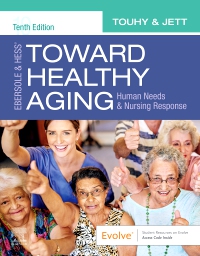

Ebersole & Hess' Toward Healthy Aging Elsevier eBook on VitalSource, 10th Edition
Elsevier eBook on VitalSource
Ensure students thoroughly understand the intricate details of providing effective care for adults as they age. Ebersole & Hess’ Toward Healthy Aging, 10th Edition is the only comprehensive gerontological nursing text that effectively communicates how to provide holistic care, promote healthy lives, and address end-of-life issues and concerns. Grounded in the core competencies recommended by the AACN in collaboration with the Hartford Institute for Geriatric Nursing, the tenth edition has been extensively revised and updated with shorter, more streamlined chapters and pedagogical features to facilitate student learning. It covers the areas of safety and ethical considerations, genetics, communication with the patient and caregiver, promoting health in persons with conditions commonly occurring in later-life world-wide addressing loss and palliative care and much more. Special sections provide an honest look at the universal experience of aging and the nurse’s role in the reduction of health disparities and inequities as a member of the global community. Plus, it contains a variety of new learning features that focus students’ attention on applying research and thinking critically in when providing care to aging adults across the care continuum.
New Edition Expected Availability: 09-07-2022

Toward Healthy Aging Elsevier eBook on VitalSource
-
- NEW! Additional coverage of frailty in older adults helps you to understand the precautions you need to take when working with this population.
- NEW! Increased information on Health Literacy assists you in learning the right terms to promote healthy aging.
- NEW! Added information on herbs/supplements includes essential oils and green tea.
-
- UPDATED COPD guidelines ensure students understand the latest information used by clinicians.
- NEW! Additional coverage of frailty in older adults helps students understand the precautions they need to take when working with this population.
- UPDATED Theories of Aging chapter discusses the latest findings on this timely issue.
- NEW! Increased information on Health Literacy assists students in learning the right terms to promote healthy aging.
- UPDATED Information on medication use and misuse instructs students in what to look for when working with prescription medications.
- UPDATED chapters incorporate the latest information on timely topics such as Palliative Care and Sleep.
- NEW! Added information on herbs/supplements includes essential oils and green tea.
- UPDATED Wound care guidelines reflect nationally recognized standards.
- UPDATED Information on LGBT family relationships and sexuality in older adults.
- A Student Speaks and An Elder Speaks sections at the beginning of every chapter provide honest and candid thoughts from students and elders.
- Learning objectives found at the beginning of every chapter help students identify the primary take away messages they should learn from the chapter.
- Promoting Healthy Aging: Implications for Gerontological Nursing sections provide best practice guidelines for management and promotion of wellness for older adults with chronic illness and those at the end of life
- Key concepts are bulleted at the end of every chapter to provide a quick review of the most important concepts found in the chapter.
- Nursing Studies provide practice examples designed to assist students in assessment, planning, interventions, and outcomes to promote healthy aging
- Critical Thinking Questions and Activities assist readers in developing critical thinking skills related to chapter and nursing study content and include suggestions for in-classroom activities to enhance learning.
- Content consistent with the core competencies for geriatric nursing incorporates the Recommended Baccalaureate Competencies and Curricular Guidelines for the Nursing Care of Older Adults, the Geriatric Nursing Education State of the Science Papers, and the Hartford Institute for Geriatric Nursing Best Practices in Nursing Care to Older Adults.
- The latest information on biological theories of aging and evolving genomic research covers current findings on these timely issues.
- Research Highlights Boxes highlight important research studies in the field of gerontology
- Research Questions found at the end of chapters gives students a chance to do further research outside of their book study to give them a better grasp of the field as a whole
- Safety Alert Boxes emphasize important safety tips for nursing students to consider while working in a clinical setting.
- Resources for Best Practice boxes contain suggestions for further information on various chapter topics and tools for practice.
- Tips for Best Practice boxes feature summarized lists of evidence-based nursing interventions for practice.
- Healthy People boxes reference the goals cited in Healthy People 2020.
-
Part I: Foundations of Healthy Aging
1. Aging, Health and Wellness in a Global Community
2. Gerontological Nursing: Past, Present, and Future
3. Theories and Processes of Aging
4. Cross-Cultural Caring and Aging
5. Cognition and LearningPart II: Foundations of Caring
6. Communicating with Older Adults
7. Health Assessment
8. Laboratory Diagnostics and Geriatrics
9. Geropharmacology
10. The Use of Dietary Supplements: Focus on Herbal ProductsPart III: Wellness and Function
11. Vision
12. Hearing
13. Skin Care
14. Nutrition
15. Hydration and Oral Care
16. Elimination
17. Sleep
18. Physical Activity and Exercise
19. Falls and Fall Risk Reduction
20. Safety and SecurityPart IV: Wellness and Chronic Illness
21. Living Well with Chronic Illness
22. Cardiovascular and Cerebrovascular Health and Wellness
23. Neurodegenerative Disorders
24. Endocrine and Immune Disorders
25. Respiratory Health and Illness
26. Common Musculoskeletal Concerns
27. Pain and Comfort
28. Mental Health
29. Care of Individuals with Neurocognitive DisordersPart V: Healthy Aging for Elders and Their Families
30. Economics and Health Care in Later Life
31. Common Legal and Ethical Issues
32. Long-Term Care
33. Intimacy and Sexuality
34. Relationships, Roles, and Transitions
35. Loss, Death, and Palliative Care
36. Self-Actualization, Spirituality, and Transcendence -
-
Ways of Reading
- The appearance of the text and page layout can be modified according to the capabilities of the reading system (font family and font size, spaces between paragraphs, sentences, words, and letters, as well as color of background and text)
- This e-publication is accessible to the full extent that the file format and types of content allow, on a specific reading device, by default, without necessarily including any additions such as textual descriptions of images or enhanced navigation
- No information about nonvisual reading is available
-
Conformance
- The publication was certified on 27-05-2026
-
Navigation
- Table of contents to all chapters of the text via links
- Page list to go to pages from the print source version
-
Rich Content
- No information is available
-
Hazards
- No information is available
-
Product Content
- No information is available
-
Legal Considerations
- No information is available
-
Additional Accessibility Information
- Page breaks included from the original print source
- For readers with color vision deficiency, use of color (e.g., in diagrams, graphics and charts, in prompts, or on buttons inviting a response) is not the sole means of graphical distinction or of conveying information
- E-publication includes basic navigation (usually less detailed than TOC-based navigation)
- Where links, controls or buttons are included in the content, the purpose or functionality of each link, control or button is apparent from the associated text alone - or where it is unclear, separate link, control or button descriptions are provided
- All (or substantially all) textual matter is arranged in a single logical reading order (including text that is visually presented as separate from the main text flow, e.g., in boxouts, captions, tables, footnotes, endnotes, citations, etc.). Non-textual content is also linked from within this logical reading order. (Purely decorative non-text content can be ignored).
- The language of the text has been specified (e.g., via the HTML or XML lang attribute) to optimise text-to-speech (and other alternative renderings), both at the whole document level and, where appropriate, for individual words, phrases or passages in a different language.
-
Ways of Reading

 as described in our