ISBN:
9780323610230
Copyright:
2020
Publication Date:
05-21-2020
Page Count:
656
Imprint:
Elsevier
List Price:
$103.99

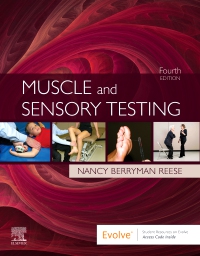
Muscle and Sensory Testing - Elsevier eBook on VitalSource, 4th Edition
by Nancy Berryman Reese, PT, PhD, MHSA, FAPTA
Elsevier eBook on VitalSource
ISBN:
9780323610230
Copyright:
2020
Publication Date:
05-21-2020
Page Count:
656
Imprint:
Elsevier
List Price:
$103.99
Most review copies are eBooks – how fast!
A review copy request is most likely to be fulfilled as an eBook on VitalSource rather than a print product, unless no eBook is available. eBooks become available in as little as a few hours. Print products will take between 7 and 10 days to arrive. To request a print copy, please contact us through the Evolve Support Center for further assistance or contact your Elsevier Sales Rep.
Mastering the art of manual muscle and sensory testing is the first step on your students’ path to becoming physical therapists (PTs). This easy-to-follow, logically organized resource includes an overview of muscle strength assessment and precise anatomic testing techniques for upper extremities, lower extremities, and head, neck, and trunk; functional muscle tests; tests for mental status, cranial nerves, and superficial reflexes; and use of observational gait analysis as a screening tool.
Photographs of testing procedures, line drawings of various innervations, and video clips showing manual muscle testing procedures augment your students’ understanding of this important skill area.
-
- NEW! Techniques of Functional Muscle Testing chapter includes completely revised content to give you a strong foundation of testing techniques.
- UPDATED! Expanded clinical notes and case vignettes challenge you to apply your knowledge to real-world situations and think creatively about clinical problems.
- UPDATED! Consistent chapter layout by joint and muscle system allows you to easily locate important information.
- UPDATED! References throughout the book enable you to quickly find the most up-to-date sources on specific topics.
- UNIQUE! 185 Video clips on the companion Evolve website reinforce your understanding of key techniques, such as muscle tests, handheld dynamometry, pediatric handheld dynamometry, sensory and neurologic testing, proper patient and clinician positioning, and force application.
-
- NEW! Techniques of Functional Muscle Testing chapter includes completely revised content to give students a strong foundation in testing techniques.
- UPDATED! Expanded clinical notes and case vignettes challenge students to apply their knowledge to real-world situations and think creatively about clinical problems.
- Photographs and illustrations demonstrate various techniques to help students better understand positioning, stabilization, and common substitutions.
- UPDATED! Consistent chapter layout by joint and muscle system allows students to easily locate important information.
- Chapters follow a logical progression from muscle testing to sensory testing to gait assessment, making the learning process clear.
- Chapters on dynamometry, sensory examination, neurologic examination, and gait provide students with additional need-to-know information on these key topics.
- UPDATED! References throughout the book enable you and your students to quickly find the most up-to-date sources on specific topics.
- UNIQUE! 185 Video clips on the companion Evolve website reinforce your students’ understanding of key techniques, such as muscle tests, handheld dynamometry, pediatric handheld dynamometry, sensory and neurologic testing, proper patient and clinician positioning, and force application.
-
-

-
 Muscle and Sensory TestingPaperback
-
-
1. Introduction to Muscle Strength Testing
2. Techniques of Manual Muscle Testing: Upper Extremity
3. Techniques of Manual Muscle Testing: Head, Neck, and Trunk
4. Techniques of Manual Muscle Testing: Lower Extremity
5. Techniques of Functional Muscle Testing
6. Techniques of Pediatric Muscle Testing
7. Hand-held Dynamometry for Muscle Testing
8. Techniques of the Sensory Examination
9. Techniques of the Remainder of the Neurologic Examination: Coordination, Mental Status, Cranial Nerves, and Superficial Reflexes
10. Observational Gait Analysis as a Screening Tool
Appendix A: Average Joint Ranges of Motion
Appendix B: Muscle Innervations by Spinal Cord Level
Appendix C: Muscle Innervations by Peripheral Nerve
Index -
-
Ways of Reading
- The appearance of the text and page layout can be modified according to the capabilities of the reading system (font family and font size, spaces between paragraphs, sentences, words, and letters, as well as color of background and text)
- This e-publication is accessible to the full extent that the file format and types of content allow, on a specific reading device, by default, without necessarily including any additions such as textual descriptions of images or enhanced navigation
- No information about nonvisual reading is available
-
Conformance
- No information is available
-
Navigation
- Table of contents to all chapters of the text via links
- Page list to go to pages from the print source version
-
Rich Content
- No information is available
-
Hazards
- No information is available
-
Product Content
- No information is available
-
Legal Considerations
- No information is available
-
Additional Accessibility Information
- Page breaks included from the original print source
- For readers with color vision deficiency, use of color (e.g., in diagrams, graphics and charts, in prompts, or on buttons inviting a response) is not the sole means of graphical distinction or of conveying information
- E-publication includes basic navigation (usually less detailed than TOC-based navigation)
- Where links, controls or buttons are included in the content, the purpose or functionality of each link, control or button is apparent from the associated text alone - or where it is unclear, separate link, control or button descriptions are provided
- All (or substantially all) textual matter is arranged in a single logical reading order (including text that is visually presented as separate from the main text flow, e.g., in boxouts, captions, tables, footnotes, endnotes, citations, etc.). Non-textual content is also linked from within this logical reading order. (Purely decorative non-text content can be ignored).
- The language of the text has been specified (e.g., via the HTML or XML lang attribute) to optimise text-to-speech (and other alternative renderings), both at the whole document level and, where appropriate, for individual words, phrases or passages in a different language.
-
Ways of Reading
Most review copies are eBooks – how fast!
A review copy request is most likely to be fulfilled as an eBook on VitalSource rather than a print product, unless no eBook is available. eBooks become available in as little as a few hours. Print products will take between 7 and 10 days to arrive. To request a print copy, please contact us through the Evolve Support Center for further assistance or contact your Elsevier Sales Rep.

 as described in our