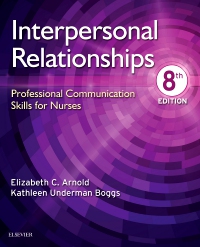

Interpersonal Relationships Elsevier eBook on VitalSource, 8th Edition
Elsevier eBook on VitalSource
Now $60.29
Now more than ever, effective communication skills are key for successful patient care and positive outcomes. Interpersonal Relationships: Professional Communication Skills for Nurses, 8th Edition helps you to develop skills in communicating effectively with clients, families, and colleagues in order to achieve treatment goals in health care. Using clear, practical guidelines, it shows how to enhance the nurse-client relationship through proven communication strategies as well as principles drawn from nursing, psychology, and related theoretical frameworks. The 8th edition includes engaging new content relating to current issues, while also emphasizing interdisciplinary communication and QSEN competencies. You will learn how to apply theory to real-life practice through case studies, interactive exercises, and evidence-based practice studies.
New Edition Expected Availability: 07-21-2022

Interpersonal Relationships Elsevier eBook on VitalSource
-
- NEW! Engaging content links the text to current issues and communication concepts
-
- UPDATED! Perspectives and Contemporary Dynamics chapter revised to be more engaging and link the content closer to current issues and related communication concepts
- UPDATED! Communicating in Groups chapter includes professional and task small group communication applications
- UPDATED! Most chapters have been retitled and expanded to highlight a stronger emphasis on interdisciplinary health team communication
- UPDATED! Safety and Quality in health care delivery (QSEN) competencies reflects current thinking on technology, safety, and evidence-based practice, especially as they relate to communication in nursing
- UPDATED! Content throughout text includes stronger emphasis on interdisciplinary relationships and collaborative communication with related evidence based case studies and analysis
- Expanded content related to socio-cultural communication competencies reduce health disparities and increase health literacy
- Additional simulated exercises and discussion questions help you practice your reflective analysis skills
- Revised content on social media and transitional care delivery reflects current practice standards
- Discussion of spirituality and end-of-life needs focuses on trust, empathy, and the nurse-client relationship — all central components of holistic nursing identified by The Joint Commission as priorities for patient care
- Nursing, behavioral, developmental, family, and communication theories provide an essential foundation and a theoretical perspective for effective communication.
- Interactive exercises let you practice, observe, and critically evaluate your professional communication skills in a safe learning environment
- Case examples help you learn to develop empathy for clients' perspectives and needs.
- Ethical Dilemma and Evidence-Based Practice boxes help you absorb and retain key ethical content throughout text
- Separate chapters on communication across the lifespan highlights crucial communication tools that are the first step in developing a culture of safety in contemporary health care delivery
-
Part I: Theoretical Foundations and Contemporary Dynamics in Patient Centered Relationships and Communication
1. Historical Perspectives and Contemporary Dynamics
2. Clarity and Safety in Communication
3. Professional Guides for Nursing Communication
4. Critical Judgment: Critical Thinking and Ethical Decision Making
Part II: Essential Communication Competencies
5. Developing Patient Centered Communication Skills
6. Variation in Communication Styles
7. Intercultural Communication
8. Communicating in Groups
Part III: Relationship Skills in Health Communication
9. Self-Concept in Professional Interpersonal Relationships
10. Developing Patient Centered Therapeutic Relationships
11. Bridges and Barriers in Therapeutic Relationships
12. Communicating with Families
Part IV: Communication for Health Promotion and Disease Prevention
13. Resolving Conflicts Between Nurse and Patient
14. Communication Strategies for Health Promotion and Disease Prevention
15. Communication in Health Teaching and Coaching
16. Communication in Stressful Situations
Part V: Accommodating Patients with Special Communication Needs
17. Communicating with Patients Experiencing Communication Deficits
18. Communicating with Children
19. Communicating with Older Adults
20. Communicating with Patients in Crisis
21. Communication in Palliative Care
Part VI: Collaborative Professional Communication
22. Role Relationship Communication within Nursing
23. Interprofessional Communication
24. Communicating for Continuity of Care
25. Documentation in Health Information Technology Systems
26. Health and Communication Technology -
-
Ways of Reading
- The appearance of the text and page layout can be modified according to the capabilities of the reading system (font family and font size, spaces between paragraphs, sentences, words, and letters, as well as color of background and text)
- This e-publication is accessible to the full extent that the file format and types of content allow, on a specific reading device, by default, without necessarily including any additions such as textual descriptions of images or enhanced navigation
- No information about nonvisual reading is available
-
Conformance
- The publication was certified on 27-05-2026
-
Navigation
- Table of contents to all chapters of the text via links
- Page list to go to pages from the print source version
-
Rich Content
- No information is available
-
Hazards
- No information is available
-
Product Content
- No information is available
-
Legal Considerations
- No information is available
-
Additional Accessibility Information
- Page breaks included from the original print source
- For readers with color vision deficiency, use of color (e.g., in diagrams, graphics and charts, in prompts, or on buttons inviting a response) is not the sole means of graphical distinction or of conveying information
- E-publication includes basic navigation (usually less detailed than TOC-based navigation)
- Where links, controls or buttons are included in the content, the purpose or functionality of each link, control or button is apparent from the associated text alone - or where it is unclear, separate link, control or button descriptions are provided
- All (or substantially all) textual matter is arranged in a single logical reading order (including text that is visually presented as separate from the main text flow, e.g., in boxouts, captions, tables, footnotes, endnotes, citations, etc.). Non-textual content is also linked from within this logical reading order. (Purely decorative non-text content can be ignored).
- The language of the text has been specified (e.g., via the HTML or XML lang attribute) to optimise text-to-speech (and other alternative renderings), both at the whole document level and, where appropriate, for individual words, phrases or passages in a different language.
-
Ways of Reading

 as described in our