ISBN:
9780323655774
Copyright:
2020
Publication Date:
11-05-2019
Page Count:
600
Imprint:
Mosby
List Price:
$74.99

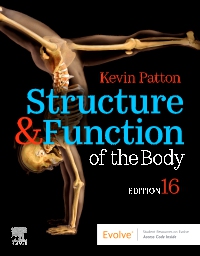
Structure & Function of the Body - Elsevier eBook on VitalSource, 16th Edition
by Kevin T. Patton, PhD and Gary A. Thibodeau, PhD
Elsevier eBook on VitalSource
ISBN:
9780323655774
Copyright:
2020
Publication Date:
11-05-2019
Page Count:
600
Imprint:
Mosby
List Price:
$74.99
Most review copies are eBooks – how fast!
A review copy request is most likely to be fulfilled as an eBook on VitalSource rather than a print product, unless no eBook is available. eBooks become available in as little as a few hours. Print products will take between 7 and 10 days to arrive. To request a print copy, please contact us through the Evolve Support Center for further assistance or contact your Elsevier Sales Rep.
Give students a solid understanding of the human body! Using simple, conversational language and vivid animations and illustrations, Structure & Function of the Body, 16th Edition introduces the normal structure and function of the human body and what the body does to maintain homeostasis. To help make difficult A&P concepts easy to understand, this new edition features thoroughly revised content and review questions which reflect the most current information available and a unique 22-page, semi-transparent insert of the human body. Plus, Connect It! boxes throughout directly correlate to online content giving students additional clinical and scientific insights essential to patient care!
New Edition Expected Availability: 07-11-2024

Structure & Function of the Body - Elsevier E-Book on VitalSource
Elsevier eBook on VitalSource
ISBN: 9780323871754
-
- NEW! Thoroughly revised chapters, illustrations, and review questions reflect the most current information available
- NEW! Connect It! boxes refer you to online content providing additional clinical and scientific insights
- NEW! A&P contributors join Dr. Patton to enhance the content and bring additional perspectives to the book
-
- NEW! Thoroughly revised chapters, illustrations, and review questions reflect the most current information available
- NEW! Expert A&P contributors join Dr. Patton to enhance the content and bring additional perspectives to the book
- Conversational and clear writing style makes content easy to read and understand for all levels of students
- Full-color design contains more than 400 drawings and photos
- NEW! Connect It! boxes refer students to online content providing additional clinical and scientific insights. F / NF #__6F___ 22-page Clear View of the Human Body is a unique, full-color, semi-transparent insert depicting the human body (male and female) in layers
- Updated study tips sections at the beginning of each chapter help break down difficult topics and guide students on how to best use book features to their advantage
- Questions for student review are found throughout the chapters and cover critical thinking, open-ended, fill-in-the-blank, matching, multiple-choice, and other question formats
- Special boxes such as Health and Well-Being boxes, Clinical Application boxes, Research and Trends boxes, and more increase student interest and help students apply what they have learned to their future careers in healthcare and science
- Language of Science and Medicine section in each chapter includes key terms, word parts, and pronunciations to place a greater focus on medical terminology
- Educator resources on the Evolve companion website include TEACH lesson plans, lecture outlines, PowerPoint slides, an image collection, test bank, and author’s revision notes
- Student resources on the Evolve companion website include Animation Direct, audio summaries, audio glossary, a new online coloring book, student review questions, and FAQs
- Chapter outlines, objectives, and outline summaries offer students easy ways to organize and prioritize content
-
-
 Elsevier Adaptive Quizzing for Structure & Function of the BodyElsevier Adaptive Quizzing - Next Generation
 -
 Study Guide for Structure & Function of the Body Elsevier eBook on VitalSourceElsevier eBook on VitalSource
 -

-
-
1. Introduction to the Body
2. Chemistry of Life
3. Cells
4. Tissues
5. Organ Systems
6. Skin and Membranes
7. Skeletal System
8. Muscular System
9. Nervous System
10. Senses
11. Endocrine System
12. Blood
13. Cardiovascular System
14. Lymphatic System and Immunity
15. Respiratory System
16. Digestive System
17. Nutrition and Metabolism
18. Urinary System
19. Fluid and Electrolyte Balance
20. Acid-Base Balance
21. Reproductive Systems
22. Growth, Development, and Aging
Appendix A: Body Mass Index
Appendix B: Common Medical Abbreviations, Prefixes, and Suffixes
Appendix C: Chapter Test Answers
Glossary
Illustration/Photo Credits -
-
Ways of Reading
- The appearance of the text and page layout can be modified according to the capabilities of the reading system (font family and font size, spaces between paragraphs, sentences, words, and letters, as well as color of background and text)
- This e-publication is accessible to the full extent that the file format and types of content allow, on a specific reading device, by default, without necessarily including any additions such as textual descriptions of images or enhanced navigation
- No information about nonvisual reading is available
-
Conformance
- No information is available
-
Navigation
- Table of contents to all chapters of the text via links
- Page list to go to pages from the print source version
-
Rich Content
- No information is available
-
Hazards
- No information is available
-
Product Content
- No information is available
-
Legal Considerations
- No information is available
-
Additional Accessibility Information
- Page breaks included from the original print source
- For readers with color vision deficiency, use of color (e.g., in diagrams, graphics and charts, in prompts, or on buttons inviting a response) is not the sole means of graphical distinction or of conveying information
- E-publication includes basic navigation (usually less detailed than TOC-based navigation)
- Where links, controls or buttons are included in the content, the purpose or functionality of each link, control or button is apparent from the associated text alone - or where it is unclear, separate link, control or button descriptions are provided
- All (or substantially all) textual matter is arranged in a single logical reading order (including text that is visually presented as separate from the main text flow, e.g., in boxouts, captions, tables, footnotes, endnotes, citations, etc.). Non-textual content is also linked from within this logical reading order. (Purely decorative non-text content can be ignored).
- The language of the text has been specified (e.g., via the HTML or XML lang attribute) to optimise text-to-speech (and other alternative renderings), both at the whole document level and, where appropriate, for individual words, phrases or passages in a different language.
-
Ways of Reading
Most review copies are eBooks – how fast!
A review copy request is most likely to be fulfilled as an eBook on VitalSource rather than a print product, unless no eBook is available. eBooks become available in as little as a few hours. Print products will take between 7 and 10 days to arrive. To request a print copy, please contact us through the Evolve Support Center for further assistance or contact your Elsevier Sales Rep.

 as described in our