ISBN:
9780323679596
Copyright:
2021
Publication Date:
09-23-2020
Page Count:
432
Imprint:
Saunders
List Price:
$76.99

Small Animal Emergency and Critical Care for Veterinary Technicians - Elsevier eBook on VitalSource, 4th Edition
by Andrea M. Battaglia, LVT and Andrea M. Steele, MSc, RVT
Elsevier eBook on VitalSource
ISBN:
9780323679596
Copyright:
2021
Publication Date:
09-23-2020
Page Count:
432
Imprint:
Saunders
List Price:
$76.99
Most review copies are eBooks – how fast!
A review copy request is most likely to be fulfilled as an eBook on VitalSource rather than a print product, unless no eBook is available. eBooks become available in as little as a few hours. Print products will take between 7 and 10 days to arrive. To request a print copy, please contact us through the Evolve Support Center for further assistance or contact your Elsevier Sales Rep.
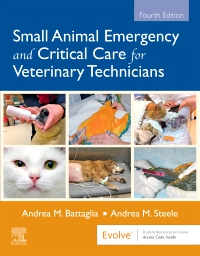
Prepare veterinary technician students for the care of critically ill or injured pets! Small Animal Emergency and Critical Care for Veterinary Technicians, 4th Edition provides quick access to dozens of common, life-saving protocols and procedures. Each treatment technique is described in step-by-step detail and illustrated in full color. To reflect the veterinary setting, a team approach is emphasized. This edition adds three new chapters and includes practical, easy-to-apply medical math and scenario-based exercises. With even more exercises on the Evolve companion website, this resource offers students the practice they need to succeed on the VTNE, in veterinary practice, and in animal hospital emergency departments.
New Edition Expected Availability: 12-18-2025

Battaglia & Steele's Small Animal Emergency and Critical Care for Veterinary Technicians - Elsevier E-Book on VitalSource
Elsevier eBook on VitalSource
ISBN: 9780443280450
-
- NEW! Three new chapters are included: Supporting the Critically Ill or Injured through Physical Rehabilitation Techniques, Fostering Wellbeing in the ER and ICU, and Managing Pharmaceuticals in the ER
- NEW! Chapter pretests assess your knowledge and allow you to identify your strengths and weaknesses
- NEW and UPDATED photos and illustrations enhance your understanding by accurately depicting the clinical signs encountered in emergency and critical care
-
- NEW! TEACH instructor resources include lesson plans, PowerPoint® slides, student handouts, and answer keys
- NEW! Three new chapters are included: Supporting the Critically Ill or Injured through Physical Rehabilitation Techniques, Fostering Wellbeing in the ER and ICU, and Managing Pharmaceuticals in the ER
- NEW! Chapter pretests allow students to measure their baseline performance to identify strengths and weaknesses
- Step-by-step instructions show how to perform specific procedures and techniques, guiding students through key assessment and treatment techniques
- NEW and UPDATED photos and illustrations accurately depict the clinical signs encountered in emergency and critical care, providing students with a firmer understanding
- Comprehensive coverage of pain management, respiratory emergencies, and urologic emergencies provides cutting-edge treatment options for a wide variety of commonly seen presenting problems
- Coverage of equipment and techniques includes the latest advances in basic lab equipment, fluid therapy, and oxygen therapy
- Equipment lists are provided at the beginning of most chapters, ensuring that vet techs will have the appropriate tools on hand for each type of emergency situation
- Review and preparation for the VTNE (Veterinary Technician National Examination) is provided by Medical Math exercises and questions based on real-world scenarios
-
SECTION I: Critically Ill Small Animals
1. Critical Thinking – Skill of Observation and Interpretation
2. Monitoring of the Critically Ill or Injured Patient
3. Patient's Lifeline: Intravenous Catheter
4. Fluid Therapy
5. Transfusion Medicine
6. Nutritional Support for the Critically Ill Patient
7. Oxygen Therapy Techniques
8. Mechanical Ventilation
9. Pain Assessment and Treatment
10. Supporting the Critically Ill or Injured through Physical Rehabilitation Techniques NEW!
11. Anesthesia in the Critically Ill or Injured
12. Isolation Techniques in Clinical Practice
SECTION II: Emergency Care for Small Animals
13. Emergency Receiving
14. Management of Patients in Shock
15. Cardiopulmonary Resuscitation: Current Practice
16. Traumatic Emergencies
17. Hematologic Emergencies
18. Cardiovascular Emergencies
19. Respiratory Emergencies
20. Gastrointestinal Emergencies
21. Metabolic and Endocrine Emergencies
22. Urologic Emergencies
23. Reproductive Emergencies
24. Ocular Emergencies
25. Neurologic Emergencies
26. Toxicologic Emergencies
27. Avian and Exotic Emergencies
28. Disaster Medicine
SECTION III: Practice Management
29. Fostering Wellbeing in the ER and ICU NEW!
30. The Art of Scheduling
31. Client Communication in an Emergency
32. Managing Pharmaceuticals in the ER NEW! -
-
Ways of Reading
- The appearance of the text and page layout can be modified according to the capabilities of the reading system (font family and font size, spaces between paragraphs, sentences, words, and letters, as well as color of background and text)
- This e-publication is accessible to the full extent that the file format and types of content allow, on a specific reading device, by default, without necessarily including any additions such as textual descriptions of images or enhanced navigation
- No information about nonvisual reading is available
-
Conformance
- No information is available
-
Navigation
- Table of contents to all chapters of the text via links
- Page list to go to pages from the print source version
-
Rich Content
- No information is available
-
Hazards
- No information is available
-
Product Content
- No information is available
-
Legal Considerations
- No information is available
-
Additional Accessibility Information
- Page breaks included from the original print source
- For readers with color vision deficiency, use of color (e.g., in diagrams, graphics and charts, in prompts, or on buttons inviting a response) is not the sole means of graphical distinction or of conveying information
- E-publication includes basic navigation (usually less detailed than TOC-based navigation)
- Where links, controls or buttons are included in the content, the purpose or functionality of each link, control or button is apparent from the associated text alone - or where it is unclear, separate link, control or button descriptions are provided
- All (or substantially all) textual matter is arranged in a single logical reading order (including text that is visually presented as separate from the main text flow, e.g., in boxouts, captions, tables, footnotes, endnotes, citations, etc.). Non-textual content is also linked from within this logical reading order. (Purely decorative non-text content can be ignored).
- The language of the text has been specified (e.g., via the HTML or XML lang attribute) to optimise text-to-speech (and other alternative renderings), both at the whole document level and, where appropriate, for individual words, phrases or passages in a different language.
-
Ways of Reading

Most review copies are eBooks – how fast!
A review copy request is most likely to be fulfilled as an eBook on VitalSource rather than a print product, unless no eBook is available. eBooks become available in as little as a few hours. Print products will take between 7 and 10 days to arrive. To request a print copy, please contact us through the Evolve Support Center for further assistance or contact your Elsevier Sales Rep.

 as described in our