ISBN:
9780323683647
Copyright:
2021
Publication Date:
02-05-2020
Page Count:
496
Imprint:
Mosby
List Price:
$104.99

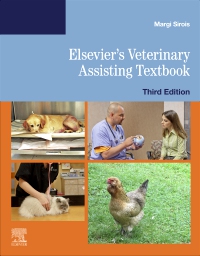
Elsevier's Veterinary Assisting Textbook-Elsevier E-Book on VitalSource, 3rd Edition
by Margi Sirois, EdD, MS, RVT, CVT, LAT, VTES
Elsevier eBook on VitalSource
ISBN:
9780323683647
Copyright:
2021
Publication Date:
02-05-2020
Page Count:
496
Imprint:
Mosby
List Price:
$104.99
Was
$104.99
Now $94.49
Or $0.00 with a valid access code
Master the role and responsibilities of the veterinary assistant! From respected veterinary educator Margi Sirois, Elsevier’s Veterinary Assisting Textbook, 3rd Edition covers everything you need to know to pass the Approved Veterinary Assistant (AVA) exam and succeed in clinical practice. With this comprehensive textbook students will learn to assist in laboratory and radiographic procedures, properly restrain animals, set up equipment and supplies, clean and maintain practice facilities, feed and exercise patients, collect samples, handle and dispense medications, groom patients, and record keeping. Updated content reflects the latest advances in veterinary assisting procedures, and new images illustrate key tasks.
New Edition Expected Availability: 09-20-2024

Elsevier's Veterinary Assisting Textbook-Elsevier E-Book on VitalSource
Elsevier eBook on VitalSource
ISBN: 9780443122750
-
- NEW! Completely updated content throughout reflects the latest advances in veterinary assisting procedures for improved patient service.
- NEW! Fear-free handling coverage now included in Chapter 6: Animal Behavior and Restraint.
- NEW! Poultry Care section added to Chapter 13: Large Animal Nursing and Husbandry.
- NEW and UPDATED! Additional and revised images throughout accurately illustrate key veterinary assisting tasks.
-
- Comprehensive coverage provides details on the tasks performed by veterinary assistants, and covers everything you need to know to pass the Approved Veterinary Assistant (AVA) exam and succeed in clinical practice.
- Step-by-step instructions and hundreds of full-color photographs show veterinary assisting tasks and clarify key concepts.
- Information on office procedures and client relations prepares you to be involved in many of the business aspects of veterinary practice and to work closely with management staff.
- Coverage of the workflow in a veterinary practice helps you understand your role as well as the roles of all the other members of the veterinary health care team.
- Critical Concept boxes highlight important points and provide useful tips to improve your knowledge and skills.
- A student workbook provides activities to help you apply concepts to veterinary practice, including definitions of key terms, review questions, crossword puzzles, illustration labeling, sample cases, and clinical applications. Available separately.
-
-
 Workbook for Elsevier's Veterinary Assisting Textbook - Elsevier eBook on VitalSourceElsevier eBook on VitalSource
 -

-
-
1.Overview of the Veterinary Profession
2.Office Procedures and Client Relations
3.Medical Terminology
4.Animal Behavior and Restraint
5.Animal Husbandry and Nutrition
6.Animal Care and Nursing
7.Anatomy and Physiology
8.Pharmacology and Pharmacy
9.Anesthesia and Surgical Assisting
10.Laboratory Procedures
11.Diagnostic Imaging
12.Avian and Exotic Animal Care and Nursing
13.Large Animal Nursing and Husbandry
Glossary
Appendices
A: Normal Physiologic Data in Adult Dogs and Cats
B: Summary of Lengths of Estrous Cycle and Gestation Periods in Dogs and Cats
C: Normal Daily Urine Production for Dogs and Cats
D: Normal Blood Gas Values
E: Normal Heart Rate and Blood Pressure in Dogs and Cats
F: Hematology Reference Range Values
G: Normal Chemistry Values
H: Normal Urinalysis Findings
I: Hemostasis Reference Range Values
J: Veterinary Assistant Model Curriculum Association of Veterinary Technician Educators
K: Policy on Assistant Training Curriculum Approval -
-
Ways of Reading
- The appearance of the text and page layout can be modified according to the capabilities of the reading system (font family and font size, spaces between paragraphs, sentences, words, and letters, as well as color of background and text)
- This e-publication is accessible to the full extent that the file format and types of content allow, on a specific reading device, by default, without necessarily including any additions such as textual descriptions of images or enhanced navigation
- No information about nonvisual reading is available
-
Conformance
- No information is available
-
Navigation
- Table of contents to all chapters of the text via links
- Page list to go to pages from the print source version
-
Rich Content
- No information is available
-
Hazards
- No information is available
-
Product Content
- No information is available
-
Legal Considerations
- No information is available
-
Additional Accessibility Information
- Page breaks included from the original print source
- For readers with color vision deficiency, use of color (e.g., in diagrams, graphics and charts, in prompts, or on buttons inviting a response) is not the sole means of graphical distinction or of conveying information
- E-publication includes basic navigation (usually less detailed than TOC-based navigation)
- Where links, controls or buttons are included in the content, the purpose or functionality of each link, control or button is apparent from the associated text alone - or where it is unclear, separate link, control or button descriptions are provided
- All (or substantially all) textual matter is arranged in a single logical reading order (including text that is visually presented as separate from the main text flow, e.g., in boxouts, captions, tables, footnotes, endnotes, citations, etc.). Non-textual content is also linked from within this logical reading order. (Purely decorative non-text content can be ignored).
- The language of the text has been specified (e.g., via the HTML or XML lang attribute) to optimise text-to-speech (and other alternative renderings), both at the whole document level and, where appropriate, for individual words, phrases or passages in a different language.
-
Ways of Reading
Was
$104.99
Now $94.49
Or $0.00 with a valid access code

 as described in our