ISBN:
9780323696081
Copyright:
2022
Publication Date:
06-11-2021
Page Count:
744
Imprint:
Elsevier
List Price:
$68.99

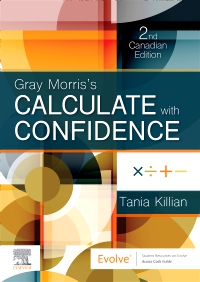
Gray Morris's Calculate with Confidence, Canadian Edition - Elsevier E-Book on VitalSource, 2nd Edition
by Tania N. Killian, BScN, BEd, MEd, CCN, CHSE
Elsevier eBook on VitalSource
ISBN:
9780323696081
Copyright:
2022
Publication Date:
06-11-2021
Page Count:
744
Imprint:
Elsevier
List Price:
$68.99
Was
$68.99
Now $48.29
Or $0.00 with a valid access code
Learn to calculate dosages accurately and administer drugs safely! Gray Morris’s Calculate with Confidence, Second Canadian Edition uses a clear, step-by-step approach to make drug dosage calculations easy. More than 2,000 practice questions help you review basic math and then master the three standard methods of dosage calculation: ratio and proportion, formula, and dimensional analysis. With the increasing responsibility of the nurse in mind, emphasis is placed on critical thinking and clinical reasoning in preventing medication errors. Reflecting current practice in Canadian health care, this book also provides excellent preparation for Canadian licensure exams!
New Edition Expected Availability: 07-22-2026

Morris's Calculate with Confidence, Third Canadian Edition - Elsevier E-Book on VitalSource
Elsevier eBook on VitalSource
ISBN: 9780443285349
-
- NEW! Next Generation NCLEX-RN® exam-style case studies on the Evolve website provide drug calculation practice for the Next Generation NCLEX Examination
- NEW! Increased number of Clinical Reasoning exercises builds students’ critical thinking skills, with a focus on preventing medication errors
- NEW! Thoroughly updated content includes the latest Health Canada-approved medications, current drug labels, the latest research, Canadian statistics, commonly used abbreviations, and recommended practices related to medication errors and their prevention
- NEW! A-Z medication index references the page numbers where drug labels can be found
- NEW! Tips for Clinical Practice from the text are now available on Evolve in printable, easy-reference format
-
- NEW! Nora AI - an AI-powered learning assistant exclusive to Elsevier ebooks on VitalSource's Bookshelf® platform - offers built-in AI learning support that provides personalized answers based on content from the Elsevier ebook
- SI measurement units and generic/Canadian drug names are included throughout the text
- Practice problems and real-world examples help students master correct dosage calculations and safe medication administration, with rationales included in practice problem answers to enhance the understanding of principles
- Tips for Clinical Practice boxes summarize information critical to math calculation and patient safety
- Safety Alert! boxes highlight common medication errors and identify actions that must be taken to avoid calculation errors
- Chapter Review problems test student knowledge of all major topics presented in the chapter
- Pre-Test review includes practice problems to help students assess their basic math skills and identify their strengths and weaknesses, covering fractions, decimals, percentages, and ratio and proportion
- Post-Test in Unit One allows students to assess and evaluate their understanding after completing the chapters on basic math
- Comprehensive Post-Test at the end of the book covers dosage calculations and conversions, using real-life drug labels and situations
- NCLEX® exam-style questions on Evolve help students prepare for the type of questions seen on the NCLEX-RN® Examination
-
-
 Book-Organized: Sherpath for Killian Morris's Calculate with Confidence, Canadian EditionSherpath Book-Organized
 -
 Elsevier Adaptive Quizzing for Gray Morris's Calculate with Confidence, Canadian Edition (eCommerce Version)Elsevier Adaptive Quizzing - Next Generation
 -

-
-
Unit One: Math Review
Pre-Test
1. Fractions
2. Decimals
3. Ratio and Proportion
4. Percentages
Post-Test
Unit Two: Systems of Measurement
5. Standardizing Measurement Systems
6. Converting Within and Between Systems
7. Additional Conversions Useful in the Health Care Setting
Unit Three: Methods of Administration and Calculation
8. Medication Administration
9. Understanding and Interpreting Medication Orders
10. Medication Administration Records and Drug Distribution Systems
11. Reading Medication Labels
12. Dosage Calculation Using the Ratio and Proportion Method
13. Dosage Calculation Using the Formula Method
14. Dosage Calculation Using the Dimensional Analysis Method
Unit Four: Oral and Parenteral Dosage Forms and Insulin Calculations
15. Oral Medications
16. Parenteral Medications
17. Reconstitution of Solutions
18. Insulin
Unit Five: Intravenous, Heparin, and Critical Care Calculations and Pediatric Dosage Calculations
19. Intravenous Solutions and Equipment
20. Intravenous Calculations
21. Heparin Calculations
22. Pediatric and Adult Dosage Calculation Based on Weight
23. Critical Care Calculations
Comprehensive Post-Test
Appendix A: Arabic Equivalents for Roman Numerals
Appendix B: Diabetes Management Record: Subcutaneous Insulin
References
Drug Index -
-
Ways of Reading
- The appearance of the text and page layout can be modified according to the capabilities of the reading system (font family and font size, spaces between paragraphs, sentences, words, and letters, as well as color of background and text)
- This e-publication is accessible to the full extent that the file format and types of content allow, on a specific reading device, by default, without necessarily including any additions such as textual descriptions of images or enhanced navigation
- No information about nonvisual reading is available
-
Conformance
- No information is available
-
Navigation
- Table of contents to all chapters of the text via links
- Page list to go to pages from the print source version
-
Rich Content
- No information is available
-
Hazards
- No information is available
-
Product Content
- No information is available
-
Legal Considerations
- No information is available
-
Additional Accessibility Information
- Page breaks included from the original print source
- For readers with color vision deficiency, use of color (e.g., in diagrams, graphics and charts, in prompts, or on buttons inviting a response) is not the sole means of graphical distinction or of conveying information
- E-publication includes basic navigation (usually less detailed than TOC-based navigation)
- Where links, controls or buttons are included in the content, the purpose or functionality of each link, control or button is apparent from the associated text alone - or where it is unclear, separate link, control or button descriptions are provided
- All (or substantially all) textual matter is arranged in a single logical reading order (including text that is visually presented as separate from the main text flow, e.g., in boxouts, captions, tables, footnotes, endnotes, citations, etc.). Non-textual content is also linked from within this logical reading order. (Purely decorative non-text content can be ignored).
- The language of the text has been specified (e.g., via the HTML or XML lang attribute) to optimise text-to-speech (and other alternative renderings), both at the whole document level and, where appropriate, for individual words, phrases or passages in a different language.
-
Ways of Reading
Was
$68.99
Now $48.29
Or $0.00 with a valid access code

 as described in our