ISBN:
9780323696890
Copyright:
2022
Publication Date:
11-29-2021
Page Count:
192
Imprint:
Elsevier
List Price:
$64.99

Pharmacology Made Simple Elsevier E-Book on VitalSource, 1st Edition
by Anthony Guerra, PharmD, RPh
Elsevier eBook on VitalSource
ISBN:
9780323696890
Copyright:
2022
Publication Date:
11-29-2021
Page Count:
192
Imprint:
Elsevier
List Price:
$64.99
Was
$64.99
Now $58.49
Or $0.00 with a valid access code
**Textbook and Academic Authors Association (TAA) Most Promising New Textbook Award Winner, 2024**
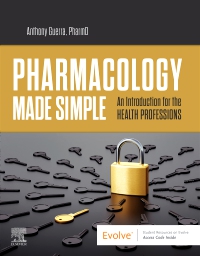
Master the pharmacology essentials that health professionals need in practice! Pharmacology Made Simple: An Introduction for the Health Professions makes it easy to understand and apply pharmacology concepts in healthcare careers. Clear and concise, this text uses colorful illustrations, case scenarios, and memory devices to simplify learning and review questions to aid comprehension. An Evolve companion website includes two practice exams for more self-testing and printable drug tables. This exciting and practical new text helps you build professional skills and ensures your readiness for the workplace.
-
- Essential information is logically organized and easy to read, focusing on what you need to know.
- Engaging, reader-friendly format breaks down pharmacology into manageable chunks of information, accompanied by "flashcard" boxes and memory devices.
- Mini case studies in each chapter demonstrate real-world healthcare applications, with scenarios from a variety of health professions settings.
- Chapter review questions provide opportunities to assess your comprehension as you move forward.
- Full-color illustrations bring complex pharmacology concepts to life with realistic figures and drawings.
- Clinical Application and Alert features stress critical thinking and effective job preparation.
- Scenario and Alert features stress clinical application and safety.
- Focus on patient education helps you learn and practice key skills in professionalism.
- Chapter key terms and back-of-book glossary includes pharmacology terms cross-referenced to the chapters in which they are introduced and discussed.
- Additional learning resources include a study guide (available separately) and an Evolve companion website with practice exams and quick reference drug tables to print.
- Chapter objectives guide your study by listing the chapter’s most important concepts.
-
-
 Student Workbook for Pharmacology Made Simple - Elsevier E-Book on VitalSourceElsevier eBook on VitalSource
 -

-

-
 Pharmacology Made SimplePaperback
-
-
UNIT 1: General Principles of Pharmacology
1. Introduction to Pharmacology
2. Drug Actions – Pharmacodynamics
3. Drug Movement – Pharmacokinetics
UNIT 2: Pharmacology in Practice
4. Drug Laws and Preventing Medication Errors
5. Drug Administration
6. Dosage Calculations
UNIT 3: Drug Classifications
7. Drug Classifications
8. Gastrointestinal
9. Musculoskeletal
10. Respiratory
11. Immune
12. Neuro Psychology
UNIT 4: Special Situations and Populations
13. Cardiology
14. Endocrine
15. Pediatric Pharmacology
16. Geriatric Pharmacology
17. Local and General Anesthetics
18. Alcohol and Drugs of Abuse -
-
Ways of Reading
- The appearance of the text and page layout can be modified according to the capabilities of the reading system (font family and font size, spaces between paragraphs, sentences, words, and letters, as well as color of background and text)
- This e-publication is accessible to the full extent that the file format and types of content allow, on a specific reading device, by default, without necessarily including any additions such as textual descriptions of images or enhanced navigation
- All content can be read as read aloud speech or dynamic braille
- Has alternative text descriptions for images
-
Conformance
- The publication contains a conformance statement that it meets the EPUB Accessibility 1.1, WCAG 2.1, Level AA standard. Please see https://bornaccessible.benetech.org/certified-publishers/ for further details of our compatibility testing.
- The certifier's credential is https://bornaccessible.benetech.org/certified-publishers/
- For detailed accessibility information, see Elsevier's website at https://www.elsevier.com/about/accessibility
- For queries regarding accessibility information, contact [email protected]
- The publication was certified on 24-03-2026
-
Navigation
- Table of contents to all chapters of the text via links
- Index with links to referenced entries
- Elements such as headings, tables, etc. for structured navigation
- Page list to go to pages from the print source version
-
Rich Content
- Math formulas in accessible format (MathML)
- Information-rich images are described by extended descriptions
-
Hazards
- The publication contains no hazards
-
Product Content
- Content includes any type of illustrations.
- The primary content is text.
- Content includes a significant number of actionable (clickable) web links to external content, downloadable resources, supplementary material, etc.
- Content includes a significant number of actionable (clickable) cross-references, hyperlinked notes and annotations, or with other actionable links between largely textual elements (e.g., quiz/test questions, 'choose your own ending', etc.).
- Content includes figures, diagrams, charts and/or graphs, including other 'mechanical' (i.e. non-photographic) illustrations.
- Content includes images displayed in a specific order for the purpose of graphic storytelling or giving information (e.g. graphic novels, comics and manga). May include text integrated into the image (as speech and thought bubbles, textual 'sound' effects, captions etc.).
- Content includes text within images, including text-as-text embedded in diagrams, charts, or within images containing speech balloons, thought bubbles, captions, etc.
- Content includes chemical notations, formulae.
- Content includes mathematical notations, formulae.
- At least some text - including text within other images - is 'text as an image' (i.e., a picture of text).
-
Legal Considerations
- No information is available
-
Additional Accessibility Information
- Content is enhanced with ARIA roles to optimize organization and facilitate navigation
- Page breaks included from the original print source
- For readers with color vision deficiency, use of color (e.g., in diagrams, graphics and charts, in prompts, or on buttons inviting a response) is not the sole means of graphical distinction or of conveying information
- The body text is presented with a contrast ratio of at least 4.5:1 (or 3:1 for large/heading text)
- Ultra-high contrast between text and background
- E-publication includes basic navigation (usually less detailed than TOC-based navigation)
- Where links, controls or buttons are included in the content, the purpose or functionality of each link, control or button is apparent from the associated text alone - or where it is unclear, separate link, control or button descriptions are provided
- All (or substantially all) textual matter is arranged in a single logical reading order (including text that is visually presented as separate from the main text flow, e.g., in boxouts, captions, tables, footnotes, endnotes, citations, etc.). Non-textual content is also linked from within this logical reading order. (Purely decorative non-text content can be ignored).
- Content provides explanations for unusual words, abbreviations, acronyms, idioms, jargon in an accessible form, such as glossaries, scripted pop-ups.
- Where interactive content is included in the product, controls are provided (e.g., for speed, pause and resume, reset) and labelled to make their use clear.
- The language of the text has been specified (e.g., via the HTML or XML lang attribute) to optimise text-to-speech (and other alternative renderings), both at the whole document level and, where appropriate, for individual words, phrases or passages in a different language.
-
Ways of Reading
Was
$64.99
Now $58.49
Or $0.00 with a valid access code

 as described in our