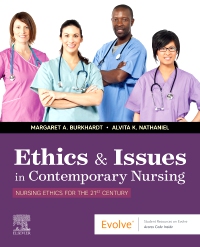

Ethics & Issues In Contemporary Nursing - Elsevier eBook on Vitalsource, 1st Edition
Elsevier eBook on VitalSource
Help your students learn to think beyond the theoretical in any environment. Ethics & Issues in Contemporary Nursing, 1st Edition examines the latest trends, principles, theories, and models in patient care to help your students learn how to make ethically sound decisions in complex and often controversial situations. Written from a global perspective, examples throughout the text reflect current national and international issues, inviting readers to explore the cases considering socio-cultural influences, personal values, and professional ethics. Historical examples demonstrate how to think critically while upholding moral and professional standards, as well as the law. Key topics throughout explore advocacy and rights, diversity, nurse burnout, mass casualty events, social media, violence in the workplace, medication error prevention, opioid and other substance use, HIPAA, and healthcare reform. In addition, this new title contains supplemental case studies and review questions to further challenge students and prepare them to make morally sound decisions in any healthcare setting.
New Edition Expected Availability: 09-03-2024

Ethics & Issues In Contemporary Nursing - Elsevier E-Book on Vitalsource
-
- NEW! Case Presentations from the United States and around the World address ethical dilemmas across the practice of nursing.
- NEW! Think About It boxes present provocative questions within every case presentation.
- NEW! Thoroughly up-to-date and well referenced content ensures material presented is accurate.
- NEW! Straightforward and conversational writing style makes content interesting and understandable.
- NEW! Review questions on Evolve allow students to practice what they have learned.
- NEW! Case studies on Evolve help students apply the theoretical concepts they have learned.
- NEW! Ask Yourself questions integrated into each chapter help students understand the relevance of the material.
- NEW! Discussion questions and Activities within every chapter encourage students to think beyond the theoretical.
- NEW! Summary and Highlights within every chapter make it easier for students to thoroughly understand key elements.
-
- NEW! Case Presentations from the United States and around the World address ethical dilemmas across the practice of nursing.
- NEW! Think About It boxes present provocative questions within every case presentation.
- NEW! Thoroughly up-to-date and well referenced content ensures material presented is accurate.
- NEW! Straightforward and conversational writing style makes content interesting and understandable.
- NEW! Review questions on Evolve allow students to practice what they have learned.
- NEW! Case studies on Evolve help students apply the theoretical concepts they have learned.
- NEW! Ask Yourself questions integrated into each chapter help students understand the relevance of the material.
- NEW! Discussion questions and Activities within every chapter encourage students to think beyond the theoretical.
- NEW! Summary and Highlights within every chapter make it easier for students to thoroughly understand key elements.
-
Part I: Guides for Principled Behavior
1. Social, Philosophical, and Other Historical Forces Influencing the Development of Nursing
2. Ethical Theory
3. Ethical PrinciplesPart II: Developing Principled Behavior
4. Values Clarification
5. Values Development
6. Ethics and Professional Nursing
7. Ethical Decision MakingPart III: Principled Behavior in the Professional Domain
8. Legal Issues
9. Professional Relationship Issues
10. Practice Issues Related to Technology
11. Practice Issues Related to Patient Self-Determination
12. Scholarship IssuesPart IV: Global Issues that Interface with Nursing Practice
13. Global Consciousness in the Twenty-First Century
14. Health Policy Issues
15. Economic Issues
16. Social Issues
17. Gender Issues
18. Transcultural and Spiritual IssuesPart V: The Power to Make a Difference
19. Empowerment for Nurses
20. Facilitating Patient EmpowermentAppendix A: Online Resources
-
-
Ways of Reading
- The appearance of the text and page layout can be modified according to the capabilities of the reading system (font family and font size, spaces between paragraphs, sentences, words, and letters, as well as color of background and text)
- This e-publication is accessible to the full extent that the file format and types of content allow, on a specific reading device, by default, without necessarily including any additions such as textual descriptions of images or enhanced navigation
- No information about nonvisual reading is available
-
Conformance
- No information is available
-
Navigation
- Table of contents to all chapters of the text via links
- Page list to go to pages from the print source version
-
Rich Content
- No information is available
-
Hazards
- No information is available
-
Product Content
- No information is available
-
Legal Considerations
- No information is available
-
Additional Accessibility Information
- Page breaks included from the original print source
- For readers with color vision deficiency, use of color (e.g., in diagrams, graphics and charts, in prompts, or on buttons inviting a response) is not the sole means of graphical distinction or of conveying information
- E-publication includes basic navigation (usually less detailed than TOC-based navigation)
- Where links, controls or buttons are included in the content, the purpose or functionality of each link, control or button is apparent from the associated text alone - or where it is unclear, separate link, control or button descriptions are provided
- All (or substantially all) textual matter is arranged in a single logical reading order (including text that is visually presented as separate from the main text flow, e.g., in boxouts, captions, tables, footnotes, endnotes, citations, etc.). Non-textual content is also linked from within this logical reading order. (Purely decorative non-text content can be ignored).
- The language of the text has been specified (e.g., via the HTML or XML lang attribute) to optimise text-to-speech (and other alternative renderings), both at the whole document level and, where appropriate, for individual words, phrases or passages in a different language.
-
Ways of Reading


 as described in our