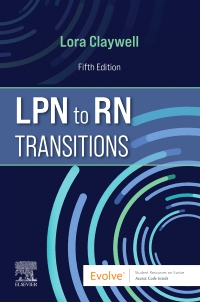

LPN to RN Transitions - Elsevier eBook on VitalSource, 5th Edition
Elsevier eBook on VitalSource
LPN to RN Transitions, 5th Edition makes it easy for students to advance in their nursing career with all of the essential information they need to pursue their RN degree and practice as registered nurses. This new edition includes practical information on role transition, cultural competency, delegation, interprofessional collaboration, professional writing, and more. Plus, newly revised and updated chapters provide the latest information for one complete, indispensable resource to help students succeed in everything from the classroom to clinical practice!
New Edition Expected Availability: 10-11-2024

LPN to RN Transitions - Elsevier E-Book on VitalSource
-
- NEW! Interprofessional collaboration coverage prepares you to work effectively with other members of the healthcare team.
- NEW! Information on trauma-Informed care prepares you to deliver care with a person-centered approach, which promotes a collaborative, trusting, respectful, and emotionally supportive care environment.
- NEW! Coverage of competencies for the RN gives you a clear vision of what skills registered nursing encompasses and how they differ from practical or vocational nursing.
- UPDATED! Next Generation NCLEX®-style content prepares you for the upcoming changes to the NCLEX-RN® exam.
- EXPANDED! Additional information on key topics enhances coverage of time management, preparing for class, self-care, prioritization, outcomes and cost containment, mandatory reporting, and case management for chronic illness across all settings, including home care.
-
- NEW! Interprofessional collaboration coverage prepares students to work effectively with other members of the healthcare team.
- NEW! Information on trauma-Informed care prepares students to deliver care with a person-centered approach, which promotes a collaborative, trusting, respectful, and emotionally supportive care environment.
- NEW! Coverage of competencies for the RN gives students a clear vision of what skills registered nursing encompasses and how they differ from practical or vocational nursing.
- UPDATED! Next Generation NCLEX®-style content prepares students for the upcoming changes to the NCLEX-RN® exam.
- EXPANDED! Additional information on key topics enhances coverage of time management, preparing for class, self-care, prioritization, outcomes and cost containment, mandatory reporting, and case management for chronic illness across all settings, including home care.
- Clear, succinct coverage helps students understand on the issues that an RN must address for a successful practice.
- Respect for the accomplishments of the LPN is emphasized throughout the text.
- Engaging design and thoughtful exercises keep students focused on key concepts and learning objectives.
- Critical thinking questions at the end of every chapter reinforce student understanding of important content.
- Patient scenarios and Application to Practice boxes challenge students to apply their knowledge to real-world clinical situations.
- FYI boxes encourage students to think about how their day-to-day interactions will change as an RN.
- Key Terms and Key Points help students learn vocabulary words and concepts related to the topic being discussed.
-
UNIT ONE ESSENTIAL SKILLS TO BEGIN YOUR TRANSITION
1 Honoring Your Past, Planning Your Future
2 Assessing Yourself and Designing Success
3 Study Habits and Test-Taking Skills
UNIT TWO THE PROFESSION AND DISCIPLINE OF REGISTERED NURSING
4 Distinguishing the RN Role from the LPN/LVN Role
5 Using Nursing Theory to Guide Professional Practice
6 Providing Patient-Centered Care Through the Nursing Process
7 Critical and Diagnostic Thinking for Better Clinical Judgment
UNIT THREE THE RN AS PROVIDER OF CARE
8 Practicing Evidence-Based Decision Making
9 Communicating with Patients and Co-Workers
10 Teaching Patients and Their Families
11 The Nurses, Ideas, and Forces That Define the Profession
12 Upholding Legal and Ethical Principles
13 Care and Safety Standards, Competence, and Nurse Accountability
UNIT FOUR THE RN AS MANAGER OF CARE
14 Leading, Delegating, and Collaborating
15 Promoting Healthful Living in the Primary Care Setting
16 Managing Care in Secondary and Tertiary Health Care
UNIT FIVE PUTTING IT ALL TOGETHER
17 Reflecting on Your Transition
18. Prepare Now to Pass NCLEX-RN®
Appendices:
Basic Math Review
-
-
Ways of Reading
- The appearance of the text and page layout can be modified according to the capabilities of the reading system (font family and font size, spaces between paragraphs, sentences, words, and letters, as well as color of background and text)
- This e-publication is accessible to the full extent that the file format and types of content allow, on a specific reading device, by default, without necessarily including any additions such as textual descriptions of images or enhanced navigation
- No information about nonvisual reading is available
-
Conformance
- No information is available
-
Navigation
- Table of contents to all chapters of the text via links
- Page list to go to pages from the print source version
-
Rich Content
- No information is available
-
Hazards
- No information is available
-
Product Content
- No information is available
-
Legal Considerations
- No information is available
-
Additional Accessibility Information
- Page breaks included from the original print source
- For readers with color vision deficiency, use of color (e.g., in diagrams, graphics and charts, in prompts, or on buttons inviting a response) is not the sole means of graphical distinction or of conveying information
- E-publication includes basic navigation (usually less detailed than TOC-based navigation)
- Where links, controls or buttons are included in the content, the purpose or functionality of each link, control or button is apparent from the associated text alone - or where it is unclear, separate link, control or button descriptions are provided
- All (or substantially all) textual matter is arranged in a single logical reading order (including text that is visually presented as separate from the main text flow, e.g., in boxouts, captions, tables, footnotes, endnotes, citations, etc.). Non-textual content is also linked from within this logical reading order. (Purely decorative non-text content can be ignored).
- The language of the text has been specified (e.g., via the HTML or XML lang attribute) to optimise text-to-speech (and other alternative renderings), both at the whole document level and, where appropriate, for individual words, phrases or passages in a different language.
-
Ways of Reading


 as described in our