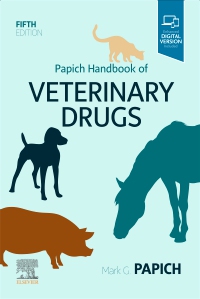

Papich Handbook of Veterinary Drugs - Elsevier eBook on VitalSource, 5th Edition
Elsevier eBook on VitalSource
Choose the drug handbook recommended by practicing veterinarians! Papich Handbook of Veterinary Drugs, 5th Edition includes concise entries for more than 550 drugs, with appendices summarizing clinically relevant information at a glance. Nineteen new drug monographs are added to this edition, and over 100 drug monographs have been updated and revised. An Expert Consult website contains more than 150 instructional handouts that may be customized and printed out for client use. Ideal for use in the classroom and the clinic, this handy reference makes it easy for students to find the drug data and dosage recommendations needed to treat small and large animals, right when they need it!
New Edition Expected Availability: 03-01-2027

Papich Handbook of Veterinary Drugs - Elsevier E-Book on VitalSource
-
- NEW! 19 new drug monographs familiarize you with the latest drugs available for veterinary practice
- UPDATED drug monographs include new information such as changes in doses, interactions, indications, adverse reactions, and contraindications
- NEW! Expert Consult companion website replaces the former website and includes more than 150 customizable client information handouts for commonly prescribed drugs, including information on the prescribed drug and dosage, do’s and don’ts, and possible side effects
- NEW! Removal of entries for drugs that have been taken off the market
-
- NEW! 19 new drug monographs familiarize students with the latest drugs available for veterinary practice
- UPDATED drug monographs include new information such as changes in doses, interactions, indications, adverse reactions, and contraindications
- NEW! Expert Consult companion website replaces the former website and includes more than 150 customizable client information handouts for commonly prescribed drugs, including information on the prescribed drug and dosage, do’s and don’ts, and possible side effects
- Over 550 concise drug monographs are organized alphabetically and cross-referenced by classification, trade, and generic name, providing quick and easy access to key information for each drug including:
Generic and trade names, pronunciation, and functional classification
Pharmacology and mechanism of action
Indications and clinical uses
Precautionary information — adverse reactions and side effects, contraindications and precautions, and drug interactions — all featured in colored boxes for at-a-glance retrieval
Instructions for use
Patient monitoring and laboratory tests
Formulations available
Stability and storage
Dosage information for both small and large animals
Regulatory information- Clinically relevant appendices help you determine appropriate therapeutic regimens and look up safety and legal considerations
- Removal of entries for drugs that have been taken off the market
-
-
 Papich Handbook of Veterinary DrugsPaperback
-
-
Listing of Drugs According to Functional and Therapeutic Classification
Alphabetical Drug Monographs
Appendices
A: Information for Pharmacists
B: Prescription Writing Reference
C: Calculation of Drug Doses
D: Compounded Formulations: What to Look For to Detect Incompatibility or Instability
E: Controlled Substance Charts: United States and Canada
F: Drugs for Infections Commonly Seen in Small Animals
G: Antibiotic Drug Selection for Equine Bacterial Pathogens
H: Drugs that May Induce Cytochrome P450 Enzymes
I: Drugs that May Inhibit Cytochrome P450 Enzymes
J: Drugs that May Inhibit the P-Glycoprotein Membrane Transporter Coded by ABCB1 (formerly known as MDR1)
K: Drugs that are Substrates for the P-Glycoprotein Membrane Transporter Coded by ABCB1 (formerly known as MDR1)
L: Fluid Solution Composition
M: How to Report an Adverse Drug Reaction
N: Drugs Prohibited from Use in Food-Producing Animals
O: Performance Horse Drug Regulations and Restrictions, Association of Racing Commissioners International, Inc., Uniform Classification Guidelines for Foreign Substances (Revised April 2015) -
-
Ways of Reading
- The appearance of the text and page layout can be modified according to the capabilities of the reading system (font family and font size, spaces between paragraphs, sentences, words, and letters, as well as color of background and text)
- This e-publication is accessible to the full extent that the file format and types of content allow, on a specific reading device, by default, without necessarily including any additions such as textual descriptions of images or enhanced navigation
- No information about nonvisual reading is available
-
Conformance
- No information is available
-
Navigation
- Table of contents to all chapters of the text via links
- Page list to go to pages from the print source version
-
Rich Content
- No information is available
-
Hazards
- No information is available
-
Product Content
- No information is available
-
Legal Considerations
- No information is available
-
Additional Accessibility Information
- Page breaks included from the original print source
- For readers with color vision deficiency, use of color (e.g., in diagrams, graphics and charts, in prompts, or on buttons inviting a response) is not the sole means of graphical distinction or of conveying information
- E-publication includes basic navigation (usually less detailed than TOC-based navigation)
- Where links, controls or buttons are included in the content, the purpose or functionality of each link, control or button is apparent from the associated text alone - or where it is unclear, separate link, control or button descriptions are provided
- All (or substantially all) textual matter is arranged in a single logical reading order (including text that is visually presented as separate from the main text flow, e.g., in boxouts, captions, tables, footnotes, endnotes, citations, etc.). Non-textual content is also linked from within this logical reading order. (Purely decorative non-text content can be ignored).
- The language of the text has been specified (e.g., via the HTML or XML lang attribute) to optimise text-to-speech (and other alternative renderings), both at the whole document level and, where appropriate, for individual words, phrases or passages in a different language.
-
Ways of Reading

 as described in our