ISBN:
9780323709750
Copyright:
2021
Publication Date:
12-10-2020
Page Count:
240
Imprint:
Mosby
List Price:
$59.99

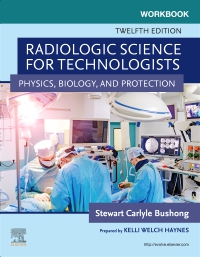
Workbook for Radiologic Science for Technologists - Elsevier E-Book on VitalSource, 12th Edition
by Elizabeth Shields, MHA, RT(R) and Stewart C. Bushong, ScD, FAAPM, FACR
Elsevier eBook on VitalSource
ISBN:
9780323709750
Copyright:
2021
Publication Date:
12-10-2020
Page Count:
240
Imprint:
Mosby
List Price:
$59.99
Most review copies are eBooks – how fast!
A review copy request is most likely to be fulfilled as an eBook on VitalSource rather than a print product, unless no eBook is available. eBooks become available in as little as a few hours. Print products will take between 7 and 10 days to arrive. To request a print copy, please contact us through the Evolve Support Center for further assistance or contact your Elsevier Sales Rep.
Reinforce student understanding of diagnostic imaging and help them sharpen their radiographic skills! Corresponding to the chapters in Bushong’s Radiologic Science for Technologists, 12th Edition, this workbook helps students review key concepts and gain the technical knowledge needed to become informed and confident radiographers. More than 100 worksheets include engaging exercises allowing students to assess their comprehension and apply their knowledge to imaging practice.
New Edition Expected Availability: 08-14-2025

Workbook for Radiologic Science for Technologists - Elsevier E-Book on VitalSource
Elsevier eBook on VitalSource
ISBN: 9780323933346
-
- NEW! Closer correlation of worksheets to the textbook simplifies your review of radiologic physics, which can be a difficult subject to understand
- NEW! New worksheets on digital radiographic technique and the digital image display correspond to the new content covered in the textbook
-
- NEW! Closer correlation of worksheets to the textbook simplifies your review of radiologic physics, which can be a difficult subject to understand
- NEW! New worksheets on digital radiographic technique and the digital image display correspond to the new content covered in the textbook
- More than 100 worksheets make it easy to review specific topics from the text, and are numbered according to textbook chapter
- In-depth coverage of the textbook’s topics lets you review medical imaging concepts and apply them to practice
- Penguin icons highlight important information from the textbook, making it easier to understand concepts and complete the worksheet exercises
-
-
 Radiologic Science for Technologists Elsevier eBook on VitalSourceElsevier eBook on VitalSource
-
-
PART 1: RADIOLOGIC PHYSICS
1. Essential Concepts of Radiologic Science
2. Basic Physics Primer
3. The Structure of Matter
4. Electromagnetic Energy
5. Electricity, Magnetism, and Electromagnetism
PART II: X-RADIATION
6. The X-Ray Imaging System
7. The X-Ray Tube
8. X-Ray Production
9. X-Ray Emission
10. X-Ray Interaction with Matter
PART III: THE MEDICAL IMAGE
11. Imaging Science
12. Computed Radiography
13. Digital Radiography
14. Digital Radiographic Technique
15. Image Acquisition
16. Patient-Image Optimization
PART IV: MEDICAL IMAGE DISPLAY
17. Viewing the Medical Image
18. Picture Archiving and Communication System
PART V: MEDICAL IMAGE QUALITY
19. Image Perception
20. Digital Display Device
21. Medical Image Descriptors
22. Scatter Radiation
23. Radiographic Artifacts
PART VI: ADVANCED MEDICAL IMAGING
24. Mammography
25. Fluoroscopy
26. Interventional Radiology
27. Computed Tomography
28. Tomosynthesis
PART VII: RADIOBIOLOGY
29. Human Biology
30. Fundamental Principles of Radiobiology
31. Molecular Radiobiology
32. Cellular Radiobiology
33. Deterministic Effects of Radiation
34. Stochastic Effects of Radiation
PART VIII: RADIATION PROTECTION
35. Health Physics
36. Designing for Radiation Protection
37. Radiography/Fluoroscopy Patient Radiation Dose
38. Computed Tomography Patient Radiation Dose
39. Patient Radiation Dose Management
40. Occupational Radiation Dose Management -
-
Ways of Reading
- The appearance of the text and page layout can be modified according to the capabilities of the reading system (font family and font size, spaces between paragraphs, sentences, words, and letters, as well as color of background and text)
- This e-publication is accessible to the full extent that the file format and types of content allow, on a specific reading device, by default, without necessarily including any additions such as textual descriptions of images or enhanced navigation
- No information about nonvisual reading is available
-
Conformance
- No information is available
-
Navigation
- Table of contents to all chapters of the text via links
- Page list to go to pages from the print source version
-
Rich Content
- No information is available
-
Hazards
- No information is available
-
Product Content
- No information is available
-
Legal Considerations
- No information is available
-
Additional Accessibility Information
- Page breaks included from the original print source
- For readers with color vision deficiency, use of color (e.g., in diagrams, graphics and charts, in prompts, or on buttons inviting a response) is not the sole means of graphical distinction or of conveying information
- E-publication includes basic navigation (usually less detailed than TOC-based navigation)
- Where links, controls or buttons are included in the content, the purpose or functionality of each link, control or button is apparent from the associated text alone - or where it is unclear, separate link, control or button descriptions are provided
- All (or substantially all) textual matter is arranged in a single logical reading order (including text that is visually presented as separate from the main text flow, e.g., in boxouts, captions, tables, footnotes, endnotes, citations, etc.). Non-textual content is also linked from within this logical reading order. (Purely decorative non-text content can be ignored).
- The language of the text has been specified (e.g., via the HTML or XML lang attribute) to optimise text-to-speech (and other alternative renderings), both at the whole document level and, where appropriate, for individual words, phrases or passages in a different language.
-
Ways of Reading
Most review copies are eBooks – how fast!
A review copy request is most likely to be fulfilled as an eBook on VitalSource rather than a print product, unless no eBook is available. eBooks become available in as little as a few hours. Print products will take between 7 and 10 days to arrive. To request a print copy, please contact us through the Evolve Support Center for further assistance or contact your Elsevier Sales Rep.

 as described in our