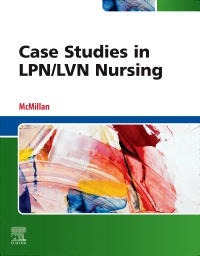

Case Studies in LPN/LVN Nursing Elsevier eBook on VitalSource, 1st Edition
Elsevier eBook on VitalSource
Give students valuable experience applying their knowledge and critical thinking skills to real-world scenarios! Case Studies in LPN/LVN Nursing features 50 case studies that cover all clinical areas of practice: fundamental skills, medical-surgical adult health nursing, pediatric, maternity, mental health, geriatric nursing, and leadership management. Patient scenarios help students learn how to apply nursing knowledge to nursing practice by promoting the development of critical thinking and clinical reasoning skills. Cases integrate content on assessment findings, diagnostic/laboratory tests, pharmacology, and nutrition to encourage students to think critically about all aspects of patient care, including the physical and psychosocial needs of the patient, communication, collaboration with the health care team, teaching wellness and health promotion, and integration of cultural competence. Cases unfold as care is provided and a variety of multiple-choice, select-all-that-apply, prioritization, and short-answer questions challenge students to formulate and select relevant and/or potential decisions. The case studies are separated by clinical area, allowing students to use this worktext throughout their nursing program. Questions for the Next-Generation NCLEX® (NGN) prepare students for the biggest change to the NCLEX-PN® test plan to date. Answer keys are available to instructors on our accompanying Evolve website.
-
- Fifty case studies cover patient scenarios that span the entire LPN/LVN curriculum
- Unfolding case progressions help students identify changes, anticipate outcomes, and prioritize care
- Emphasis on interprofessional collaboration builds students’ communication and delegation skills
- A variety of question formats reinforce critical thinking and help prepare students for the NCLEX-PN® exam
- Documentation questions challenge students to identify critical information to chart
-
-

-
 Case Studies in LPN/LVN NursingPaperback
-
-
Fundamentals
Asepsis and Infection Control
Data Collection (Vital Signs)
Nutrition and Fluids
Medication Administration
Mobility and Transferring
Patient Hygiene
Postop (wound care, respiratory, embolism)
Medical-Surgical
Breast Cancer
Bronchitis
Cerebral Vascular Accident
Chronic Kidney Disease
Diabetes Mellitus, Type 2
Emphysema
Gastroesophageal Reflux Disease
Heart Failure
Hypertension
Low Back Pain
Multiple Sclerosis
Myocardial Infarction
Parkinson’s Disease
Peptic Ulcer Disease
Pneumonia
Prostate Cancer
Rheumatoid Arthritis
Thyroid Disorder
Urinary Tract Infection
Maternity
Abruptio Placentae
Assessment of Newborn
Contraception
Gestational Diabetes
Incompetent Cervix
Normal Labor
Placenta Previa
Postpartum Mood Disorder
Preterm Infant
Pediatrics
Asthma
Autism
Cerebral Palsy
Cleft Lip/Palate
Communicable disease
Cystic Fibrosis
Diabetes Mellitus Type 1
Eating Disorder
Fracture
Meningitis
Obesity
Otitis Media
Physical Assessment of child
Tonsillitis
Sickle Cell Anemia
Scoliosis
Mental Health
Alcoholism
Anxiety Disorder
Bipolar Disorder
Depression
Post-Traumatic Stress Disorder
Schizophrenia
Substance Abuse
Geriatrics
Abuse/Neglect
Alzheimer’s Disease
Constipation
Death and Dying
Dehydration
End-of-Life
Falls
Incontinence
Mobility
Osteoporosis
Pneumonia
Pressure Injury
-
-
Ways of Reading
- The appearance of the text and page layout can be modified according to the capabilities of the reading system (font family and font size, spaces between paragraphs, sentences, words, and letters, as well as color of background and text)
- This e-publication is accessible to the full extent that the file format and types of content allow, on a specific reading device, by default, without necessarily including any additions such as textual descriptions of images or enhanced navigation
- All content can be read as read aloud speech or dynamic braille
- Has alternative text descriptions for images
-
Conformance
- The publication contains a conformance statement that it meets the EPUB Accessibility 1.1, WCAG 2.1, Level AA standard. Please see https://bornaccessible.benetech.org/certified-publishers/ for further details of our compatibility testing.
- The certifier's credential is https://bornaccessible.benetech.org/certified-publishers/
- For detailed accessibility information, see Elsevier's website at https://www.elsevier.com/about/accessibility
- For queries regarding accessibility information, contact [email protected]
- The publication was certified on 12-02-2026
-
Navigation
- Table of contents to all chapters of the text via links
- Index with links to referenced entries
- Elements such as headings, tables, etc. for structured navigation
- Page list to go to pages from the print source version
-
Rich Content
- No information is available
-
Hazards
- The publication contains no hazards
-
Product Content
- Content includes any type of illustrations.
- The primary content is text.
- Content includes a significant number of actionable (clickable) web links to external content, downloadable resources, supplementary material, etc.
- Content includes a significant number of actionable (clickable) cross-references, hyperlinked notes and annotations, or with other actionable links between largely textual elements (e.g., quiz/test questions, 'choose your own ending', etc.).
- Content includes figures, diagrams, charts and/or graphs, including other 'mechanical' (i.e. non-photographic) illustrations.
- Content includes a significant number of web links (printed URLs, QR codes etc.).
- Content includes assessment material, e.g., Questions or student exercises, problems, quizzes or tests (as an integral part of the work).
- Content includes text within images, including text-as-text embedded in diagrams, charts, or within images containing speech balloons, thought bubbles, captions, etc.
-
Legal Considerations
- No information is available
-
Additional Accessibility Information
- Content is enhanced with ARIA roles to optimize organization and facilitate navigation
- Page breaks included from the original print source
- For readers with color vision deficiency, use of color (e.g., in diagrams, graphics and charts, in prompts, or on buttons inviting a response) is not the sole means of graphical distinction or of conveying information
- The body text is presented with a contrast ratio of at least 4.5:1 (or 3:1 for large/heading text)
- Ultra-high contrast between text and background
- E-publication includes basic navigation (usually less detailed than TOC-based navigation)
- Where links, controls or buttons are included in the content, the purpose or functionality of each link, control or button is apparent from the associated text alone - or where it is unclear, separate link, control or button descriptions are provided
- All (or substantially all) textual matter is arranged in a single logical reading order (including text that is visually presented as separate from the main text flow, e.g., in boxouts, captions, tables, footnotes, endnotes, citations, etc.). Non-textual content is also linked from within this logical reading order. (Purely decorative non-text content can be ignored).
- Where interactive content is included in the product, controls are provided (e.g., for speed, pause and resume, reset) and labelled to make their use clear.
- The language of the text has been specified (e.g., via the HTML or XML lang attribute) to optimise text-to-speech (and other alternative renderings), both at the whole document level and, where appropriate, for individual words, phrases or passages in a different language.
-
Ways of Reading

 as described in our