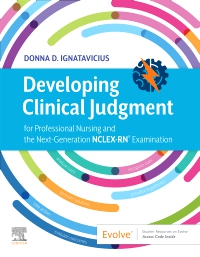

Developing Clinical Judgment Elsevier eBook on VitalSource, 1st Edition
Elsevier eBook on VitalSource
Equip your students to pass the Next-Generation NCLEX® Examination (NGN) on their first try with Developing Clinical Judgment for Professional Nursing and the Next-Generation NCLEX-RN® Examination. Written by renowned nursing education expert Donna D. Ignatavicius and a team of expert item writers, this practical workbook is the only book on the market focused exclusively on developing the clinical reasoning skills needed for success on the NGN and in clinical practice. This collection of engaging and practical thinking exercises has been carefully developed to incorporate the National Council of State Boards of Nursing (NCSBN) Clinical Judgment Model (CJM) and to emphasize the new item types that will be integral to the NGN. Exercises range from basic to more complex and address all specialty areas to fully prepare students for all facets of the exam. In all, this "next-generation" workbook will become an invaluable companion throughout nursing school, helping you grow your students’ clinical reasoning skills to match what’s expected on the new NGN!
New Edition Expected Availability: 01-18-2024

Developing Clinical Judgment for Professional Nursing Practice and NGN Readiness - Elsevier eBook on VitalSource
-
- This one-of-a-kind workbook dedicated to developing clinical judgment skills helps prepare students for the Next-Generation NCLEX® Exam (NGN) through practical thinking exercises in which students will apply the National Council of State Boards of Nursing (NCSBN) Clinical Judgment Model (CJM)
- A comprehensive collection of carefully developed clinical reasoning exercises range from basic to more complex and address all specialty areas
- Answer key with robust rationales to remediate learning follows at the end of the book
- Six-part organization guides students through the entire test NGN plan
- Students can answer questions in the book itself or on a companion Evolve website for automated scoring and remediation
-
Part 1: Introduction: The Use of Clinical Judgment in Professional Nursing Practice
1. Transitioning from the Nursing Process to Clinical Judgment
2. Applying the NCSBN Clinical Judgment Model to Ensure Client Safety
Part 2: Clinical Judgment for Clients Across the Lifespan Experiencing Commonly Occurring Health Problems
3. Perfusion: Common Problems
4. Clotting: Deep Vein Thrombosis
5. Gas Exchange: Common Problems
6. Elimination: Benign Prostatic Hyperplasia
7. Nutrition: Common Problems
8. Mobility: Common Problems
9. Metabolism: Common Problems
10. Cellular Regulation: Breast Cancer
11. Inflammation: Common Problems
12. Infection: Common Problems
13. Sensory Perception: Cataracts
14. Cognition: Common Problems
15. Mood and Affect: Depression
16. Stress and Coping: Generalized Anxiety Disorder
17. Reproduction: Uterine Leiomyoma/Hysterectomy
Part 3: Clinical Judgment for Childbearing Families
18. Reproduction: Childbearing Family
Part 4: Clinical Judgment for Clients Across the Lifespan Experiencing Complex Multi-System Health Problems
19. Perfusion: Complex Problems
20. Mobility: Spinal Cord Injury
21. Cognition: Traumatic Brain Injury
22. Infection: Sepsis
23. Gas Exchange: Chest Trauma
24. Elimination: Complex Problems
25. Metabolism: Complex Problems
26. Tissue Integrity: Burns
27. Stress and Coping: Substance Use Disorder
28. Management of Care: Complex Problems
Part 5: Pharmacology for Nursing
29. Pharmacology in Management of Common Health Problems
30. Pharmacology in Management of Complex Health Problems
Part 6: Answers and Rationales for Thinking Exercises
Answers and Rationales for Thinking Exercises -
-
Ways of Reading
- The appearance of the text and page layout can be modified according to the capabilities of the reading system (font family and font size, spaces between paragraphs, sentences, words, and letters, as well as color of background and text)
- This e-publication is accessible to the full extent that the file format and types of content allow, on a specific reading device, by default, without necessarily including any additions such as textual descriptions of images or enhanced navigation
- No information about nonvisual reading is available
-
Conformance
- No information is available
-
Navigation
- Table of contents to all chapters of the text via links
- Page list to go to pages from the print source version
-
Rich Content
- No information is available
-
Hazards
- No information is available
-
Product Content
- No information is available
-
Legal Considerations
- No information is available
-
Additional Accessibility Information
- Page breaks included from the original print source
- For readers with color vision deficiency, use of color (e.g., in diagrams, graphics and charts, in prompts, or on buttons inviting a response) is not the sole means of graphical distinction or of conveying information
- E-publication includes basic navigation (usually less detailed than TOC-based navigation)
- Where links, controls or buttons are included in the content, the purpose or functionality of each link, control or button is apparent from the associated text alone - or where it is unclear, separate link, control or button descriptions are provided
- All (or substantially all) textual matter is arranged in a single logical reading order (including text that is visually presented as separate from the main text flow, e.g., in boxouts, captions, tables, footnotes, endnotes, citations, etc.). Non-textual content is also linked from within this logical reading order. (Purely decorative non-text content can be ignored).
- The language of the text has been specified (e.g., via the HTML or XML lang attribute) to optimise text-to-speech (and other alternative renderings), both at the whole document level and, where appropriate, for individual words, phrases or passages in a different language.
-
Ways of Reading


 as described in our