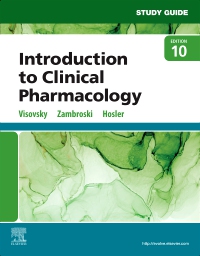

Study Guide for Introduction to Clinical Pharmacology Elsevier eBook on VitalSource, 10th Edition
Elsevier eBook on VitalSource
Reinforce student understanding of nursing pharmacology and medication safety! Corresponding chapter by chapter to Introduction to Clinical Pharmacology, 10th Edition, this study guide provides exercises designed to help your students administer medications safely and prevent drug errors. Learning activities include a math review, dosage calculation exercises, and case studies that emphasize clinical decision-making and prioritization. It’s the comprehensive review that students need to succeed on course and licensure exams!
New Edition Expected Availability: 02-12-2024

Study Guide for Introduction to Clinical Pharmacology - Elsevier eBook on VitalSource
-
- NEW! Updated exercises cover newly approved pharmaceutical treatments and drugs.
- NEW Next Generation NCLEX®-format and alternate item review questions prepare you for the new licensure exam.
- NEW organization of chapters more logically organizes review exercises by body system and type of drug.
-
- NEW! Updated exercises cover newly approved pharmaceutical treatments and drugs.
- NEW Next Generation NCLEX®-format and alternate item review questions prepare students for the new licensure exam.
- NEW organization of chapters more logically organizes review exercises by body system and type of drug.
- Variety of exercises reinforces student understanding with matching, multiple-choice, and select-all-that-apply questions, as well as crossword puzzles.
- Practice quizzes prepare students for course and licensure exams.
- Reader-friendly writing style and organization makes the content easier to understand.
-
-
 Introduction to Clinical Pharmacology - Elsevier eBook on VitalSourceElsevier eBook on VitalSource
-
-
Unit I General Principles
1. Pharmacology and the Nursing Process in LPN Practice
2. Legal, Regulatory, and Ethical Aspects of Drug Administration
3. Principles of Pharmacology
Unit II Principals of Medication Administration
4. Drug Calculation: Preparing and Administering Drugs
Unit III Drug Categories
5. Drugs for Bacterial Infections
6. Drugs for Fungal Infections and Tuberculosis
7. Drugs for Viral and Retroviral Infections
8. Drugs for Allergy and Respiratory Problems
9. Drugs Affecting the Renal/Urinary System
10. Drugs Affecting the Cardiovascular System
11. Drugs for Central Nervous System Problems
12. Drugs for Mental Health
13. Drugs for Pain Management
14. Drugs for Inflammation, Arthritis and Gout
15. Drugs for Gastrointestinal Problems
16. Drugs Affecting the Hematologic System
17. Drugs for Immunization and Immunomodulation
18. Drugs for Osteoporosis and Hormonal Problems
19. Drug Therapy for Diabetes
20. Drugs for Eye and Ear Problems
21. Over-the-Counter Drug Therapy
-
-
Ways of Reading
- The appearance of the text and page layout can be modified according to the capabilities of the reading system (font family and font size, spaces between paragraphs, sentences, words, and letters, as well as color of background and text)
- This e-publication is accessible to the full extent that the file format and types of content allow, on a specific reading device, by default, without necessarily including any additions such as textual descriptions of images or enhanced navigation
- No information about nonvisual reading is available
-
Conformance
- No information is available
-
Navigation
- Table of contents to all chapters of the text via links
- Page list to go to pages from the print source version
-
Rich Content
- No information is available
-
Hazards
- No information is available
-
Product Content
- No information is available
-
Legal Considerations
- No information is available
-
Additional Accessibility Information
- Page breaks included from the original print source
- For readers with color vision deficiency, use of color (e.g., in diagrams, graphics and charts, in prompts, or on buttons inviting a response) is not the sole means of graphical distinction or of conveying information
- E-publication includes basic navigation (usually less detailed than TOC-based navigation)
- Where links, controls or buttons are included in the content, the purpose or functionality of each link, control or button is apparent from the associated text alone - or where it is unclear, separate link, control or button descriptions are provided
- All (or substantially all) textual matter is arranged in a single logical reading order (including text that is visually presented as separate from the main text flow, e.g., in boxouts, captions, tables, footnotes, endnotes, citations, etc.). Non-textual content is also linked from within this logical reading order. (Purely decorative non-text content can be ignored).
- The language of the text has been specified (e.g., via the HTML or XML lang attribute) to optimise text-to-speech (and other alternative renderings), both at the whole document level and, where appropriate, for individual words, phrases or passages in a different language.
-
Ways of Reading

 as described in our