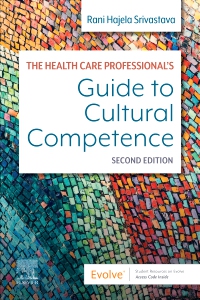

The Health Care Professional's Guide to Cultural Competence - Elsevier E-Book on VitalSource, 2nd Edition
Elsevier eBook on VitalSource
With this text, your students will learn how to understand and care for a wide diversity of patients! The Health Care Professional’s Guide to Cultural Competence, 2nd Edition provides a guide to safe and effective cross-cultural care. Applying theory to practice, the book begins with an overview of clinical cultural competence. This guide shows how to apply cultural competence across diverse populations, and then discusses considerations in working with specific populations. Using this approach, students will develop a set of behaviours, attitudes, and policies that enhance care in many settings. Written by a diverse authoring group with respect to geography, cultural identity, professional discipline, and perspectives, this guide helps students develop skills in caring for Indigenous, LGBTQ2, racialized persons, and immigrant and refugee populations.
-
- NEW! New chapters on Indigenous health, sexual and gender diversity, immigrant and refugee health, and community health are added to this edition, and new topics include cultural safety, cultural humility, the impacts of racism, working with interpreters and the use of technology, palliative care, and more
- NEW! UNIQUE! Cultural competence and safety perspectives throughout the text help you to be more responsive in delivering culturally safe care, and in reaching the goal of equity and culturally competent care
- NEW! Discussion of cultural issues addresses power, privilege, intersectionality, equity, advocacy, and being an ally
- NEW! Up-to-date content includes the latest statistics, guidelines, research, references, and resources
- NEW! Evolve website enhances your understanding with review questions, unfolding case studies, and more
-
- NEW! New chapters on Indigenous health, sexual and gender diversity, immigrant and refugee health, and community health are added to this edition, and new topics include cultural safety, cultural humility, the impacts of racism, working with interpreters and the use of technology, palliative care, and more
- NEW! UNIQUE! Cultural competence and safety perspectives are threaded throughout the text to support the responsiveness of health care educators and providers in delivering culturally safe care, and in reaching the goal of equity and culturally competent care
- NEW! Expanded discussion of cultural issues addresses power, privilege, intersectionality, equity, advocacy, and being an ally
- NEW! Up-to-date content includes the latest statistics, guidelines, research, references, and resources
- NEW! Evolve website includes PowerPoint® slides, review questions, unfolding case studies, and more
- UNIQUE approach looks at populations the way health care workers encounter them, not by ethno-cultural/religious labels
- Accessible writing style relays information in a balanced and concise manner for undergraduate and graduate students as well as health care professionals
- Multidisciplinary perspective is provided by authors who represent a variety of health disciplines and cultural identities, who may be educators or practitioners, each presenting complex ideas in understandable ways and controversial ideas in a transparent way
- Cultural Considerations in Care and Cultural Competence in Action boxes integrate theory into practice and invite critical self-reflection
- Teaching and learning tools include learning objectives and key terms at the beginning of each chapter, plus end-of-chapter group activities, review questions, and more
-
SECTION I Foundation Stones
1. Cultural Competence in Health Care: Overview of Issues
2. Myths, Misconceptions, and Evolving Perspectives
3. The Culture Care Framework
4. Navigating Difference
SECTION II Universally Applicable Cultural Knowledge
5. Cross-Cultural Communication
6. Working With Interpreters in Health Care Settings
7. Caring for Diverse Families
8. Healing Systems and Traditions
9. Cultural Safety for Indigenous Health Equity
10. Sexual and Gender Diversity
11. Immigrant and Refugee Health
SECTION III Specific Cultural Considerations
12. Cultural Considerations at the Beginning of Life (The Perinatal Period)
13. Cultural Considerations at the End of Life
14. Cultural Considerations in Mental Health Practice
15. Cultural Considerations in Pain Management
16. The Impact of Social and Structural Determinants on Community Health: A Focus on the African Nova Scotian Experience -
-
Ways of Reading
- The appearance of the text and page layout can be modified according to the capabilities of the reading system (font family and font size, spaces between paragraphs, sentences, words, and letters, as well as color of background and text)
- This e-publication is accessible to the full extent that the file format and types of content allow, on a specific reading device, by default, without necessarily including any additions such as textual descriptions of images or enhanced navigation
- No information about nonvisual reading is available
-
Conformance
- No information is available
-
Navigation
- Table of contents to all chapters of the text via links
- Page list to go to pages from the print source version
-
Rich Content
- No information is available
-
Hazards
- No information is available
-
Product Content
- No information is available
-
Legal Considerations
- No information is available
-
Additional Accessibility Information
- Page breaks included from the original print source
- For readers with color vision deficiency, use of color (e.g., in diagrams, graphics and charts, in prompts, or on buttons inviting a response) is not the sole means of graphical distinction or of conveying information
- E-publication includes basic navigation (usually less detailed than TOC-based navigation)
- Where links, controls or buttons are included in the content, the purpose or functionality of each link, control or button is apparent from the associated text alone - or where it is unclear, separate link, control or button descriptions are provided
- All (or substantially all) textual matter is arranged in a single logical reading order (including text that is visually presented as separate from the main text flow, e.g., in boxouts, captions, tables, footnotes, endnotes, citations, etc.). Non-textual content is also linked from within this logical reading order. (Purely decorative non-text content can be ignored).
- The language of the text has been specified (e.g., via the HTML or XML lang attribute) to optimise text-to-speech (and other alternative renderings), both at the whole document level and, where appropriate, for individual words, phrases or passages in a different language.
-
Ways of Reading



 as described in our