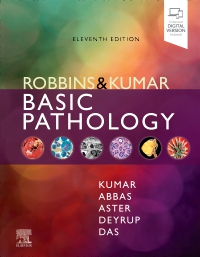

Robbins & Kumar Basic Pathology, Elsevier eBook on VitalSource, 11th Edition
Elsevier eBook on VitalSource
Now $76.49
**Selected for 2026 Doody's Core Titles as an Essential Purchase in Pathology**
Readable, well-illustrated, and concise, Robbins and Kumar’s Basic Pathology, 11th Edition, offers today’s busy students a rich understanding of all essential pathology concepts from trusted names in the field. This updated edition thoroughly covers key pathologic processes and the time-honored tools of gross and microscopic analysis, while also retaining a strong emphasis on clinicopathologic correlations and the impact of molecular pathology on the practice of medicine. Outstanding artwork and schematic drawings, as well as a robust eBook experience with extensive additional features, make complex concepts easier to learn and retain.
-
- Includes fully updated clinical topics throughout
- Features high-quality photomicrographs, gross photos, and radiologic images, as well as new artwork and over 150 new schematic diagrams that help summarize key or complex disease mechanisms
- Contains a new Rapid Review section that uses bulleted summary boxes to deliver essential take-home messages and help you focus on the fundamentals.
- Includes tables of relevant laboratory tests for each chapter that link pathophysiology of disease and diagnostic testing
- Highlights pathogenesis, morphology, and pathophysiologic content throughout.
- Features increased representation of diverse populations throughout the text, including clinical photographs of skin lesions in multiple skin types and a new section on the role of socially defined race in health disparities
- An eBook version is included with purchase. The eBook allows you to access all of the text, figures and references, with the ability to search, customize your content, make notes and highlights, and have content read aloud—as well as access bonus content, including case studies, additional gross and microscopic figures, and more
-
-
 Robbins & Kumar Basic PathologyHardcover
-
-
1. Cell Injury, Cell Death, and Adaptations
2. Inflammation and Repair
3. Hemodynamic Disorders, Thromboembolism, and Shock
4. Genetic and Pediatric Diseases
5. Diseases of the Immune System
6. Neoplasia
7. Environmental and Nutritional Diseases
8. Blood Vessels
9. Heart
10. Hematopoietic and Lymphoid Systems
11. Lung
12. Kidney and Its Collecting System
13. Oral Cavities and Gastrointestinal Tract
14. Liver and Gallbladder
15. Pancreas and Biliary System
16. Male Genital System and Lower Urinary Tract
17. Female Genital System and Breast
18. Endocrine System
19. Bones, Joints, and Soft Tissue Tumors
20. Peripheral Nerves and Muscles
21. Central Nervous System
22. Skin -
-
Ways of Reading
- The appearance of the text and page layout can be modified according to the capabilities of the reading system (font family and font size, spaces between paragraphs, sentences, words, and letters, as well as color of background and text)
- This e-publication is accessible to the full extent that the file format and types of content allow, on a specific reading device, by default, without necessarily including any additions such as textual descriptions of images or enhanced navigation
- No information about nonvisual reading is available
-
Conformance
- No information is available
-
Navigation
- Table of contents to all chapters of the text via links
- Page list to go to pages from the print source version
-
Rich Content
- No information is available
-
Hazards
- No information is available
-
Product Content
- No information is available
-
Legal Considerations
- No information is available
-
Additional Accessibility Information
- Page breaks included from the original print source
- For readers with color vision deficiency, use of color (e.g., in diagrams, graphics and charts, in prompts, or on buttons inviting a response) is not the sole means of graphical distinction or of conveying information
- E-publication includes basic navigation (usually less detailed than TOC-based navigation)
- Where links, controls or buttons are included in the content, the purpose or functionality of each link, control or button is apparent from the associated text alone - or where it is unclear, separate link, control or button descriptions are provided
- All (or substantially all) textual matter is arranged in a single logical reading order (including text that is visually presented as separate from the main text flow, e.g., in boxouts, captions, tables, footnotes, endnotes, citations, etc.). Non-textual content is also linked from within this logical reading order. (Purely decorative non-text content can be ignored).
- The language of the text has been specified (e.g., via the HTML or XML lang attribute) to optimise text-to-speech (and other alternative renderings), both at the whole document level and, where appropriate, for individual words, phrases or passages in a different language.
-
Ways of Reading

 as described in our