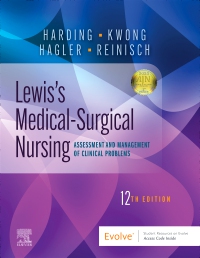

Lewis' Medical-Surgical Nursing Elsevier eBook on VitalSource, 12th Edition
Elsevier eBook on VitalSource
Now $151.19
**American Journal of Nursing (AJN) Book of the Year Awards, 1st Place in Medical-Surgical Nursing, 2023**
**Selected for Doody’s Core Titles® 2024 with "Essential Purchase" designation in Medical/Surgical**
Gain the knowledge and skills you need to succeed in medical-surgical nursing with this leading textbook! Lewis's Medical-Surgical Nursing, 12th Edition uses a conversational writing style, a focus on nursing concepts and clinical trends, evidence-based content, and basic pathophysiology review to provide the solid foundation needed in a rapidly changing healthcare environment. Comprehensive chapters cover topics including nursing management and collaboration, health promotion, acute interventions, and ambulatory care. Summary tables and boxes make it easy to find essential information, and a building-block approach makes even the most complex concepts simple to grasp. In addition to three new chapters, this edition includes a stronger focus on the nursing process, clinical judgment, and preparation for the Next-Generation NCLEX® Examination.
New Edition Expected Availability: 01-26-2026

Lewis' Medical-Surgical Nursing - Elsevier E-Book on VitalSource
-
- Enhanced focus on clinical judgment and preparation for the Next-Generation NCLEX® Exam (NGN) features Applying Clinical Judgment With Multiple Patients boxes with traditional and NGN-style questions
- Revised table of contents reflects critical care content throughout the book and adds new chapters including Supporting Ventilation and Caring for Lesbian, Gay, Bisexual, Transgender, Queer or Questioning, and Gender Diverse Patients
- Social Determinants of Health chapter focuses on nursing awareness of how patient circumstances affect health outcomes
- Clinical problems language replaces NANDA-I / ICNP diagnoses and better aligns with Harding & Hagler’s Conceptual Nursing Care Planning
- Case studies — now labeled with Cognitive Skills from the NCSBN’s Clinical Judgment Measurement Model — bring patient care to life, helping you develop skills in clinical judgment, prioritization, delegation, and evidence-based practice
- Conceptual focus for the patient experiencing infection or inflammation is included in the Infection chapter and the Inflammation and Healing chapter
- Updated content throughout reflects the latest evidence-based guidelines for patient care
- Streamlined features and content provide an optimized learning experience
-
- Content written and reviewed by leading experts in the field ensures that information is comprehensive, current, and clinically accurate
- Interprofessional care is addressed in special Interprofessional Care sections and Interprofessional Care tables
- Bridge to the NCLEX® Examination review questions reinforce key content and include both standard and alternate item format questions to help you prepare for the NCLEX exam
- Coverage of cultural and ethnic health disparities highlights important issues such as risk factors, economic aspects, and access to health care
- Coverage of gerontology and chronic illness is addressed in a separate chapter and highlighted in special gerontologic tables
- Pathophysiology maps use flowcharts to outline complex concepts related to diseases, making them easier to understand
- Focused Assessment boxes provide brief checklists for a practical "assessment on the run" or bedside approach to assessment, and can be used to evaluate the status of previously identified health problems and monitor for signs of new problems
- Safety Alert boxes highlight patient safety issues and focus on the National Patient Safety Goals
- Nutritional Therapy tables summarize nutritional interventions and strategies for promoting healthy lifestyles
- Promoting Population Health boxes summarize health care goals as they relate to specific disorders such as cancer and diabetes, and identify strategies for health promotion
- Drug Therapy tables and Drug Alerts highlight important safety considerations for key drugs
- Check Your Practice boxes challenge you to think critically, analyze patient assessment data, and implement appropriate interventions
- Coverage of genetics includes a separate chapter on genetics, Genetics in Clinical Practice boxes covering disorders and genetic testing, risk alerts, and links to disorders
- Focus on patient and caregiver teaching shows how you can help patients and caregivers learn to manage chronic illnesses and conditions
- Ethical / Legal Dilemmas boxes introduce key topics such as informed consent, advance directives, and confidentiality
-
-
 Sherpath for Harding Lewis's Medical-Surgical NursingSherpath Book-Organized
 -
 Sherpath Vantage for Harding Lewis's Medical-Surgical NursingSherpath Vantage
 -
 Elsevier Adaptive Quizzing for Lewis Medical-Surgical NursingElsevier Adaptive Quizzing - Next Generation
 -
 Clinical Companion to Lewis's Medical-Surgical Nursing Elsevier eBook on VitalSourceElsevier eBook on VitalSource
 -
 Study Guide for Lewis's Medical-Surgical Nursing - Elsevier eBook on VitalSourceElsevier eBook on VitalSource
 -

-
-
SECTION 1 Concepts in Nursing Practice
1. Professional Nursing
2. Social Determinants of Health
3. Health History and Physical Examination
4. Patient and Caregiver Teaching
5. Chronic Illness and Older Adults
6. Caring for Lesbian, Gay, Bisexual, Transgender, Queer or Questioning, and Gender Diverse Patients
SECTION 2 Problems Related to Comfort and Coping
7. Stress Management
8. Sleep and Sleep Disorders
9. Pain
10. Palliative and End-of-Life Care
11. Substance Use Disorders in Acute Care
SECTION 3 Problems Related to Homeostasis and Protection
12. Inflammation and Healing
13. Genetics
14. Immune Responses and Transplantation
15. Infection
16. Cancer
17. Fluid, Electrolyte, and Acid-Base Imbalances
SECTION 4 Perioperative and Emergency Care
18. Preoperative Care
19. Intraoperative Care
20. Postoperative Care
21. Emergency and Disaster Nursing
SECTION 5 Problems Related to Altered Sensory Input
22. Assessment and Management: Visual Problems
23. Assessment and Management: Auditory Problems
24. Assessment: Integumentary System
25. Integumentary Problems
26. Burns
SECTION 6 Problems of Oxygenation: Ventilation
27. Assessment: Respiratory System
28. Supporting Ventilation
29. Upper Respiratory Problems
30. Lower Respiratory Problems
31. Obstructive Pulmonary Diseases
32. Acute Respiratory Failure and Acute Respiratory Distress Syndrome
SECTION 7 Problems of Oxygenation: Transport
33. Assessment: Hematologic System
34. Hematologic Problems
SECTION 8 Problems of Oxygenation: Perfusion
35. Assessment: Cardiovascular System
36. Hypertension
37. Coronary Artery Disease and Acute Coronary Syndrome
38. Heart Failure
39. Dysrhythmias
40. Inflammatory and Structural Heart Disorders
41. Vascular Disorders
42. Shock, Sepsis, and Multiple Organ Dysfunction Syndrome
SECTION 9 Problems of Ingestion, Digestion, Absorption, and Elimination
43. Assessment: Gastrointestinal System
44. Nutrition Problems
45. Obesity
46. Upper Gastrointestinal Problems
47. Lower Gastrointestinal Problems
48. Liver, Biliary Tract, and Pancreas Problems
SECTION 10 Problems of Urinary Function
49. Assessment: Urinary System
50. Renal and Urologic Problems
51. Acute Kidney Injury and Chronic Kidney Disease
SECTION 11 Problems Related to Regulatory and Reproductive Mechanisms
52. Assessment: Endocrine System
53. Diabetes
54. Endocrine Problems
55. Assessment: Reproductive System
56. Breast Problems
57. Sexually Transmitted Infections
58. Female Reproductive Problems
59. Male Reproductive Problems
SECTION 12 Problems Related to Movement and Coordination
60. Assessment: Nervous System
61. Acute Intracranial Problems
62. Stroke
63. Chronic Neurologic Problems
64. Dementia and Delirium
65. Spinal Cord and Peripheral Nerve Problems
66. Assessment: Musculoskeletal System
67. Musculoskeletal Trauma and Orthopedic Surgery
68. Musculoskeletal Problems
69. Arthritis and Connective Tissue Diseases
APPENDIXES
A. Basic Life Support for Health Care Providers
B. Clinical Problems With Definitions
C. Laboratory Reference Intervals -
-
Ways of Reading
- The appearance of the text and page layout can be modified according to the capabilities of the reading system (font family and font size, spaces between paragraphs, sentences, words, and letters, as well as color of background and text)
- This e-publication is accessible to the full extent that the file format and types of content allow, on a specific reading device, by default, without necessarily including any additions such as textual descriptions of images or enhanced navigation
- No information about nonvisual reading is available
-
Conformance
- For detailed accessibility information, see Elsevier's website at https://www.elsevier.com/about/accessibility
- For queries regarding accessibility information, contact [email protected]
- The publication was certified on 18-11-2025
-
Navigation
- Table of contents to all chapters of the text via links
-
Rich Content
- No information is available
-
Hazards
- No information is available
-
Product Content
- No information is available
-
Legal Considerations
- No information is available
-
Additional Accessibility Information
- For readers with color vision deficiency, use of color (e.g., in diagrams, graphics and charts, in prompts, or on buttons inviting a response) is not the sole means of graphical distinction or of conveying information
- E-publication includes basic navigation (usually less detailed than TOC-based navigation)
- Where links, controls or buttons are included in the content, the purpose or functionality of each link, control or button is apparent from the associated text alone - or where it is unclear, separate link, control or button descriptions are provided
- All (or substantially all) textual matter is arranged in a single logical reading order (including text that is visually presented as separate from the main text flow, e.g., in boxouts, captions, tables, footnotes, endnotes, citations, etc.). Non-textual content is also linked from within this logical reading order. (Purely decorative non-text content can be ignored).
- The language of the text has been specified (e.g., via the HTML or XML lang attribute) to optimise text-to-speech (and other alternative renderings), both at the whole document level and, where appropriate, for individual words, phrases or passages in a different language.
-
Ways of Reading

 as described in our