ISBN:
9780323792905
Copyright:
2023
Publication Date:
02-03-2022
Page Count:
704
Imprint:
Saunders
List Price:
$112.99

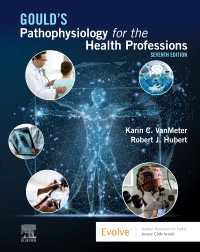
Gould's Pathophysiology for the Health Professions Elsevier eBook on VitalSource, 7th Edition
by Karin C. VanMeter, PhD and Robert J. Hubert, BS
Elsevier eBook on VitalSource
ISBN:
9780323792905
Copyright:
2023
Publication Date:
02-03-2022
Page Count:
704
Imprint:
Saunders
List Price:
$112.99
Was
$112.99
Now $101.69
Or $0.00 with a valid access code
Master the fundamentals of pathophysiology with this concise, easy-to-understand text! Gould's Pathophysiology for the Health Professions, 7th Edition helps you learn basic concepts of disorders and disease processes. Known for its readability and vivid, full-color illustrations, this text describes disorders by body system and includes case studies applying the material to real-life situations. This edition is updated with the latest research and the newest methods of diagnostic testing and treatment. No matter which healthcare field students may enter, this book provides solid preparation for the conditions commonly encountered in clinical practice.
New Edition Expected Availability: 09-10-2026

Gould's Pathophysiology for the Health Professions - Elsevier E-Book on VitalSource
Elsevier eBook on VitalSource
ISBN: 9780443285073
-
- NEW! The Bigger Picture bulleted summaries identify other body systems that might be affected by a particular disease or disorder covered in a body system chapter
- NEW coverage of COVID-19 is added, as well as new information on other conditions and diseases
- NEW diagnostic methods and treatments are covered, describing how these are impacted by digitalization, information technology, and artificial intelligence
- NEW! Updated statistics on diseases and their related pathophysiology are included.
- NEW photographs and illustrations are added
-
- NEW! Nora AI - an AI-powered learning assistant exclusive to Elsevier ebooks on VitalSource's Bookshelf® platform - offers built-in AI learning support that provides personalized answers based on content from the Elsevier ebook
- UNIQUE! Apply Your Knowledge questions ask you to use what you’ve learned to predict What can go wrong with this structure or system?, transitioning you from the body’s normal anatomy and physiology into its pathophysiology
- UNIQUE! Think About questions relate to the text’s facts, potential applications, or the integration of concepts, alerting you to important points and helping with self-evaluation, test preparation, and review
- Case studies provide realistic, clinical applications of the book’s concepts
- Format for discussions of individual disorders follows a "building block" approach, making understanding easier with 1) background, 2) pathophysiology, 3) etiology, 4) signs and symptoms, 5) diagnostic tests, 6) complications, and 7) treatment
- Concise and readable approach presents the content in a way that doesn’t overwhelm the reader and yet familiarizes you with necessary scientific and medical terminology
- Hundreds of illustrations clarify and reinforce pathophysiology concepts with photographs, flow charts, and schematic diagrams
-
-
 Study Guide for Gould's Pathophysiology for the Health Professions Elsevier eBook on VitalSourceElsevier eBook on VitalSource
 -

-

-

-

-
-
Section I: Pathophysiology: Background and Overview
1. Introduction to Pathophysiology
2. Fluid, Electrolyte, and Acid-Base Imbalances
3. Introduction to Basic Pharmacology and Other Common Therapies
4. Pain
Section II: Defense/Protective
5. Inflammation and Healing
6. Infection
7. Immunity
Section III: Pathophysiology of Body Systems
8. Skin Disorders
9. Musculoskeletal Disorders
10. Blood and the Circulatory System
11. Lymphatic System Disorders
12. Cardiovascular System Disorders
13. Respiratory System Disorders
14. Neurological Disorders
15. Eyes, Ears and Other Sensory Organs
16. Endocrine Disorders
17. Digestive System Disorders
18. Urinary System Disorders
19. Reproductive System Disorders
20. Neoplasms and Cancer
Section IV: Factors Contributing to Pathophysiology
21. Congenital and Genetic Disorders
22. Complications Due to Pregnancy
23. Complications Due to Adolescence
24. Complications Due to Aging
Section V: Environmental Factors and Pathophysiology
25. Immobility and Associated Problems
26. Stress and Associated Problems
27. Substance Abuse and Associated Problems
28. Environmental Hazards and Associated Problems
Appendixes: Ready References
Ready Reference 1: Body Planes, Cavities, Regions, Fluid Compartments, and Body Movements
Ready Reference 2: Anatomic Terms
Ready Reference 3: Conversion Tables
Ready Reference 4: Common Abbreviations and Acronyms
Ready Reference 5: Common Diagnostic Studies and Tests
Ready Reference 6: Example of a Medical History
Ready Reference 7: Disease Index
Ready Reference 8: Drug Index
Ready Reference 9: Additional Resources -
-
Ways of Reading
- The appearance of the text and page layout can be modified according to the capabilities of the reading system (font family and font size, spaces between paragraphs, sentences, words, and letters, as well as color of background and text)
- This e-publication is accessible to the full extent that the file format and types of content allow, on a specific reading device, by default, without necessarily including any additions such as textual descriptions of images or enhanced navigation
- No information about nonvisual reading is available
-
Conformance
- For detailed accessibility information, see Elsevier's website at https://www.elsevier.com/about/accessibility
- For queries regarding accessibility information, contact [email protected]
- The publication was certified on 18-11-2025
-
Navigation
- Table of contents to all chapters of the text via links
-
Rich Content
- No information is available
-
Hazards
- No information is available
-
Product Content
- No information is available
-
Legal Considerations
- No information is available
-
Additional Accessibility Information
- For readers with color vision deficiency, use of color (e.g., in diagrams, graphics and charts, in prompts, or on buttons inviting a response) is not the sole means of graphical distinction or of conveying information
- E-publication includes basic navigation (usually less detailed than TOC-based navigation)
- Where links, controls or buttons are included in the content, the purpose or functionality of each link, control or button is apparent from the associated text alone - or where it is unclear, separate link, control or button descriptions are provided
- All (or substantially all) textual matter is arranged in a single logical reading order (including text that is visually presented as separate from the main text flow, e.g., in boxouts, captions, tables, footnotes, endnotes, citations, etc.). Non-textual content is also linked from within this logical reading order. (Purely decorative non-text content can be ignored).
- The language of the text has been specified (e.g., via the HTML or XML lang attribute) to optimise text-to-speech (and other alternative renderings), both at the whole document level and, where appropriate, for individual words, phrases or passages in a different language.
-
Ways of Reading
Was
$112.99
Now $101.69
Or $0.00 with a valid access code

 as described in our