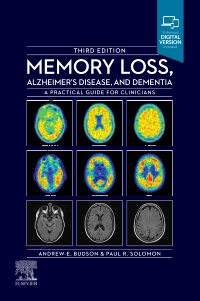
Memory Loss, Alzheimer's Disease and Dementia, 3rd Edition
Paperback
New Edition Expected Availability: 01-01-2027

Memory Loss, Alzheimer's Disease and Dementia: A Practical Guide for Clinicians
-
- Provides in-depth coverage of clinically useful diagnostic tests and the latest research findings and treatment approaches
- Incorporates real-world case studies that facilitate the management of both common and uncommon conditions
- Contains new chapters on Alzheimer’s look-alikes and posterior cortical atrophy
- Covers key topics such as chronic traumatic encephalopathy, primary age-related tauopathy (PART) and limbic-predominant, age-related TDP-43 encephalopathy (LATE), in addition to new criteria for dementia with Lewy bodies and posterior cortical atrophy
- Includes current National Institute on Aging–Alzheimer's Association and DSM-5 criteria for Alzheimer’s disease and mild cognitive impairment
- Demonstrates how to use diagnostic tests such as the amyloid imaging scans florbetapir (Amyvid), flutemetamol (Vizamyl), and florbetaben (Neuraceq), which can display amyloid plaques in the living brains of patients, as well as the new tau scans
- Includes access to more than two dozen videos that illustrate common tests, clinical signs, and diagnostic features
- Enhanced eBook version included with purchase. Your enhanced eBook allows you to access all of the text, figures, and references from the book on a variety of devices
-
SECTION I: EVALUATING THE PATIENT WITH MEMORY LOSS
1. Why Diagnose and Treat Memory Loss, Alzheimer’s Disease, and Dementia?
2. Evaluating the Patient with Memory Loss or Dementia
3. Approach to the Patient with Memory Loss, Mild Cognitive Impairment, or Dementia
SECTION II: DIFFERENTIAL DIAGNOSIS OF MEMORY LOSS
4. Alzheimer’s Disease and Mild Cognitive Impairment due to Alzheimer’s Disease
5. Alzheimer’s Look-Alikes: Primary Age-Related Tauopathy (PART) and Limbic-predominant, Age-related TDP-43 Encephalopathy (LATE)
6. Dementia with Lewy Bodies (Including Parkinson’s Disease Dementia)
7. Posterior Cortical Atrophy
8. Vascular Dementia and Vascular Cognitive Impairment
9. Primary Progressive Aphasia & Other Disorders of Speech
10. Frontotemporal Dementia
11. Progressive Supranuclear Palsy
12. Corticobasal Degeneration
13. Normal Pressure Hydrocephalus
14. Jakob-Creutzfeldt Disease
15. Chronic Traumatic Encephalopathy
16. Other Disorders That Disrupt Memory
SECTION III: TREATMENT OF MEMORY LOSS
17. Goals of Treatment of Memory Loss, Alzheimer’s Disease, and Dementia
18. Cholinesterase Inhibitors
19. Memantine (Generic and Namenda XR)
20. Vitamins, Herbs, Supplements, and Anti-Inflammatories
21. Future Treatments of Memory Loss
22. Physical exercise, Diet, Strategies, and Non-Pharmacological Treatment of Memory Loss
SECTION IV: BEHAVIORAL AND PSYCHOLOGICAL SYMPTOMS OF DEMENTIA
23. Evaluating the Behavioral and Psychological Symptoms of Dementia
24. Caring For and Educating the Caregiver
25. Non-Pharmacological Treatment of the Behavioral and Psychological Symptoms of Dementia
26. Pharmacological Treatment of the Behavioral and Psychological Symptoms of Dementia
SECTION V: ADDITIONAL ISSUES
27. Life Adjustments
28. Legal and Financial Issues
29. Special Issues
ONLINE ONLY APPENDICES
APPENDIX
A: Cognitive Test and Questionnaire Forms, Instructions, and Normative Data
B: Screening for Memory Loss
C: Our Current Understanding of Memory -
No accessibility information is available for this product.

 as described in our