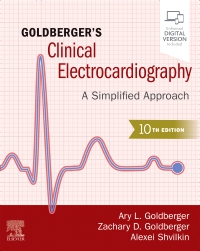

Goldberger's Clinical Electrocardiography - Elsevier eBook on VitalSource, 10th Edition
Elsevier eBook on VitalSource
-
- Offers practical, comprehensive coverage of real-world ECGs across a range of point-of-care settings, explaining not only how to interpret the data, but the implications of ECG findings for clinical management
- Covers recent advances in pacemaker and implantable cardioverter-defibrillator technology; myocardial ischemia and infarction; arrhythmias, including atrial fibrillation, ventricular tachycardias and sudden cardiac arrest syndromes; drug toxicities; cardiac monitoring, including wearable devices; cardiomyopathies and COVID-19
- Features nearly 300 high-quality illustrations, with an abundance of quick reference information highlights, including key pathophysiologic concepts, reminders, clinical pearls, and key points, as well as more than 250 review questions online
- Discusses basic principles of electrophysiology in an easily understandable format for students and non-cardiologists
-
1. Essential Concepts: What Is an ECG?
2. Electrocardiogram Basics: Waves, Intervals, and Segments
3. How to Make Basic ECG Measurements
4. Electrocardiogram Leads
5. The Normal Electrocardiogram
6. Electrical Axis and Axis Deviation
7. Atrial and Ventricular Overload/Enlargement
8. Ventricular Conduction Disturbances: Bundle Branch Blocks and Related Abnormalities
9. Myocardial Ischemia and Infarction, Part I: ST Segment Elevation and Q Wave Syndromes
10. Myocardial Ischemia and Infarction, Part II: Non-ST Segment Elevation and Non-Q Wave Syndromes
11. Drug Effects, Electrolyte Abnormalities, and Metabolic Disturbances
12. Pericardial, Myocardial, and Pulmonary Syndromes
13. Sinus and Escape Rhythms
14. Supraventricular Arrhythmias, Part I: Premature Beats and Paroxysmal Supraventricular Tachycardias
15. Supraventricular Arrhythmias, Part II: Atrial Flutter and Atrial Fibrillation
16. Ventricular Arrhythmias
17. Atrioventricular (AV) Conduction Abnormalities, Part I: Delays, Blocks, and Dissociation Syndromes
18. Atrioventricular (AV) Conduction Disorders, Part II: Preexcitation (Wolff–Parkinson–White) Patterns and Syndromes
19. Bradycardias and Tachycardias: Review and Differential Diagnosis
20. Digitalis Toxicity
21. Sudden Cardiac Arrest and Sudden Cardiac Death Syndromes
22. Pacemakers and Implantable Cardioverter–Defibrillators: Essentials for Clinicians
23. Interpreting ECGs: An Integrative Approach
24. Limitations and Uses of the ECG
25. ECG Differential Diagnoses -
-
Ways of Reading
- The appearance of the text and page layout can be modified according to the capabilities of the reading system (font family and font size, spaces between paragraphs, sentences, words, and letters, as well as color of background and text)
- This e-publication is accessible to the full extent that the file format and types of content allow, on a specific reading device, by default, without necessarily including any additions such as textual descriptions of images or enhanced navigation
- No information about nonvisual reading is available
-
Conformance
- No information is available
-
Navigation
- Table of contents to all chapters of the text via links
- Page list to go to pages from the print source version
-
Rich Content
- No information is available
-
Hazards
- No information is available
-
Product Content
- No information is available
-
Legal Considerations
- No information is available
-
Additional Accessibility Information
- Page breaks included from the original print source
- For readers with color vision deficiency, use of color (e.g., in diagrams, graphics and charts, in prompts, or on buttons inviting a response) is not the sole means of graphical distinction or of conveying information
- E-publication includes basic navigation (usually less detailed than TOC-based navigation)
- Where links, controls or buttons are included in the content, the purpose or functionality of each link, control or button is apparent from the associated text alone - or where it is unclear, separate link, control or button descriptions are provided
- All (or substantially all) textual matter is arranged in a single logical reading order (including text that is visually presented as separate from the main text flow, e.g., in boxouts, captions, tables, footnotes, endnotes, citations, etc.). Non-textual content is also linked from within this logical reading order. (Purely decorative non-text content can be ignored).
- The language of the text has been specified (e.g., via the HTML or XML lang attribute) to optimise text-to-speech (and other alternative renderings), both at the whole document level and, where appropriate, for individual words, phrases or passages in a different language.
-
Ways of Reading


 as described in our