ISBN:
9780323825757
Copyright:
2024
Publication Date:
05-08-2024
Page Count:
152
Imprint:
Saunders
List Price:
$33.99

Study Guide for Understanding Pharmacology - Elsevier eBook on VitalSource, 3rd Edition
by M. Linda Workman, PhD, RN, FAAN
Elsevier eBook on VitalSource
ISBN:
9780323825757
Copyright:
2024
Publication Date:
05-08-2024
Page Count:
152
Imprint:
Saunders
List Price:
$33.99
Was
$33.99
Now $30.59
Or $0.00 with a valid access code
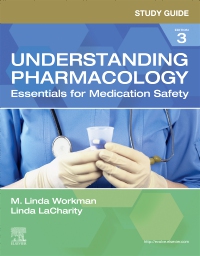
This study guide for Understanding Pharmacology: Essentials for Medication Safety, 3rd Edition offers content review and a wide range of engaging activities and medication safety practice questions to help you master pharmacology concepts, learn drug safety, and practice dosage calculation.
-
- NEW! Case studies for the Next Generation NCLEX® in clinical chapters help students practice for the next generation licensure exam
- Updated exercises cover newly approved pharmaceutical treatments and drugs
-
- A variety of learning activities, including matching, fill-in-the-blank, true/false, identification, and multiple-choice questions, plus crossword puzzles, help reinforce learning
- Medication Safety Practice sections emphasize important safety concepts related to medication administration
- Practice quizzes, comprised of multiple-choice and select-all-that-apply questions for the NCLEX®, assess students’ knowledge of important chapter concepts to prepare them for the NCLEX-PN® and NCLEX-RN® Examinations
- Reader-friendly writing style and organization increases understanding for entry-level students
-
-
 Understanding Pharmacology - Elsevier eBook on VitalSourceElsevier eBook on VitalSource
 -
 Understanding PharmacologyPaperback
 -

-
-
1. Drug Therapy: Roles, Regulations, Actions, and Responses
2. Safely Preparing and Giving Drugs
3. Mathematics Review and Introduction to Dosage Calculations
4. Medical Systems of Weights and Measures
5. Dosage Calculation of Intravenous Solutions and Drugs
6. Anti-Infectives: Antibacterial Drugs
7. Anti-Infectives: Antiviral Drugs
8. Anti-Infectives: Antitubercular and Antifungal Drugs
9. Drugs for Pain Control, Migraines, and Skeletal Muscle Spasms
10. General Anti-Inflammatory Drugs
11. Immunizations and Immunosuppressant Drugs
12. Drugs That Affect Urine Output
13. Drug Therapy for Hypertension
14. Drug Therapy for Heart Failure
15. Drug Therapy for Dysrhythmias
16. Drug Therapy for High Blood Lipids
17. Drugs That Affect Blood Clotting
18. Drug Therapy for Asthma and Other Respiratory Problems
19. Drug Therapy for Gastrointestinal Problems
20. Drug Therapy for Gastric Ulcers, Reflux, and Inflammatory Bowel Disease
21. Drug Therapy for Diabetes
22. Drug Therapy for Thyroid and Adrenal Gland Problems
23. Drug Therapy for Seizures
24. Drug Therapy for Alzheimer’s and Parkinson’s Diseases
25. Drug Therapy for Psychiatric Problems
26. Drug Therapy for Insomnia
27. Drug Therapy for Eye Problems
28. Drug Therapy for Male Reproductive Problems
29. Drug Therapy for Female Reproductive Problems -
-
Ways of Reading
- The appearance of the text and page layout can be modified according to the capabilities of the reading system (font family and font size, spaces between paragraphs, sentences, words, and letters, as well as color of background and text)
- This e-publication is accessible to the full extent that the file format and types of content allow, on a specific reading device, by default, without necessarily including any additions such as textual descriptions of images or enhanced navigation
- No information about nonvisual reading is available
-
Conformance
- For detailed accessibility information, see Elsevier's website at https://www.elsevier.com/about/accessibility
- For queries regarding accessibility information, contact [email protected]
- The publication was certified on 03-11-2025
-
Navigation
- Table of contents to all chapters of the text via links
-
Rich Content
- No information is available
-
Hazards
- No information is available
-
Product Content
- No information is available
-
Legal Considerations
- No information is available
-
Additional Accessibility Information
- For readers with color vision deficiency, use of color (e.g., in diagrams, graphics and charts, in prompts, or on buttons inviting a response) is not the sole means of graphical distinction or of conveying information
- E-publication includes basic navigation (usually less detailed than TOC-based navigation)
- Where links, controls or buttons are included in the content, the purpose or functionality of each link, control or button is apparent from the associated text alone - or where it is unclear, separate link, control or button descriptions are provided
- All (or substantially all) textual matter is arranged in a single logical reading order (including text that is visually presented as separate from the main text flow, e.g., in boxouts, captions, tables, footnotes, endnotes, citations, etc.). Non-textual content is also linked from within this logical reading order. (Purely decorative non-text content can be ignored).
- The language of the text has been specified (e.g., via the HTML or XML lang attribute) to optimise text-to-speech (and other alternative renderings), both at the whole document level and, where appropriate, for individual words, phrases or passages in a different language.
-
Ways of Reading
Was
$33.99
Now $30.59
Or $0.00 with a valid access code

 as described in our